
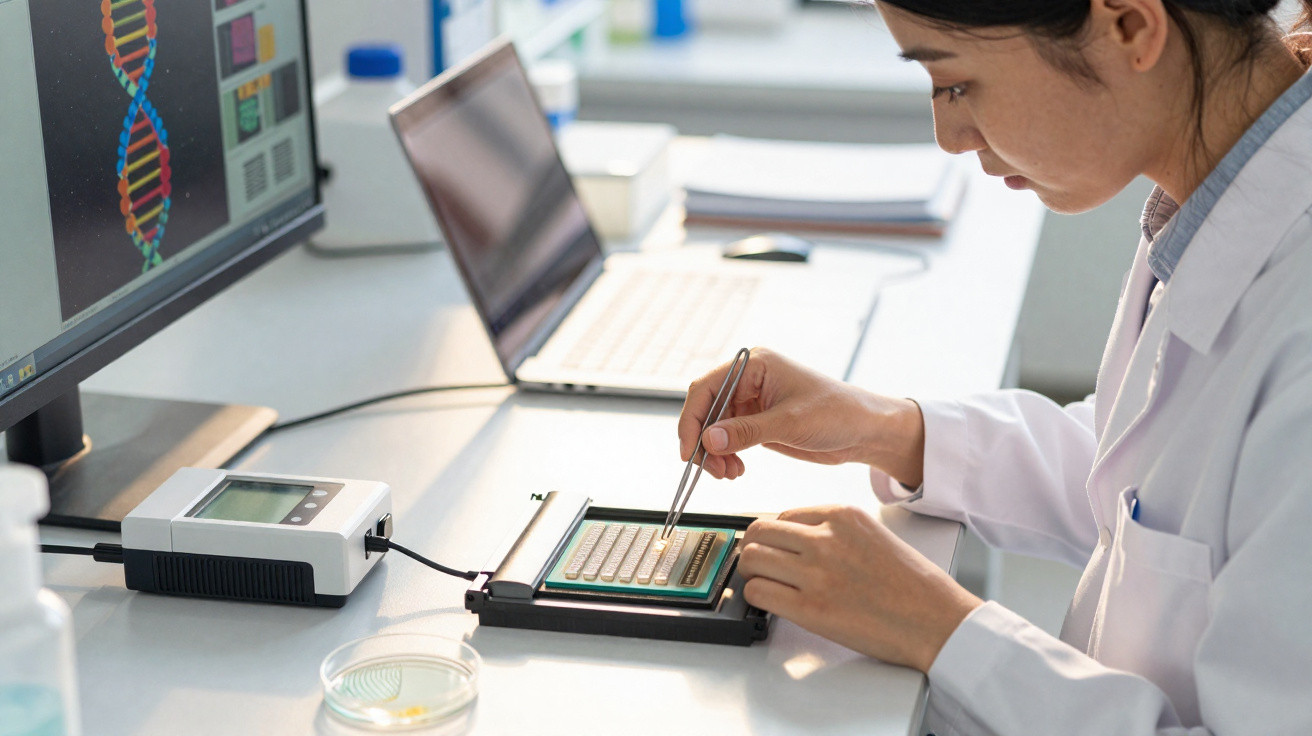
Electronic storage may be efficient, but it still falls short of nature’s own medium: DNA. Researchers have now developed a way to write information into DNA that operates like a printing press, making the process straightforward enough that virtually anyone could use it.
Normally, putting data into DNA means synthesising strands one “letter” at a time - effectively adding bases like beads onto a thread. That approach is inherently slow, particularly when a single DNA sequence can contain billions of bases.
DNA data storage: why it matters
The case for DNA as a storage format is easy to see. It is extraordinarily dense - estimates suggest you could fit more than 10 billion gigabytes of data into just 1 cm³ of DNA. Even better, if kept in suitable conditions, the information can persist for thousands, or even millions, of years, which makes it highly attractive for long-term archiving.
Retrieving information from DNA is comparatively quick, but writing it remains the main bottleneck. The researchers behind the new study took inspiration from how text production was transformed in the past, and applied a similar idea at the molecular level.
A DNA printing press built from “bricks”
The new DNA printing press dramatically accelerates writing. The team assembled a library of 700 DNA “bricks”, each 24 bases long, designed to act like movable type. By arranging these bricks into a specific sequence, they can then be used to ‘print’ information onto blank DNA template strands.
Instead of recording one bit at a time, this approach boosts throughput to 350 bits at once, per reaction.
To keep the workflow simple, the information is not encoded in DNA’s usual G, C, A and T letters. Rather, it is represented as familiar binary ones and zeroes. Here, some DNA bricks were fitted with chemical markers while others were left unmarked: marked bricks stood for ones, and unmarked bricks represented zeroes.
Molecular movable type and the epigenome
Movable type printing made the first mass-produced texts possible. Individual characters on small stamps could be set into large blocks, allowing many copies to be produced quickly. In this work, the idea of molecular movable type was inspired by the way our own cells store and use information.
Every cell in your body carries your full genome. What makes cells in different tissues distinct is an additional layer of information known as the epigenome. Chemical markers attached to DNA signal which genes should be switched on or off, enabling cells to take on different functions.
Put another way, if your body were a company, every employee would receive the same handbook - but different departments (brain, liver, skin, and so on) would have different passages highlighted, so each cell can access the specific instructions it needs to do its job.
In the DNA printing press, these chemical markers - methyl groups - are what carry the information that gets written and later read back. The DNA bricks function as the movable type, and the empty DNA template strands serve as the paper.
When a particular sequence is required, the relevant bricks are chosen and mixed in solution with the template. The bricks then bind to matching regions along the DNA template strand.
The final step is the equivalent of adding ink. An enzyme duplicates the pattern by copying all the methyl groups from the bricks onto the corresponding sections of the DNA template. Afterwards, a nanopore sequencing device can read the resulting pattern of ones and zeroes, allowing the original digital files to be reconstructed.
Because the bricks self-assemble along the template strand, many bits are written in parallel rather than one by one. By increasing speed and making the process usable by non-scientists, the method could help DNA become a practical data storage medium.
Demonstrations: images and iDNAdrive
To demonstrate the technique, the researchers stored image data, including 16,833 bits for an ancient Chinese rubbing of a tiger, as well as a photograph of a panda containing more than 252,500 bits. After refinement of the method, they were able to recover 100 percent of the data using standard DNA reading techniques.
To highlight how accessible the system could be, the team also ran a study involving 60 people. Using a software platform called iDNAdrive, participants encoded text excerpts of their own choosing, amounting to about 5,000 bits in total. The stored information was then read back with 98.58 percent accuracy.
The paper was published in the journal Nature.





Comments
No comments yet. Be the first to comment!
Leave a Comment