
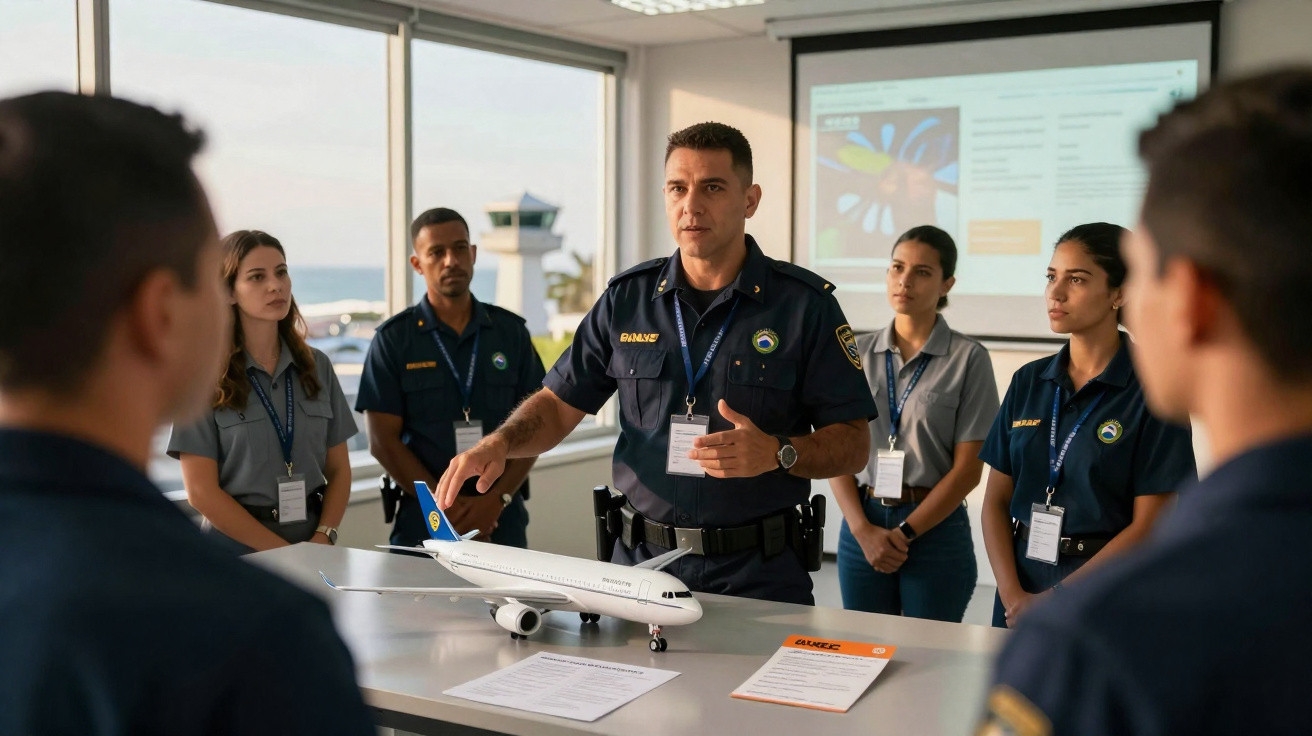
Civil Aviation Security against Acts of Unlawful Interference (AVSEC) was the central theme of the 2nd Integrated Symposium and AVSEC Workshop, organised by the Department of Airspace Control (DECEA) from 16 to 19 June at the Air Force Military Convention and Accommodation Centre (CEMCOHA) in Salvador, Bahia.
Over four days, civil and military aviation specialists and practitioners explored issues including in-flight contingencies, drones, risk management, audits, security procedures and the challenges created by emerging threats to aviation.
The event brought together representatives from bodies such as the National Civil Aviation Agency (ANAC), NAV Brasil, Guarulhos International Airport, the Airspace Control Operational Safety Advisory (ASOCEA) and organisations within the Brazilian Airspace Control System (SISCEAB), creating a forum for sharing experience and developing solutions to strengthen aviation security.
2nd Integrated Symposium and AVSEC Workshop: programme and focus
The programme opened with two days of talks, panel sessions and debates on topics that form part of day-to-day work for professionals in the field.
At the close of this first stage, the Deputy Head of DECEA’s Administration Subdepartment, Colonel Aviator José Evânio Guedes Júnior, underlined why the gathering mattered.
“I see this symposium not only as a meeting of specialists, but as a point of unity between authorities and industry in pursuit of the shared aim of anticipating risks and working so that Brazil remains aligned with the most stringent international standards for civil aviation security,” he said.
Practical exercises on vulnerabilities and risk treatment
Following the theoretical discussions, attendees moved into the practical phase. During the AVSEC Workshop, participants were split into groups to review simulated scenarios involving vulnerabilities and incidents, prepare reports and recommend measures to address the risks identified.
This activity enabled participants to engage with situations similar to those encountered in operational settings, applying what had been shared throughout the symposium and reinforcing the value of integrated action when responding to potential threats.
In total, the event drew 445 participants-75 attending in person and 370 remotely. Among them was the AVSEC Regional Agent from the Fourth Integrated Air Defence and Air Traffic Control Centre (CINDACTA IV) in Manaus, Amazonas, Third Sergeant Air Traffic Controller Patrícia Leite da Silva Borges.
“It was an excellent opportunity for professional development and learning. We had access to important discussions and the exchange of experiences among participants, which enriches our day-to-day work. In addition, we were able to get to know and practise using the SGAVSEC system, enabling a deeper understanding of its functionalities and applications,” she said.
Case study GOL 1774 and key takeaways
Among the most significant moments in the schedule, the Head of DECEA’s Civil Aviation Security Advisory, Lieutenant Colonel Aviator João Carlos Perpetua Barbosa-who coordinated the event-highlighted the case study of flight GOL 1774. The session examined the procedures applied, the challenges faced and the importance of coordination between the different bodies involved.
“With that, we reached the conclusion that our regulatory framework is robust, the training of our controllers is appropriate, although we can improve inter-agency communication during an occurrence. We concluded that holding the Second Integrated Symposium and AVSEC Workshop was a success. We strengthened Civil Aviation Security against acts of unlawful interference at national level,” he concluded.





Comments
No comments yet. Be the first to comment!
Leave a Comment