
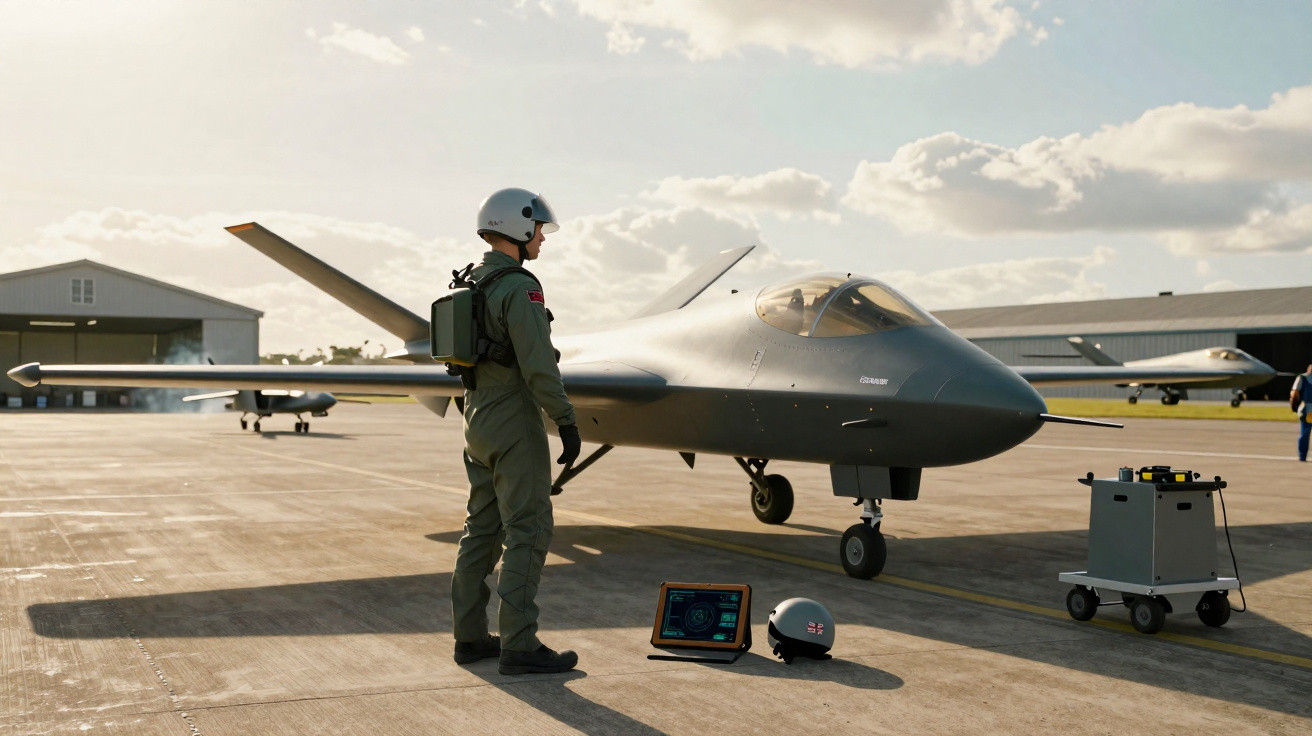
The UK Ministry of Defence has confirmed that the Collaborative Combat Aircraft (CCA) programme-its new collaborative combat drone intended to back up Britain’s Eurofighter Typhoon and F-35 fleets-will be renamed Storm Fighter. The system is designed to fly alongside crewed aircraft, extending their combat options and improving survivability in future operational environments.
The change was announced by the UK Minister of State for Defence Procurement and Industry, Luke Pollard, at the Global Air and Space Chiefs’ Conference. The reveal sits within the Defence Investment Plan (DIP), which sets out spending of £298 billion over the next four years. Of that total, £31 billion is allocated to air and space power, while £5 billion is earmarked for the development of drones and other advanced uncrewed systems.
Storm Fighter will fly alongside UK fighters
In his remarks, Pollard said Storm Fighter will enable the UK to field a new generation of autonomous aircraft capable of operating with the Eurofighter Typhoon, the F-35 and the future Tempest fighter. He explained that these systems are expected to serve both as protective escorts and as offensive platforms during air operations. “Today I am pleased to reveal that our new autonomous CCA programme will be called Storm Fighter. Storm Fighter will make the Royal Air Force (RAF) Europe’s first sixth-generation air force,” Pollard said.
Pollard added that funding for Storm Fighter is included within the £5 billion budget dedicated to drones and advanced uncrewed systems. He also argued that the programme will drive fresh technological development, bolster the UK defence industrial base, and create scope for exports and co-operation with allied nations.
The programme will include new uncrewed platforms
The RAF later confirmed that the effort will not be confined to Storm Fighter alone. The Chief of the Air Staff, Air Chief Marshal Sir Harv Smyth, stated that the UK will develop at least two further platforms: Storm Chrome, intended for electronic warfare missions, and Storm Fire, a one-way attack drone with a range of up to 1,000 miles (approximately 1,600 kilometres).
These projects build on experience from StormShroud, an autonomous system brought into service last year. According to the RAF, that platform shields pilots by jamming hostile radars during air operations. “Our new CCA Storm Fighter programme will significantly shift the economic balance in our favour, absorbing risk and enabling our crewed platforms to survive more easily,” Sir Harv Smyth said.
An investment aimed at building Europe’s first sixth-generation air force
Under the Defence Investment Plan, £300 million is set aside to get the Storm Fighter programme under way, and the official target is to achieve the first flight of a technology demonstrator by around 2030. Even so, Smyth has recently indicated he would like a demonstrator to fly alongside a Eurofighter Typhoon sooner-potentially as early as next year.
Pollard stressed that the UK views collaborative drones as an addition to, rather than a replacement for, crewed fighters. On that basis, he said the future UK air force will combine the F-35, Eurofighter Typhoon, Tempest and Storm Fighter within an integrated architecture, with the aim of strengthening national deterrence and positioning the RAF as Europe’s first sixth-generation air force.




Comments
No comments yet. Be the first to comment!
Leave a Comment