
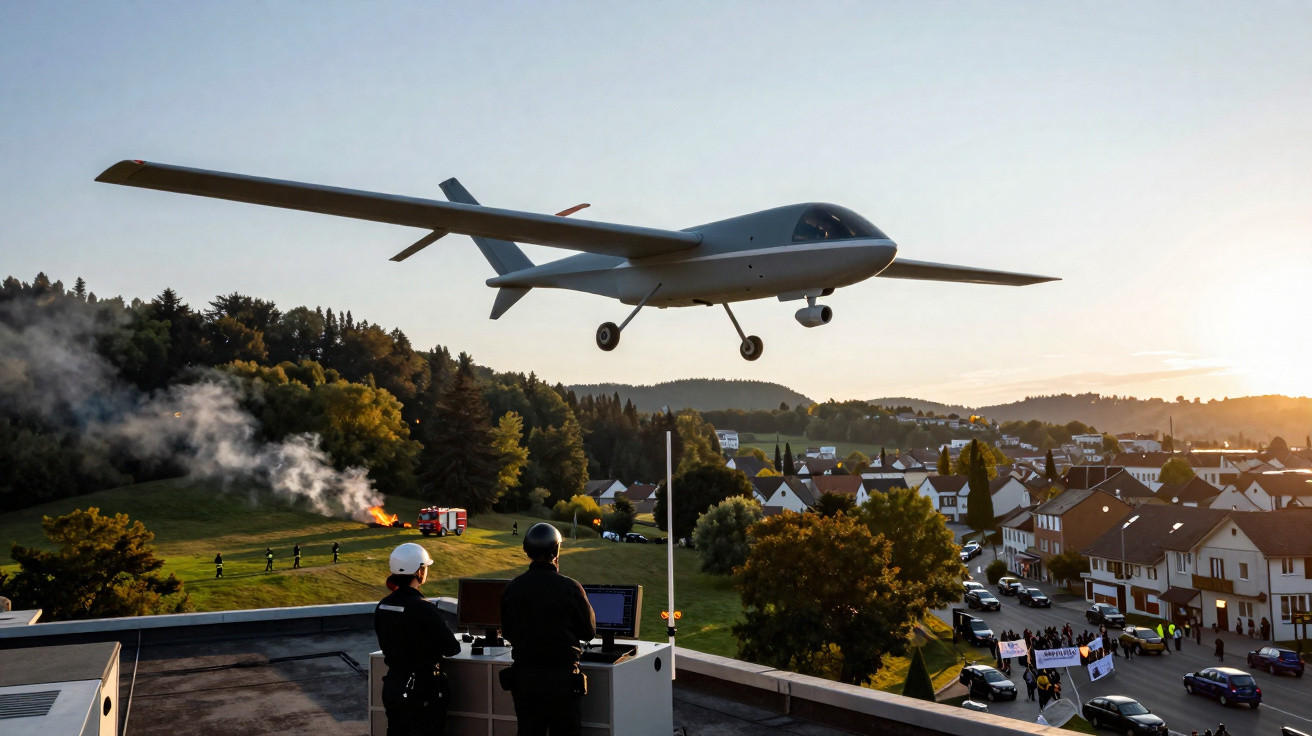
From hushed industrial estates to packed city centres, a different class of aircraft is preparing to observe Europe from the sky.
A major French aerospace group is pushing to have its UAS100 long-endurance drone certified by 2025, arguing it will make airspace safer and logistics more efficient. Civil liberties groups look at the very same platform and see the foundations for an additional, permanent layer of aerial monitoring and police-type activity.
What the UAS100 actually is
The UAS100 is a fixed-wing unmanned aircraft system built for long-endurance missions beyond visual line of sight. Developed by a prominent French aviation manufacturer better known for regional airliners and business jets, it is intended to bring airline-grade dependability to unmanned flight.
In physical terms it sits in the small light-aircraft bracket, featuring a long, straight wing optimised for efficiency and a rear-mounted pusher propeller. To satisfy Europe’s demanding airworthiness expectations, it is designed with layered redundancy, including triple avionics and duplicated communications links.
The UAS100 is being pitched as one of the first drones designed from day one to meet commercial aviation safety standards, not hobby rules.
Rather than behaving like a consumer quadcopter, the UAS100 is meant to operate in controlled airspace alongside passenger flights. In practice, that implies oversight by national aviation authorities and Eurocontrol, with transponders and standardised operating procedures.
Long endurance, long reach
Staying in the air for extended periods is the core selling point. The platform is expected to remain airborne for many hours at a time, travelling hundreds of kilometres from its base while still being supervised from a ground station.
That capability enables missions such as:
- Border and coastline patrols over remote terrain
- Pipeline and power line inspections spanning whole regions
- Wide-area detection and tracking of forest fires
- Permanent “airborne relay” duties for telecoms and data links
- Long-distance cargo hops between secondary airports
The manufacturer emphasises a hybrid mission concept: civil protection on one day, industrial inspection on the next, and cargo operations after that. The plan depends on versatility.
A new step in European drone regulation
Aiming for certification by 2025 is more than a marketing target; it is also positioned as a real-world test of Europe’s developing drone framework under the European Union Aviation Safety Agency (EASA).
Today, most drones fly in the “open” or “specific” categories, where operations are typically limited to short ranges, lower heights and narrowly defined conditions. The UAS100 is intended for the “certified” category, which requires aircraft and operators to satisfy rules closer to those applied to small passenger aircraft.
| Aspect | Typical small drone | UAS100-type system |
|---|---|---|
| Flight range | A few kilometres | Hundreds of kilometres |
| Endurance | 20–40 minutes | Many hours |
| Airspace | Low-level, segregated | Shared with manned aircraft |
| Certification | Light regulatory oversight | Full aviation-style approval |
If certification is achieved, aircraft of this type could fly regular routes over rural areas and, potentially, over towns and cities-provided national authorities sign off specific operations and the associated risk assessments.
From civil protection to permanent surveillance
On paper, many suggested uses appear straightforward. Environmental bodies want better tools for tracking pollution plumes or spotting illegal dumping. Fire and rescue services want broader situational awareness during the early phase of a forest fire. Infrastructure operators see the appeal of lower-cost, lower-risk inspection.
Critics argue that exactly the same hardware, combined with high-end cameras and AI software, can be quietly repurposed for wide-area surveillance of populations.
Privacy campaigners focus on what long endurance and higher-altitude profiles make possible. A drone cruising at a height of a couple of kilometres, fitted with a powerful zoom lens, thermal sensors and automated object-recognition software, could follow people and vehicles across wide swathes of a city.
They warn that repeated, persistent flights-during demonstrations, along migrant routes, or above disadvantaged neighbourhoods-could build detailed maps of movement. Blending that imagery with phone metadata, social media content and facial recognition would sharpen the resulting picture further.
Concerns about “military-style policing”
While the UAS100 is promoted as a civil platform, the French company behind it has longstanding ties to both military and commercial aviation. Meanwhile, police and gendarmerie already deploy smaller drones for crowd observation and tactical work.
Security analysts argue that once certified, long-range systems are widely available, law enforcement will seek them out as lower-cost substitutes for helicopters.
From helicopter orbit to drone loiter
Helicopters are loud, conspicuous and costly to run, and that visibility has historically constrained their use for constant monitoring. Drones shift that equation.
- A drone can loiter for hours more quietly, with lower fuel and crew costs.
- It can be flown from a remote control room rather than a clearly identifiable air base.
- Several drones can rotate across districts, sustaining a near-continuous aerial presence.
For critics, this is the point at which “military-style policing” takes shape. What was once associated with overseas counterinsurgency begins to resemble everyday urban policing: pattern-of-life assessment, monitoring of “areas of interest”, and pre-emptive deployments before any offence has occurred.
The manufacturer’s pitch: safety and sovereignty
The French aviation giant developing the UAS100 tells a very different story, framed around European technological sovereignty, improved safety in the sky and new economic opportunities.
The company frames the UAS100 as a way for Europe to avoid dependence on foreign drone platforms and to keep sensitive data on European servers.
From an engineering perspective, the system is presented as being built with multiple safety barriers: redundant flight controls, protected data links, automatic return-to-base behaviour and compatibility with future “U-space” drone traffic management.
Supporters also contend that drones like the UAS100 could cut emissions by replacing certain helicopter and light-aircraft tasks. Some inspection work, mapping and limited cargo services could shift to a more efficient airframe with lower fuel burn or hybrid propulsion.
What long-endurance really changes
For years, European drone operations have been constrained by the requirement for pilots to keep aircraft within visual line of sight. Long-endurance platforms remove that constraint, but only when paired with new communications networks, updated regulation and the ground infrastructure to match.
For the UAS100, ground stations can connect the aircraft into national air traffic systems, while satellite links or 4G/5G connectivity extend control over greater distances. Over time, operators could supervise several aircraft from one control room, handing over between them as they move from region to region.
Scaling in this way can dramatically reduce the cost per flight hour. Once the fixed costs of infrastructure have been paid for, the incentive grows to keep aircraft airborne for as much of the time as possible.
Scenarios that worry civil liberties groups
Campaigners describe a set of medium-term outcomes they consider plausible rather than speculative.
- Large European cities routinely patrolled overnight by long-endurance drones equipped with thermal cameras.
- Border areas monitored continuously, with automated alerts triggered by human movement across fields or rivers.
- Protests recorded from beginning to end, then processed using software that flags “repeat participants”.
- Archives of aerial footage cross-referenced with vehicle number plates, mobile phone signals and AI-based identity matching.
Campaigners stress that these outcomes are not guaranteed. However, once legal barriers ease, the technology makes them relatively straightforward-particularly if UAS100-type systems are operated at scale.
European rules, national choices
EASA defines broad technical and operational standards, but each state still decides how its police and security bodies use drones. That split of responsibility could lead to very different outcomes across Europe.
Some countries may adopt strict transparency requirements and robust oversight, including public reporting on flight paths and sensor use. Others might broaden aerial surveillance quietly under “public order” or “counter-terrorism” powers, with little public insight into how often drones are flown.
Privacy advocates are pushing for binding, EU-wide limits on persistent aerial monitoring-especially over residential areas-along with safeguards such as independent audits and strict data-retention rules.
Key terms worth unpacking
Two technical terms sit at the centre of the discussion.
Beyond visual line of sight (BVLOS) means the remote pilot cannot see the drone directly and instead relies on instruments and data links. BVLOS is what makes long-distance, long-endurance operations feasible; without it, drones remain tethered to operators like kites on strings.
Long endurance is not only about battery capacity or fuel load. It refers to the whole system’s ability to run for extended periods: engines, communications, ground crews and maintenance. A drone that could theoretically fly for twelve hours becomes a persistent presence only when the surrounding ecosystem is built to sustain that tempo.
Balancing benefits and risks
The UAS100 and similar platforms could help detect forest fires sooner, inspect ageing bridges before failures occur, and connect isolated communities with critical medical deliveries. Each of these missions offers an obvious public benefit.
At the same time, the combined impact of always-on aerial sensors, large-scale analytics and adaptable unmanned aircraft raises hard questions. Once the infrastructure for routine, long-endurance drone operations is in place, separating beneficial applications from intrusive ones becomes an ongoing political and legal contest-not a one-off decision tied to a single aircraft model.





Comments
No comments yet. Be the first to comment!
Leave a Comment