
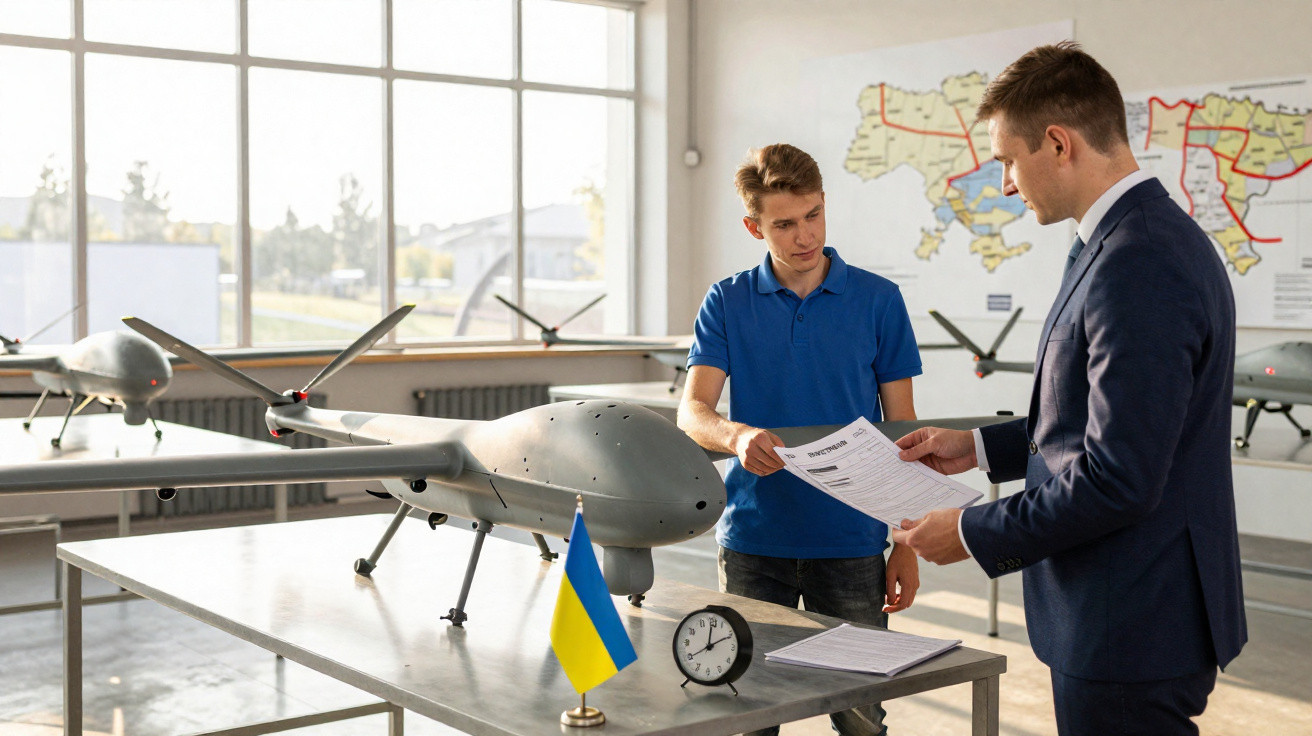
Ukraine’s government, even as it remains in a dispute with Poland over drone production, has announced a new mechanism designed to bolster the country’s defence industry by making it easier to export unmanned systems and weapons to third countries. The plan is intended to bring existing rules together under a single, more transparent process, following a request from the Ukrainian Presidency to streamline co-operation with international partners and draw in investment that can expand manufacturing capacity across the sector.
According to Ukraine’s Minister of Defence, Mykhailo Fedorov, the new framework will be based on a pre-approved list of partner countries signed off by the Ministry of Foreign Affairs, alongside a catalogue of items deemed critical that will not be allowed for export. He also said that equipment sold abroad will not include the transfer of intellectual property rights for production in other countries. In addition, the updated regulation sets out that 20% of the revenue generated from each export contract will be paid into the State budget.
Ukraine’s new export mechanism for drones and defence equipment
Another notable element is that the mechanism introduces more favourable terms for countries that are part of the so-called Drone Agreement and for Ukraine’s strategic partners, enabling a more direct relationship with domestic manufacturers. This could help unlock the deadlock with Poland regarding drone production-an issue that remains on hold and which also affects negotiations over a potential transfer of MiG-29 fighter jets to Kyiv.
Poland, MiG-29 fighters and the drone production impasse
At the end of June, Poland’s Minister of Defence, Władysław Kosiniak-Kamysz, said he had proposed an exchange based on the delivery of MiG fighters in return for Ukrainian drones. He stated that Kyiv initially accepted the concept, but the arrangement was never implemented; as a result, Poland did not receive the drones and Ukraine likewise did not obtain the aircraft. He later added that Ukrainians had shown they were capable of supplying military equipment by supporting operations in the Middle East during Operation Epic Fury, underlining the value of sharing technology and operational experience.
Export safeguards for Ukraine’s Armed Forces and a 30-day deadline
Despite the opening to new markets, the Ukrainian government has made it clear that exports will only be authorised if they do not undermine supply to the country’s own Armed Forces. In practice, manufacturers will have to demonstrate that they can meet demand from the Ministry of Defence and from foreign customers at the same time. If they cannot, licences may be refused until national military requirements are fully satisfied.
Fedorov emphasised that defence technology developed in Ukraine has already proven effective on the battlefield, and said the government’s aim is to create conditions that allow manufacturers to scale up output, win new markets and attract international investment, while still prioritising deliveries to the Ukrainian Armed Forces.
Even with these assurances, Western analysts estimate that between 40% and 70% of Ukraine’s defence-industry production capacity remains idle. Because the government has been virtually the only buyer of domestically produced equipment and faces budget constraints, a large share of that capacity has not been used. Against this backdrop, the new export mechanism may offer a route to increase production and improve the sector’s financial sustainability.
Even so, questions remain about whether Ukraine’s bureaucratic structure can process export requests within the 30 days set out in the new rules. Speaking to Politico, Ihor Fedirko, Director General of the Council of Defence Industries of Ukraine, warned that the State Export Control Service could face a genuine administrative bottleneck-even if only some companies apply for export licences-making it necessary to expand the staff responsible for this work.





Comments
No comments yet. Be the first to comment!
Leave a Comment