
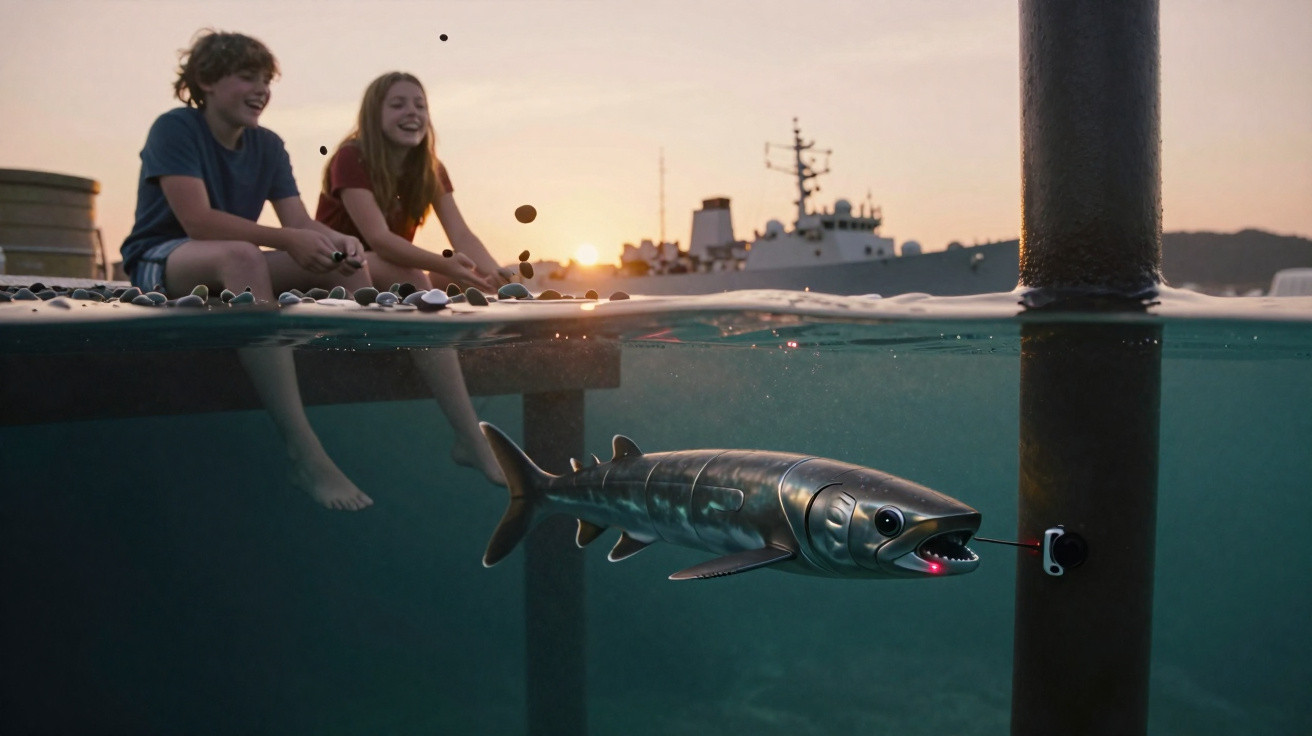
The first time you watch it swim, your brain refuses to accept what you’re seeing. A long, pale, twisting body slides through milky water in a test tank, keeping close to the wall like something living and unsure of itself. Then the shot widens: the Lockheed Martin logo sits on a control console, and a tidy line of engineers in polo shirts look on without a word, tablets casting a cool blue glow in the dim room. The “creature” bends, ripples, and then shoots ahead with a snap you’d expect on a fishmonger’s slab - not inside a defence lab.
Somewhere between a sea monster and a spreadsheet, a new kind of war machine has just arrived.
What exactly is this lamprey drone – and why does it feel so unsettling?
In Lockheed Martin’s own language, it’s a “biomimetic undersea vehicle” modelled on the lamprey: a jawless, eel-like parasite that latches onto fish and drinks their blood. In leaked clips from demonstrations and trade shows, the prototype is uncomfortably close to that inspiration - a segmented, bendy tube that moves with no obvious propellers, curling around pipes and structures like an inquisitive animal. This isn’t Hollywood CGI; it’s a real machine built to operate in places conventional submarines find difficult.
The sales line is straightforward: a low-noise, hard-to-spot robot that can wriggle through complicated underwater spaces while carrying sensors, tools… or a payload.
This lamprey drone didn’t emerge in a vacuum. Defence research teams have toyed with fish-like robotics for years - from tuna-style propulsion experiments to “robotic manta rays” designed to loiter near harbour floors. Across 2023 and 2024, early versions of Lockheed’s lamprey-shaped vehicle appeared quietly at military technology conferences, often wedged between slide decks on hypersonic missiles and AI-driven logistics.
One demonstration scenario keeps resurfacing: the drone creeps along an underwater pipeline, hesitates at suspect joints, then appears to “bite” on to inspect - or potentially interfere with - the line. Another clip shows it perched high on a seafloor framework, almost blending in, before easing away in a slow, spine-like wave. The mood is less Top Gun and more horror.
There’s a practical engineering reason it feels so eerie. Biomimetic motion - copying how animals actually swim - helps it hold steady in currents, squeeze through cramped gaps, and cut acoustic signatures that sonar might detect. An eel-like body can thread between cables or through the latticework of an offshore rig in ways a standard torpedo-shaped craft simply can’t.
Strategically, that’s significant. Undersea infrastructure is one of modern life’s softest targets: internet cables, gas pipelines, deep-sea sensors, offshore energy platforms. A drone that can silently cling to any of these for hours or days is a dream for intelligence planners. For everyone else, it prompts a colder question: who is watching the machines that watch the seabed?
Revolutionary tech… or just a prettier mask on the same old war?
Under the polished talk of “innovation”, an older playbook is still in use. Lockheed Martin doesn’t only build drones; it also builds narratives. The lamprey-style vehicle is presented as dual-use: inspecting ageing oil infrastructure in the North Sea one day, and tracking enemy submarines in the Baltic the next. That “civilian plus military” framing is invaluable for any defence contractor seeking to reassure regulators and entice investors.
The shift is gradual. You lead with “safety” and public-good examples - preventing leaks, monitoring reefs, surveying shipwrecks - and then, once the room is on side, you introduce phrases like “threat environment” and “force protection”.
Most people recognise the pattern: a gleaming new device is marketed as a breakthrough for everyday needs, only for its battlefield testing to become clear later. In a quieter way, the lamprey drone is following that same route. In glossy brochures, there are staged images of engineers smiling in hard hats beside offshore platforms. Further down in the technical wording, terms start to appear: “covert deployment”, “modular payloads”, “autonomous loitering in contested environments”.
Consider Nord Stream - the undersea gas pipelines damaged by sabotage in 2022. No one has publicly confirmed who carried it out or the precise method, but the episode highlighted how exposed seabed infrastructure can be. The idea of a lamprey-style drone sliding along similar routes in future - for “inspection” or “deterrence” - starts to feel less like science fiction and more like an inevitable line item.
From a corporate perspective, the incentives are stark. Undersea warfare is one of the last major frontiers for defence spending. Satellites pack the sky and drones crowd the air, yet the deep ocean remains a murky, difficult wild west for militaries. A firm that masters silent, flexible, persistent undersea surveillance doesn’t just secure a single contract - it positions itself to dominate a whole era.
That’s where the “terrifying new chapter” edge comes in. Once a device exists that can cling to cables, rigs, or ports like a robotic leech, who decides where it is permitted to operate? Boards answer shareholders, not voters. Armed forces respond to threat briefings the public rarely reads. The sea is about to be crowded with things we never voted for and can’t easily detect.
How should we, as ordinary citizens, respond to something this invisible?
A practical first step is to follow the funding and the language, not just the slick demonstration footage. When you see headlines about “revolutionary undersea inspection vehicles” or “next-gen maritime autonomy”, look closely to see whether Lockheed, Raytheon, or another major defence contractor sits in the small print. Then pay attention for the move from “monitoring” to “securing interests”.
You don’t need to be a policy specialist. Watch which governments sign “strategic partnerships”, what sort of undersea infrastructure is suddenly described as “critical”, and how phrases like “lamprey drone” begin to vanish from public materials - replaced by bland acronyms nobody remembers. That’s one of the ways disputed systems become normal without much scrutiny.
It’s also worth avoiding an easy emotional mistake: assuming that because the technology is underwater and out of sight, it has nothing to do with you. Subsea cables carry the overwhelming majority of international internet traffic. Energy costs are tied to pipelines and offshore fields. If tools inspired by a parasitic fish can attach themselves to those arteries unnoticed, then any geopolitical dispute can turn dark - quickly.
To be fair, almost nobody pores over defence budgets or naval procurement documents every day. Even so, patterns are visible. Sudden jumps in “maritime domain awareness” spending. Ministers and officials talking about “left of boom” undersea capabilities. Tech outlets gushing over AI-led “sea serpents” that “never need sleep”. Beneath the buzzwords is a basic fact: systems like the lamprey drone are being made to feel routine before we’ve decided whether we actually accept them.
“Every new leap in military tech arrives wearing the costume of inevitability,” a retired naval officer told me, on condition of anonymity. “We’re told: it swims, it’s stealthy, the other side will have it anyway, so we’d better build it first. What nobody asks is whether flooding the seabed with semi-autonomous predators is actually making us safer, or just giving everyone new ways to panic.”
- Watch the framing: notice when “maintenance” drones quietly turn into “tactical assets”. Language is the first layer of camouflage.
- Follow infrastructure stories: when a cable, rig, or pipeline incident makes the news, ask what tools exist to interact with those systems without being seen.
- Support transparency groups: NGOs tracking autonomous weapons and the militarisation of the seabed are often the only people reading the dry documentation.
- Question “dual-use” assurances: the same eel-like movement that can inspect a coral reef can also place a device on a harbour wall.
- Talk about it offline: it stays abstract until someone says, out loud, “So we’re fine with robot parasites in the ocean now?”
What this lamprey-shaped future says about us
Lockheed Martin’s lamprey drone sits in an uncomfortable overlap: impressive engineering, genuine problem-solving potential, and a gut-level anxiety about who gets to direct the future of conflict. On one side, a flexible, quiet robot that can check corroding infrastructure or map delicate seabeds is an obvious benefit. On the other, a corporate heavyweight built on weapons contracts is hardly a neutral custodian of the ocean floor.
Perhaps that’s the real point - not the unsettling tank footage of a robotic eel, but the speed at which new military capabilities slip beneath the surface while public debate stays fixated on above-water politics. Down in the dark, a quiet arms race is already practising fresh forms of pressure, sabotage, and control. The lamprey is simply the most literal metaphor yet: a robotic parasite produced by a company that profits when tensions remain just high enough.
How we discuss it now - before these drones vanish into the murk of classified operations and alphabet-soup programmes - may be the only meaningful opportunity to decide what sort of sea we want our cables, our data, and our children to inherit.
| Key point | Detail | Value for the reader |
|---|---|---|
| Biomimetic design | Lamprey-style movement allows silent, flexible navigation around cables, rigs, and tight structures | Helps you understand why this tech is more powerful – and more unsettling – than classic submarines |
| Dual-use framing | Marketed for “inspection” and “maintenance” while being built for surveillance and potential sabotage | Gives you a lens to read corporate and government messaging more critically |
| Invisible militarization | Undersea drones expand conflict to seabed infrastructure far from public view | Shows how distant tech decisions can affect your internet, energy prices, and security |
FAQ:
- Question 1 What exactly is Lockheed Martin’s “lamprey drone”?
Answer 1 It is a biomimetic undersea vehicle that mirrors the swimming motion of a lamprey or eel, using a flexible, segmented body rather than propellers to move quietly around underwater structures and along the seafloor.- Question 2 Is it already being used by militaries?
Answer 2 Lockheed has shown prototypes at defence and maritime technology events. While full operational information is classified or not disclosed, it is clearly being positioned for future military procurement linked to undersea surveillance and infrastructure-focused operations.- Question 3 Could it have peaceful or civilian uses?
Answer 3 Yes. The same approach could be used to inspect pipelines, subsea cables, and offshore platforms, or to support scientific mapping and environmental monitoring - which is a central part of how it is being presented to governments and investors.- Question 4 Why are people worried about it?
Answer 4 Because a quiet, flexible drone that can attach itself to critical seabed infrastructure is well suited to covert surveillance, coercion, and sabotage. When combined with corporate and military secrecy, the public has little visibility of what is happening under the waves.- Question 5 What can ordinary readers actually do about this?
Answer 5 Pay attention to how undersea technology is framed, back organisations monitoring autonomous weapons and seabed militarisation, and push these discussions into public life - from local politics to everyday conversations - before the technology disappears into the classified deep.





Comments
No comments yet. Be the first to comment!
Leave a Comment