
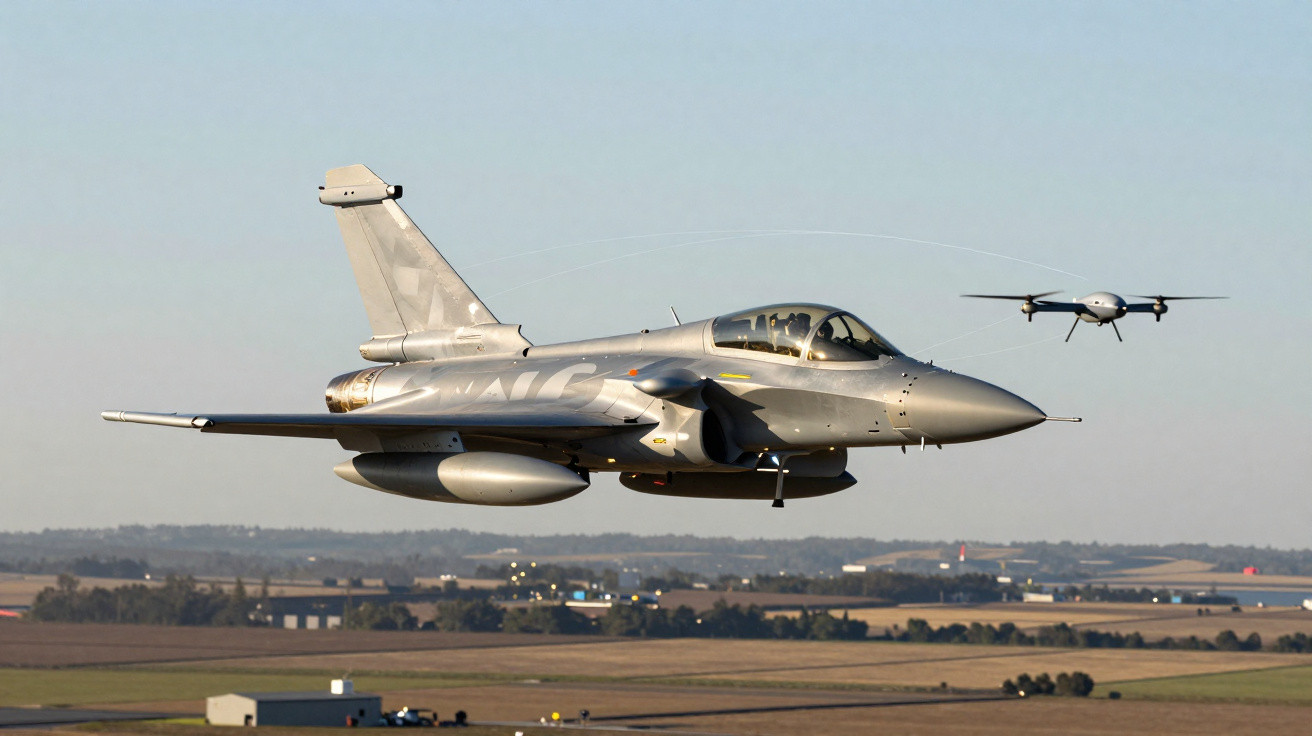
Dassault Aviation of France announced a few hours ago that it has successfully completed a test flight involving a Rafale F4 fighter aircraft and a Raybird drone fitted with the NAMIB system. NAMIB is an electronic warfare payload developed jointly with Harmattan AI.
Rafale F4 and NAMIB trial with the Raybird drone
During the latest test sortie, the team assessed how the Rafale F4 could operate collaboratively with an unmanned aerial system carrying NAMIB within a simulated environment. According to Dassault, “...during the demonstration flight, NAMIB discreetly and very accurately located a radar several tens of kilometres away. This position was transmitted to the Rafale fighter aircraft, which simulated an attack against the target...”.
Collaborative unmanned air systems are a concept that continues to gather momentum, driven by the need for lower-cost, complementary assets that can extend the capabilities of crewed weapon systems-here, the Rafale F4.
For this recent evaluation, Dassault Aviation and Harmattan AI used a Rafale F4 fighter and a Raybird drone carrying the NAMIB system. It is worth noting that the unmanned platform employed is produced by the Ukrainian company Skyeton; it has been in service for several years and has been combat-proven by Ukraine’s Armed Forces.
The cooperation between Harmattan AI and Skyeton was agreed in October 2025, with the aim of “...increasing the platform’s adaptability and operational capability, offering governments and allied forces a reliable and scalable solution to the challenges of modern defence...”, as the Ukrainian firm stated at the time.
Strategic partnership
Dassault Aviation highlighted that development of the NAMIB electronic warfare system began in January 2026, being “...one of the components of the strategic partnership between Dassault Aviation and Harmattan AI, whose objective is to integrate advanced autonomous capabilities into the next generation of air combat systems...”.
The exercise also underscored the Rafale F4’s strengths for collaborative combat in multi-dimensional environments. Eric Trappier, Chairman and Chief Executive Officer of Dassault Aviation, stressed that “...the standard F4 architecture enables seamless communication with a wide range of actors, including ground forces, allowing effective use of new functionalities such as NAMIB in terms of electromagnetic detection and location...”.
Mouad M’Ghari, co-founder and Chief Executive Officer of Harmattan AI, said that with this test between NAMIB and the Rafale F4 “...we have demonstrated that it is now possible to deploy these capabilities on lightweight autonomous systems, as close to the threat as possible. This success illustrates the complementarity between Dassault Aviation and Harmattan AI, combining expertise in air combat systems with our specialisation in autonomy and embedded intelligence...”.
Collaborative drones, crewed aircraft and electronic warfare
Collaborative-type unmanned air systems will make it possible to broaden the capabilities of crewed aircraft, both in direct combat and in supporting roles such as electronic warfare. In increasingly contested environments-where integrated air defence systems remain a constant threat-the use of drones as part of a combat package will continue to expand as a complement and, in the future, as a replacement for conventional assets.




Comments
No comments yet. Be the first to comment!
Leave a Comment