
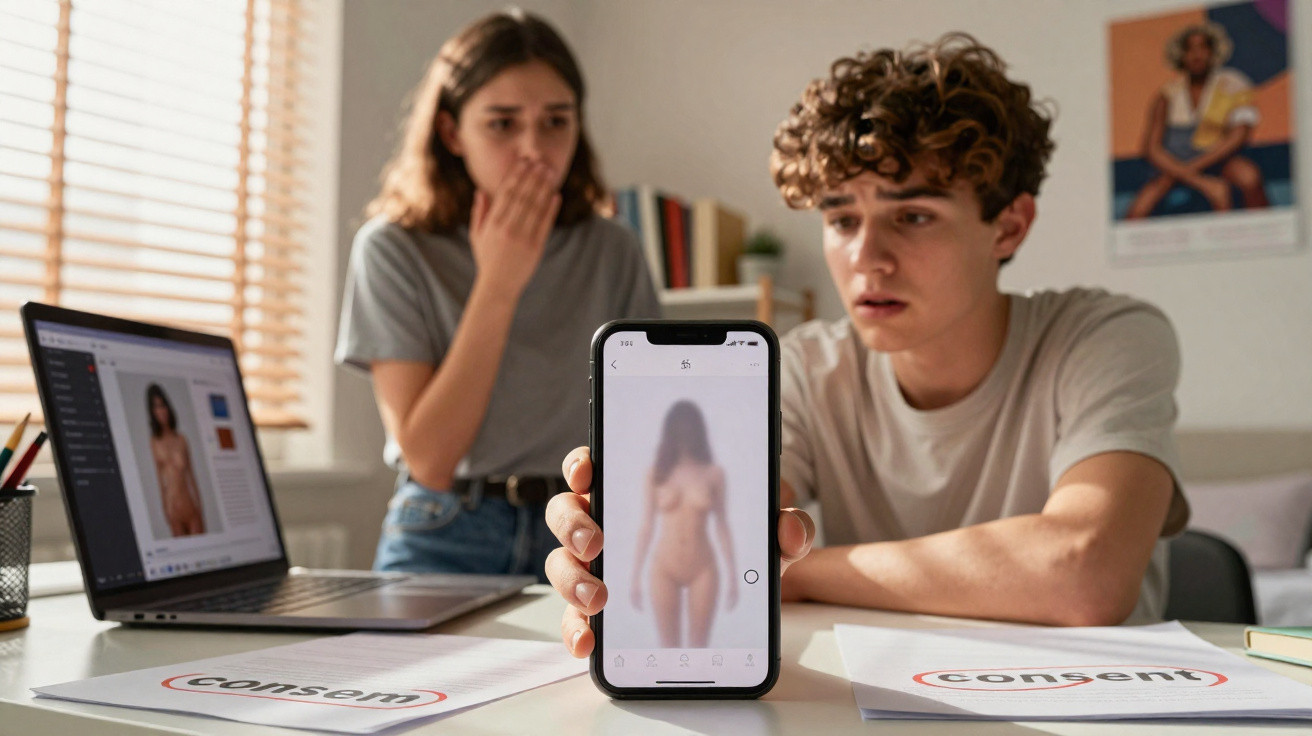
Researchers say that over half of the U.S. teenagers they surveyed have used artificial intelligence tools to produce sexualised fake nude images.
The research positions these images as a routine feature of teen digital behaviour, not a rare or fringe misuse.
Many teens create fake images
In an anonymous sample of 557 teenagers, the practice appeared woven into ordinary online life rather than confined to a handful of isolated incidents.
From the responses, Chad Steel at George Mason University (GMU) calculated that 55.3 percent had made at least one image of this kind.
A majority of participants also said they had received such images, suggesting that making them quickly becomes everyday peer-to-peer sharing.
Taken together, the results indicate a behaviour that has already become normalised at scale, raising sharper questions around consent and harm.
AI tools make fake images easily
Rather than generators that create scenes from text prompts, or software that simply makes a clothed photo appear nude, these AI tools begin with a real person’s photograph.
With a single existing selfie serving as source material in seconds, the set-up reduces the effort required to create a sexualised image.
Steel reported that teenagers turned to these apps more often than broader image-creation systems, an important detail because the person depicted was typically identifiable.
When a real face is clearly attached to the output, it becomes much harder to wave away embarrassment, coercion, and rumour-spreading as “just” fiction.
Teens face non-consensual harm
Reports of harm were nearly as common as reports of taking part, and the distance between the two was smaller than many adults might assume.
In the survey, 36.3 percent said someone had generated a sexualised AI image of them without consent.
A further 33.2 percent said someone had shared one of these images, shifting what might have been a private violation into a social spectacle.
Making and distributing the images function as distinct harms, because preventing one does not necessarily prevent the other.
Behaviour that’s common across all teens
By race, age, and most other measures, the practice looked broadly spread rather than concentrated in a single obvious subgroup.
Male participants nonetheless reported higher rates across several behaviours, including creating or sharing images of themselves, of peers, and of adults.
Female participants followed a pattern close to the overall results, challenging the assumption that this is something only boys do.
Any programme designed around a single stereotype would fail to address much of what the survey actually recorded.
Younger teens are also involved
Within this survey, age did not appear to offer meaningful protection. Thirteen-year-olds and 17-year-olds reported comparable levels of both use and victimisation.
Schools could interpret that as an argument for teaching about consent, privacy, and image sharing earlier-before middle-school routines become entrenched.
Separately, Britain’s communications regulator published a 2025 report finding that half of children aged eight through 17 had used AI tools.
AI familiarity no longer starts only in late adolescence, which helps explain why waiting until secondary school may be too late.
AI turns this into new sexting
Earlier research on teen sexting did not involve AI, but it still illustrates how much the behaviour has shifted.
A 2018 review covering 39 studies estimated youth sexting at 14.8 percent for sending and 27.4 percent for receiving.
Today, an image can be created from a prompt or altered from a real photograph, reducing the effort involved and blurring accountability.
“Teens are no longer just digital natives but AI-natives. ‘Nudification’ and GenAI apps are their new ‘sexting’, only with more challenging issues surrounding consent,” said Steel.
Teen behaviour clashes with law
US federal law can apply more broadly than many teenagers are likely to realise, even if an image is entirely synthetic.
Legally, obscene sexual images involving minors may be unlawful even where no real child is depicted.
That sits uneasily alongside peer-to-peer behaviour, because some teenagers may treat these exchanges as flirting or experimentation.
Schools, parents, and lawmakers still face the more difficult task: discouraging harm without acting as though the behaviour is uncommon.
Part of a larger issue
Beyond this survey, youth-created sexual imagery already accounts for a substantial portion of online abuse reports.
The Internet Watch Foundation’s 2023 report stated that 92 percent of the child sexual abuse imagery it identified and helped remove was self-generated.
AI did not create the motivation to produce or exchange intimate images, but it has made editing, faking, and redistribution easier.
Prevention efforts cannot focus on AI alone when the underlying social behaviour clearly predates the software.
Limitations of the study
Although captured in January 2025, the research still has notable blind spots, even as it puts firm figures on a largely hidden behaviour.
GMU surveyed only English-speaking U.S. teenagers aged 13 through 17, and participation required parental consent.
Adult perpetrators, younger children, and many smaller subgroups were not included in the study design, meaning some harms could be higher or simply different.
Even with these constraints, the numbers are far too large to dismiss as a narrow issue awaiting further evidence.
This is not a marginal practice limited to a few reckless teenagers; it is a widespread digital behaviour shaped by consent, social pressure, and harm.
That reality means earlier education, stronger safeguards, and better support for victims are not merely important-they are overdue.






Comments
No comments yet. Be the first to comment!
Leave a Comment