
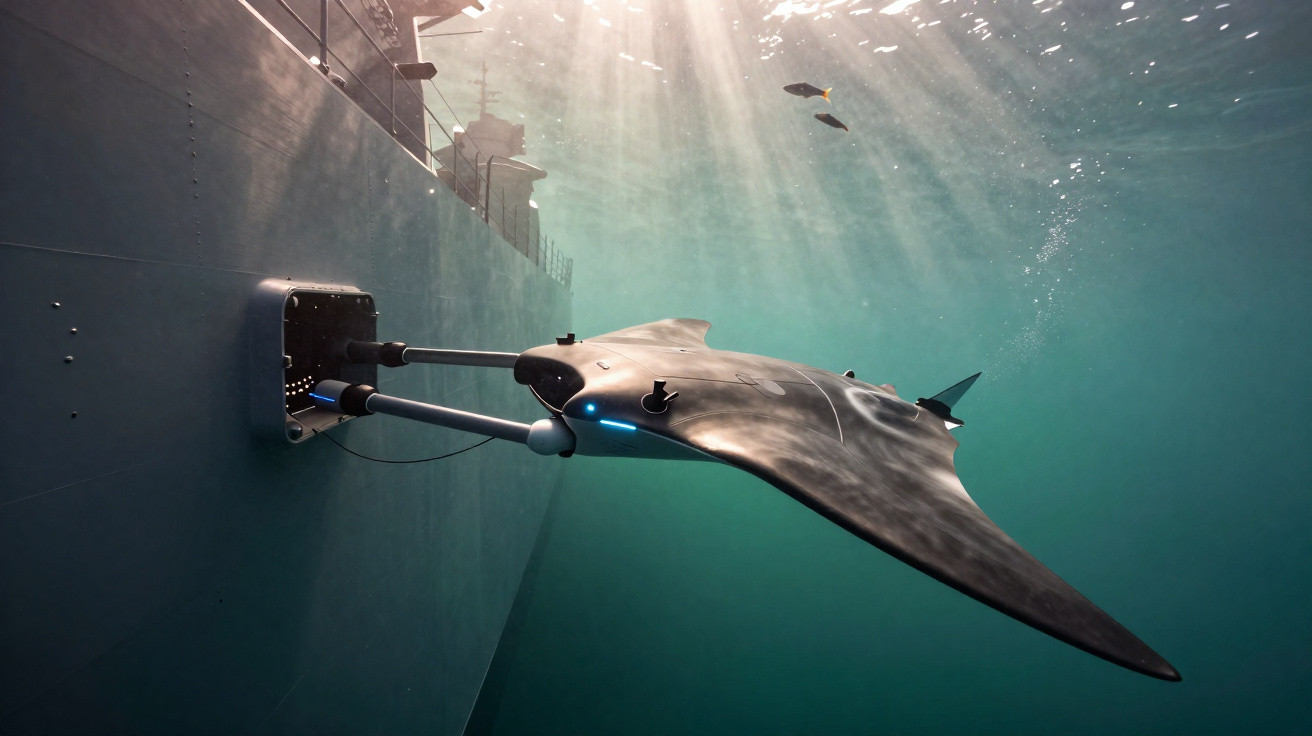
Lockheed Martin has unveiled an unusually flexible underwater drone called the Lamprey, a system intended to cling to ships, sit quietly on the seabed, and deploy both torpedoes and airborne drones-an indicator of how naval combat could evolve in the years ahead.
A shape-shifting undersea weapon
Lockheed characterises Lamprey as a “multi‑mission autonomous undersea vehicle” - essentially, a large uncrewed submarine designed to switch tasks as needed.
At the centre of the design is a 7.3‑metre payload bay, which gives engineers the space to fit different weapons, sensors, and mission-specific modules depending on what the vehicle is being sent to do.
The Lamprey can operate from seabed to surface, switching between spying, striking and supporting other forces without a crew on board.
Lockheed says Lamprey can remain on the ocean floor for extended periods, using depth and stillness to stay hidden, before moving up towards the surface when it needs to employ weapons or send drones into the air.
Attaching itself to ships for power and cover
One of the most distinctive features is reflected in the name: much like the parasitic fish, Lamprey is designed to attach itself to a larger “host”.
Lockheed says the vehicle can physically clamp onto a ship in order to recharge, effectively using that vessel as a mobile charging point.
By clamping onto a host ship, Lamprey tops up its batteries while hiding in plain sight beneath the waterline.
This ability is about more than endurance. It also provides cover: an opponent’s sensors might register only the ship itself, rather than an extra undersea vehicle travelling beneath the hull.
From that position, Lamprey could release itself without much notice, move off to patrol an area, then return-either to the same ship or another one-to recharge and exchange data.
Armed for underwater and surface combat
Lamprey is presented as more than a reconnaissance asset; it is intended to function as a weapons platform in its own right.
Torpedoes and decoys below the waves
Underwater, the drone is designed to fire anti-submarine torpedoes at hostile submarines, and potentially at smaller surface vessels.
It can also deploy decoys-systems intended to imitate the acoustic signature or radar profile of a ship or submarine-drawing enemy weapons away or complicating sensor tracking.
- Antisubmarine torpedoes: attack enemy submarines from standoff range.
- Decoys: lure or mislead enemy torpedoes and sonar systems.
- Seabed surveillance gear: gather intelligence from the ocean floor.
Together, these options make Lamprey a kind of underwater multi-tool: at times the attacker, at times the escort, and at times the discreet collector of information.
Airborne drones launched from the sea
Close to the surface-or on it-Lamprey is described as having another capability. Lockheed states that it can launch unmanned aerial vehicles into the air.
Those aerial drones could carry out reconnaissance, searching for ships, coastal infrastructure, or missile batteries beyond line of sight.
They could also conduct “kinetic strikes”, a phrase typically used for releasing munitions or directing precision weapons on to a target.
From a single underwater platform, commanders could task Lamprey to hit a submarine, monitor a coastline and launch an aerial strike package.
Autonomy, swarms and networked warfare
Lockheed emphasises that Lamprey is autonomous, handling many actions independently while still operating within limits defined by human commanders.
The company also says the system can take part in swarms, coordinating with other uncrewed platforms across the sea, air, or even space.
In practical terms, multiple Lampreys could monitor a chokepoint such as a strait, share sonar and radar information, allocate targets, and cycle through recharging periods with nearby ships.
Onboard sensors are intended to support surveillance above and below the surface, with intelligence passed back via secure data connections.
Privately funded and rapidly iterated
Lockheed notes that Lamprey was created using the company’s own funding rather than through a conventional government-led programme.
According to the firm, that approach enables quicker prototyping and adjustment, because it does not have to go through the full defence procurement process each time the design is refined.
Lockheed says self-funding let engineers iterate “at lightning speed” and offer the US Navy a ready-made multi-mission system.
For the Navy, that could reduce the time between an idea and an operational system, although any move towards widespread deployment would still depend on service testing and evaluation.
Why Lamprey matters for future naval warfare
The increasing reliance on uncrewed maritime systems reflects a change that has already taken hold in the air and on land.
With missile ranges growing and satellites able to track movements in near real time, crewed warships operating close to hostile coastlines face greater danger.
Large autonomous undersea vehicles such as Lamprey offer an alternative. They can move in front of a fleet to scout routes, chart minefields, or prepare ambushes against enemy submarines-without placing sailors directly in harm’s way.
They may also force opponents to plan differently. Rival navies could have to assume that any significant ship might have Lampreys-or comparable drones-attached to it or operating nearby, equipped with torpedoes or carrying loitering aerial drones.
| Feature | Role |
|---|---|
| Ship attachment | Recharging, concealment and data transfer |
| 7.3‑metre payload bay | Modular weapons and sensors for multiple missions |
| Torpedoes & decoys | Antisubmarine warfare and protection of friendly ships |
| Air-launched drones | Reconnaissance and precision strikes from the sea |
| Swarm operations | Coordinated missions with other unmanned systems |
Key terms and real-world scenarios
The term “autonomous undersea vehicle” often prompts questions about who is in control. In reality, these systems operate according to software rules and report back to human operators at intervals using acoustic communications or satellite links.
They can be instructed to patrol a defined area, avoid particular zones, or keep weapons unarmed unless a specific authorisation code is received from a ship or a shore-based station.
In a Baltic Sea crisis, for instance, a navy could deploy several Lampreys ahead of a task group. One could stay close to the seabed, placing acoustic sensors to listen for submarines. Another might remain near an allied frigate, effectively serving as an additional torpedo magazine. A third could operate nearer the surface, waiting for the command to launch small reconnaissance drones over contested coastlines.
There are also notable risks. Autonomous weapons bring legal and ethical arguments about responsibility if a mistake occurs. Safe navigation in busy coastal waters is challenging even for crewed ships, and the introduction of uncrewed vehicles adds further complexity.
On the other hand, systems like Lamprey can reduce the need to send crewed submarines into heavily defended waters, which could lower casualties during conflict.
For coastal states, the spread of this technology may encourage greater investment in undersea sensor networks, minefields, and anti-submarine aircraft, as the gap between a quiet seabed and an active battlefield narrows considerably.



Comments
No comments yet. Be the first to comment!
Leave a Comment