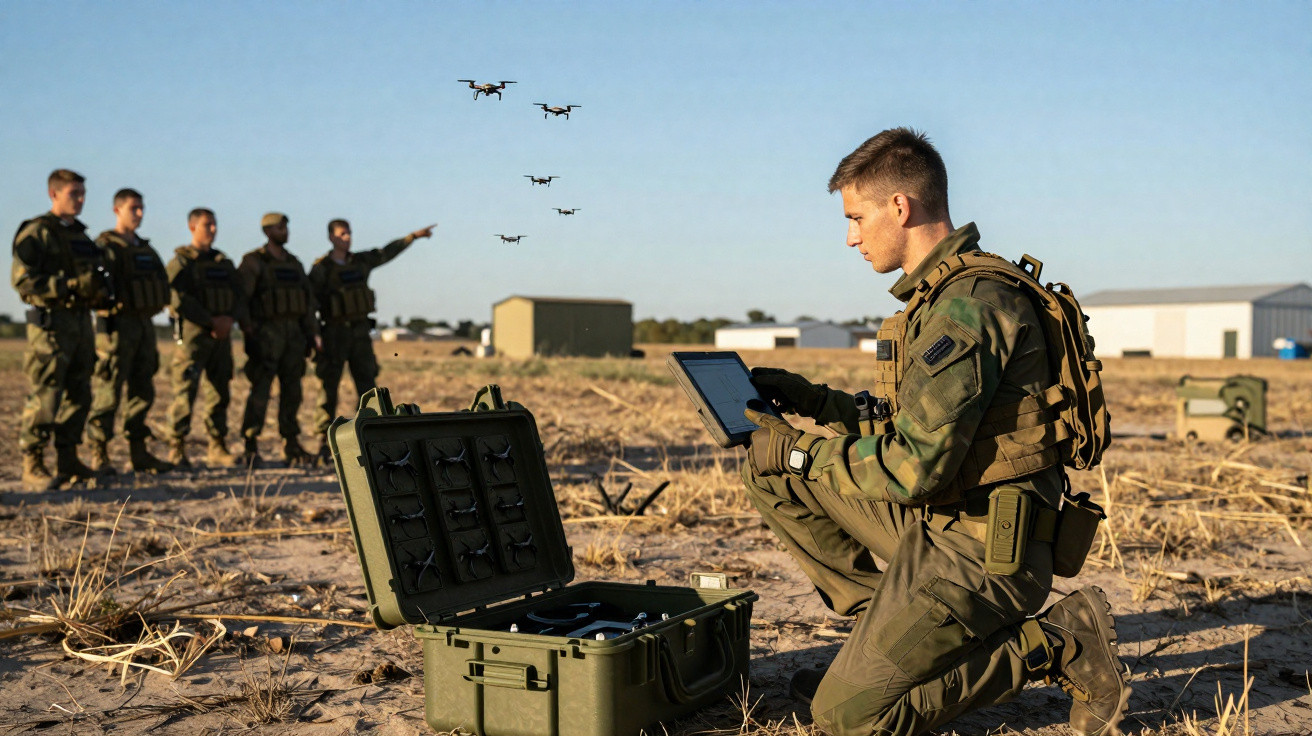
French soldiers on a training range are opening cases containing compact grey quadcopters that are set to change the way they train each day.
Those unassuming aircraft are the result of a rapid industrial effort. In a single year, a newly created French start-up designed, manufactured and supplied 1,000 micro-drones to the army, ready for one of Europe’s most ambitious military exercises.
French Army receives 1,000 new Sonora micro-drones
The French Army has started taking delivery of its complete 1,000-strong order of Sonora micro-drones from Harmattan AI, a French defence technology start-up founded only in 2024. The contract was awarded in June and, according to France’s defence procurement agency, the DGA, every system was delivered within six months.
The shipment fulfils an urgent need identified by the French Army at the end of 2024: 1,000 affordable micro-drones intended chiefly for training and operational preparation.
The Sonora programme shows how fast a Western army can move when it accepts simpler specifications and short development cycles.
The drones will be issued to formations preparing for Orion 2026, a major multi-domain exercise intended to assess France’s capacity to conduct high-intensity warfare alongside allied forces. Participating units will employ Sonora systems for reconnaissance and surveillance in demanding combat scenarios.
A rapid contract based on simpler requirements
The pace of the Sonora programme is notable in an industry frequently criticised for lengthy, inflexible procurement processes. When the army set out its requirement in December 2024, the DGA began a European tender process with intentionally reduced technical specifications.
The requirement broadly matched systems already available commercially and contained only about 20 essential specifications. The intention was straightforward: limit administrative burden, lower the price of each drone and support fast production while retaining fundamental operational capability.
By trimming the wish list, the French defence ministry traded “gold-plated” features for speed, volume and affordability.
That model meant Harmattan AI received the contract just six months after the original requirement was issued. It then had a further six months to develop, industrialise and supply 1,000 customised systems, a timetable that conventional procurement routes would have made unimaginable.
Who is Harmattan AI?
Harmattan AI represents a new wave of European defence start-ups operating at the intersection of civilian robotics and military technology. Established in 2024, it quickly became part of the French “defence aerial drones pact”, a state-backed scheme designed to organise a domestic drone industry.
The pact is intended to build a sovereign industrial base for small and medium unmanned systems, reducing reliance on overseas suppliers in a field led by US, Chinese and Turkish manufacturers.
Harmattan AI has already reached an important symbolic milestone. It recently became the first French defence-technology start-up to achieve “unicorn” status, meaning a valuation above €1 billion. The increase followed an investment round involving Dassault Aviation, France’s leading aerospace company.
Expanding international presence
The Sonora contract is not Harmattan’s sole significant order. The firm has won a separate UK Ministry of Defence agreement covering 3,000 autonomous systems, indicating a wider European ambition.
Harmattan is also collaborating with Ukrainian drone producer Skyeton to improve the capabilities of the Ryabird drone using artificial intelligence developed with Dassault Aviation.
- France: 1,000 Sonora micro-drones for the army
- United Kingdom: 3,000 autonomous systems for the MoD
- Ukraine: AI support for the Ryabird reconnaissance drone
Sonora drone: lightweight, straightforward and designed for training
The Sonora drone is clearly a “micro” system. At roughly 1.8 kg, it prioritises simple operation, quick deployment and low running costs rather than substantial payloads or long-range attack missions.
The DGA states that Sonora has a range of more than 2 km and a flight endurance of approximately 40 minutes. This is sufficient to observe a village, woodland area or urban district from a stand-off position during an exercise.
With a 40-minute endurance and multi-kilometre range, Sonora gives junior leaders a pocket-sized eye-in-the-sky for routine drills.
The drone is fitted with optronic equipment from French manufacturer Lynred, providing day and night imagery to personnel. Units can therefore trial tactics that rely on continuous observation, including detecting enemy movement, inspecting routes, confirming friendly-force locations and identifying ambushes.
Typical training mission scenarios
At a French training site, Sonora might be assigned to:
- Survey a tree line before an infantry section moves forward.
- Watch a convoy route for simulated improvised explosive devices.
- Follow opposing-force activity during a simulated urban engagement.
- Give engineers overwatch as they clear obstacles.
As the drones are comparatively cheap, commanders can use them in realistic high-risk situations, including electronic-jamming trials and simulated hostile fire.
Why training with mass-produced drones matters
The war in Ukraine has prompted European armed forces to reassess their training methods. Inexpensive quadcopters and fixed-wing drones now play a central part in artillery spotting, infantry manoeuvre and target acquisition. Without them, units are effectively blind.
France aims for its personnel to be as familiar with operating drones as they are with using radios. Achieving this requires regular access to systems during both basic and advanced training, rather than restricting them to specialist reconnaissance formations.
The army is betting that thousands of basic drones in training today will translate into instinctive battlefield use tomorrow.
A dedicated fleet of 1,000 Sonora drones reduces both the financial and psychological obstacles to experimentation. Soldiers can rehearse assertive manoeuvres, rapid launches, transfers between operators and emergency drills without worrying about losing a limited asset.
Balancing cost, capability and risk
Deploying large numbers of small drones also creates concerns. Every additional aircraft is another platform that could be jammed, hacked or detected. Training must cover:
- What to do if GPS is denied or spoofed.
- How to protect data if a drone is shot down or captured.
- When not to fly in order to avoid revealing positions.
Using Sonora drones in substantial numbers during exercises such as Orion 2026 will allow the French Army to model these threats and improve its doctrine before confronting an actual opponent.
France’s push for a new defence-industrial pace
During a January visit to Toulon, France’s defence minister said Harmattan AI typifies businesses that “move fast, innovate and take risks”, particularly in dual-use technologies that have civilian as well as military applications.
She presented the six-month delivery of 1,000 customised drones as the level of responsiveness France wants to make routine. The statement reflects wider pressure across NATO nations to shorten acquisition cycles, back agile start-ups and get prototype equipment into troops’ hands within months instead of years.
| Aspect | Traditional programmes | Sonora approach |
|---|---|---|
| Specification | Complex, hundreds of requirements | About 20 key requirements |
| Timeline | Several years from need to delivery | 12 months from need to 1,000 units |
| Cost focus | High-end, bespoke systems | Low unit cost, mass production |
Key concepts behind the Sonora programme
The Sonora programme also demonstrates two defence-technology concepts that can otherwise seem theoretical.
Dual-use technology: This describes innovation that can be used in both civilian and military markets. A computer-vision algorithm that enables a commercial drone to count warehouse stock could also allow a military drone to identify vehicles in a field. Harmattan AI’s artificial-intelligence work follows this model, helping it draw commercial and defence investment.
Sovereign capability: For Paris, drone sovereignty does not automatically require every component to be produced domestically. Instead, it means maintaining enough French and European control over critical technologies. Selecting a French start-up and French optronics supplier Lynred keeps sensitive expertise and supply chains within its own political sphere.
Practically, this gives France greater ability to export, alter or integrate the systems without foreign restrictions. It also limits vulnerability to sanctions or embargoes that might affect commercially available foreign drones.
What widespread micro-drone use could mean on operations
In the longer term, the mass training made possible by Sonora suggests how French units could operate if fighting moved beyond exercises. An infantry platoon might launch several micro-drones simultaneously: one monitoring its flanks, another inspecting rooftops and a third following enemy withdrawals.
Artillery batteries might feed drone imagery directly into fire-control systems, while engineers could use the aircraft to examine damaged bridges or minefields before sending personnel forward. The main limitation may cease to be hardware and instead become bandwidth, electronic warfare and people’s capacity to handle the vast quantity of video and data.
This is where Harmattan AI’s wider work on autonomy and AI-assisted analysis becomes relevant. The company that is supplying basic training drones now is also seeking to market more advanced, intelligent systems in France, the UK and elsewhere in the future.














Comments
No comments yet. Be the first to comment!
Leave a Comment