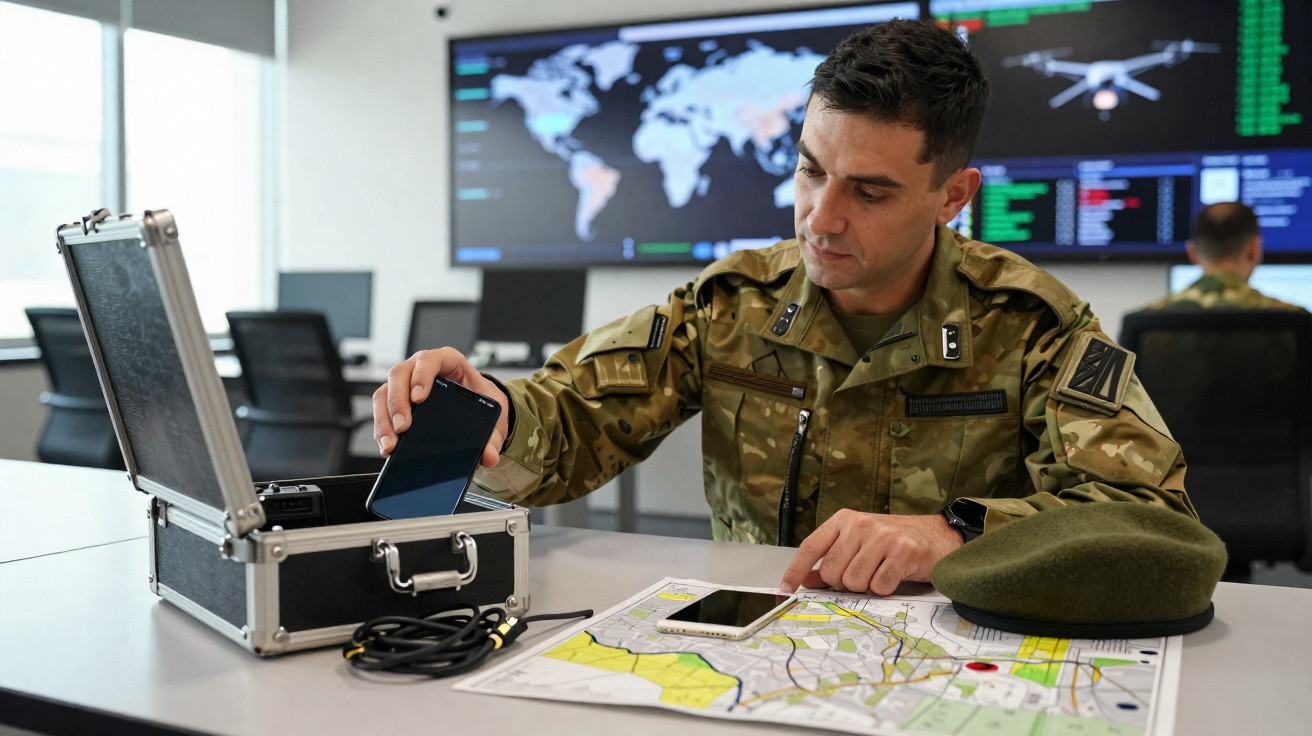
In Israel’s military, a seemingly ordinary item is set to become a critical security instrument: the officer’s smartphone.
The Israel Defense Forces (IDF) are preparing to impose a stringent new policy on senior officers’ handsets, subtly changing the way digital security is managed at the highest levels of command. The measure reflects rising concern over targeted hacking campaigns, espionage efforts and the smartphone’s status as an exposed point in modern warfare.
Android out, iPhone in for senior Israeli officers
Israeli media reports say the IDF will prohibit the use of Android phones for official communications on army-issued lines by officers holding the rank of lieutenant colonel or higher. For these secure communications, only iPhones will be allowed.
This is not an argument about consumer preference. It represents a policy change driven by years of operational experience, hard-learned lessons from cyber incidents and an escalating contest with extremely capable adversaries.
The IDF wants senior officers on a single, tightly controlled smartphone platform, rather than a chaotic mix of Android devices.
Military-issued handsets used by senior officers connect military, political and intelligence networks. If one device is compromised, it may reveal contact lists, diaries, location histories and even real-time microphone or camera access. To foreign intelligence agencies, this information is highly valuable.
Why the IDF is moving away from Android
The main case within the IDF is not that Android is “insecure by design”, but that its fragmentation makes robust, centralised protection harder to manage.
Fragmentation versus uniformity
Android is spread across dozens of manufacturers, innumerable handset models and several layers of customised software. Security updates can be delayed or may never arrive. Configurations also vary between brands, making large-scale enforcement of rigorous, standardised security rules difficult.
By contrast, iPhones offer the army a more consistent environment. Apple oversees the hardware, operating system and principal app store. Updates are delivered relatively uniformly, while mobile device management tools can be deployed in the same way across devices.
Standardising on iPhone lets IDF cyber teams lock down one ecosystem instead of chasing vulnerabilities across many Android variants.
Restricting the device range is intended to help the IDF:
- Cut the “attack surface” open to hackers
- Make security patches and operating-system updates easier to deploy
- Apply tighter configuration rules to every senior officer
- Improve the monitoring and auditing of devices
The smartphone as a battlefield vulnerability
Israeli security bodies have long regarded personal phones as easy targets. Soldiers carry smartphones everywhere, including bases, border areas, private homes and sensitive meetings. This makes them ideal bait for hostile intelligence services.
Honeypots and weaponised chats
A repeated method is the “honeypot” operation. Adversaries create false social-media accounts, frequently pretending to be young women, and contact soldiers through messaging applications. After building trust, they persuade targets to download apparently harmless apps that conceal spyware.
Such implants can do more than take chat records. They may collect contacts, photographs, internal files and exact location information, discreetly building a picture of the soldier’s life and, therefore, their unit.
Compromised phones have already been used to harvest photos, contacts and GPS trails from military personnel in the field.
The IDF has countered this threat with digital-discipline initiatives, including training, simulations and red-team exercises that assess soldiers’ resistance to social engineering. So far, the emphasis has largely been on awareness and user behaviour.
The proposed directive points to a shift away from educating the individual alone and towards strengthening the whole technical stack around them.
Context: targeted espionage and state spyware
The timing of the change is deliberate. Recent cyber-espionage campaigns attributed to Iran have focused on officials, defence personnel and political staff. These efforts generally combine false identities, rigged encrypted chats and software backdoors that covertly take over devices.
Instead of broad spam-style campaigns, these are bespoke operations directed at a limited set of high-value targets. Each smartphone within that group can become a possible route into the machinery of the state.
Meanwhile, sophisticated spyware is increasingly a routine instrument for states and law-enforcement bodies. In the United States, for instance, the immigration agency ICE has reportedly received authorisation to use an Israeli-made spyware tool named Graphite. These tools can defeat encrypted messaging applications by compromising the handset itself and converting it into a listening device.
When spyware hits the device, encryption on apps like Signal or WhatsApp offers little protection; the phone itself becomes the weak link.
From phones to cars: everything is a sensor
The IDF’s smartphone decision forms part of a wider security instinct taking hold among governments and armed forces: ordinary electronic products must be considered possible surveillance platforms.
Suspicion of connected vehicles
Today’s cars are, in effect, computers on wheels, fitted with cameras, microphones, GPS components and continuous internet links. Some security agencies and militaries have begun limiting access by certain foreign-built vehicles near bases, particularly Chinese brands believed to transmit greater amounts of data to manufacturers or remote servers.
Reports suggest that vehicles made by firms including BYD and Chery are being kept away from sensitive sites in a number of countries. The issue is not simply the manufacturer, but the information a vehicle continually gathers and the destination of that data.
| Device type | Main security concern |
|---|---|
| Smartphones | Location tracking, microphone access, contact and document leaks |
| Connected cars | Movement patterns, video from cameras, audio from inside cabins |
| Smart home devices | Always-on microphones, network mapping, presence detection |
Consequently, the boundary between routine consumer technology and strategic infrastructure is becoming increasingly indistinct. A private phone or family car may abruptly be considered a sensitive asset, depending on its owner and where it is used.
What this shift means for digital sovereignty
For armed forces and governments, digital sovereignty is no longer confined to creating secure networks or using military-grade encryption. Choices over which phones officers can use, or which car models may come near a site, have become part of the sovereignty toolkit.
This model involves compromises. Heavy reliance on a single supplier such as Apple can create dependence on one overseas company and could prompt political or industrial concerns. Yet the reduced complexity and greater control may be appealing when minimising immediate risk is the overriding priority.
How a similar policy might look elsewhere
Should another government or military adopt the IDF approach, it could proceed as follows:
- Identify the ranks or roles that must use approved devices only
- Provide standardised handsets with hardened settings and restricted apps
- Prohibit personal phones in particular locations and meetings
- Pair technical restrictions with compulsory cyber-awareness training
- Assess connected vehicles, laptops and wearables at the same time
For individual officers, such an arrangement may feel restrictive. They could need to carry a locked-down work device alongside another phone for their private lives. Commonly used apps and cloud services might vanish from official handsets without warning. In high-risk settings, however, this compromise is increasingly presented as unavoidable.
Two concepts underpin these choices: “attack surface” and “supply chain.” The attack surface covers every route an adversary could exploit, from each app and sensor to every wireless connection. The supply chain is the intricate network of manufacturers, software suppliers and network providers involved with a device before it reaches an officer’s pocket. Both are now regarded as active battlefields.














Comments
No comments yet. Be the first to comment!
Leave a Comment