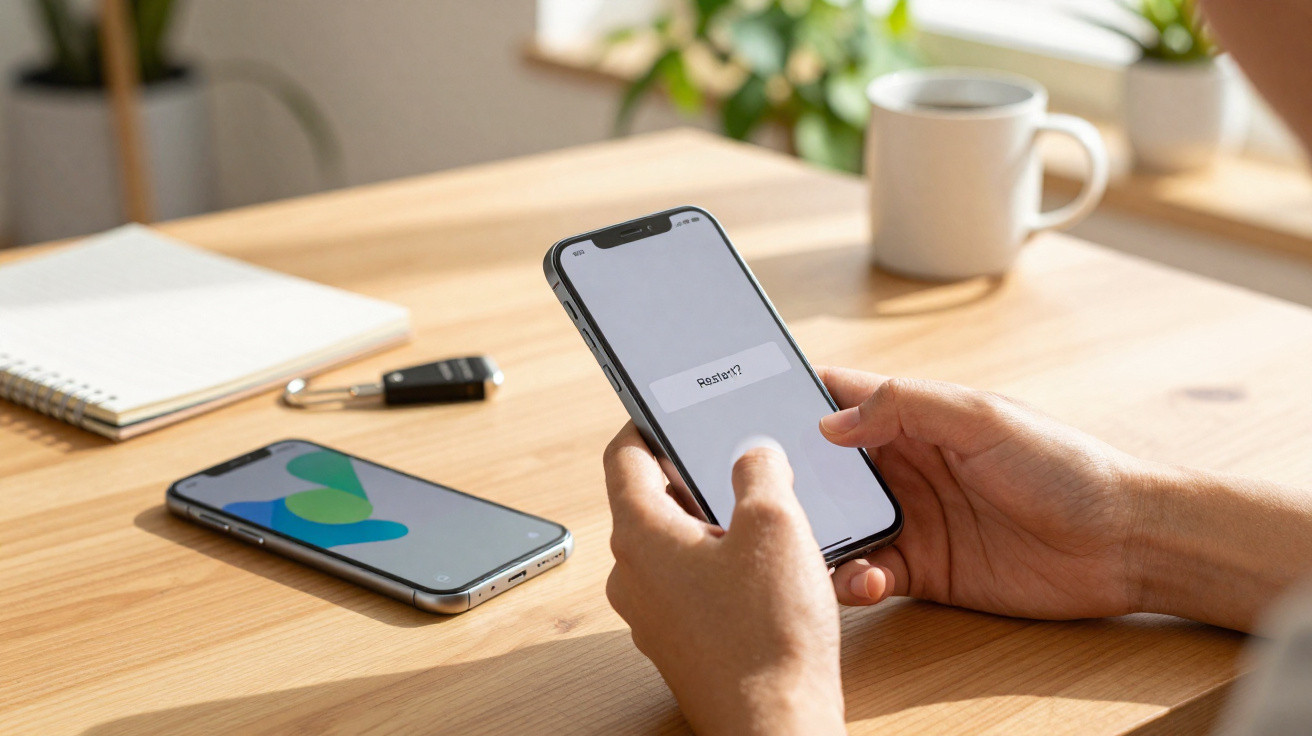
The notification appears just as you are drifting off: “Software update ready to install. Restart now?”
You exhale, tap “Later”, set the phone on the bedside table and turn over. Its display shines briefly before switching off, yet the device remains very much awake: connected to the outside world, to the network and, potentially, to anyone quietly monitoring it in the background.
In windowless rooms in Washington, people are concerned about precisely that moment.
They would like you to choose restart.
And to do so often.
Why US spies now care about your phone’s power button
During the past few years, US intelligence agencies have repeatedly offered a strikingly straightforward recommendation: switch your phone off, then on again. Not very occasionally, but as a regular practice.
For iPhone and Android owners who normally charge their phones overnight without ever powering them down, it may sound rather dated-rather like being told to “blow on the cartridge” during the Nintendo era.
But for professionals whose work involves tracking hackers and foreign intelligence services, this small action has become a discreet defensive measure.
It is a basic, low-tech routine in an age of exceptionally advanced surveillance technology.
This warning did not originate with an obscure blog or a fearful Reddit discussion. It has come from organisations including the NSA and FBI, through briefings for policymakers, defence contractors, journalists and even business executives.
Their concern is known as “zero-click” and “zero-day” exploits: unseen attacks that can enter a phone without the victim ever selecting a questionable link.
One US official explained, with weary directness, that a phone may be compromised merely by receiving a specially constructed message or call from somebody who understands exactly which software weakness to exploit.
You neither notice nor feel it, but the entrance has suddenly been opened.
Why is a reboot relevant?
Many highly covert tools operate solely in a phone’s temporary RAM, meaning they can disappear without producing clear evidence. They are designed to remain unseen, rather than to be impossible to remove.
A restart clears that short-term memory.
It is not a cure for every risk, nor will it somehow cleanse a device that has already been completely compromised. However, for a substantial category of sophisticated spyware, rebooting is rather like pulling the carpet from beneath an intruder.
It is a modest routine that silently resets the environment.
How a weekly reboot became a frontline security habit
Within some US federal agencies, staff are now instructed to restart their phones at least weekly. For those in sensitive positions-intelligence, defence and diplomacy, for example-it is policy rather than simply useful advice.
A senior member of staff likened the routine to the way people once checked their home before bed: walk the dog, lock the door, reboot the phone.
The reasoning is starkly straightforward. It is impossible to patch every undiscovered vulnerability as soon as it emerges. It is possible, however, to interrupt malware that relies on remaining quietly active in memory while it watches, listens and transmits information.
Consider the Pegasus scandal: the notorious spyware created by NSO Group and deployed against politicians, activists, lawyers and journalists worldwide. Investigations found that some of these tools arrived through missed calls or invisible iMessage exploits, before remaining in phones like ghosts.
There was no pop-up, no suspicious application and no obvious warning.
Security researchers examining these attacks identified an important distinction. Some infections required persistence techniques to remain present after a reboot. Others simply stopped functioning once the phone restarted, requiring attackers to compromise the target afresh time after time.
Suddenly, the unremarkable act of switching a phone off and on appeared less like superstition and more like an obstacle attackers genuinely disliked.
For intelligence agencies, that obstacle is valuable. Each required reinfection can create additional traces, more possibilities for discovery and further opportunities to strengthen defences.
From their perspective, a weekly reboot is like clearing the stage before the bad actors have completed their performance.
That does not suggest that you are personally on a government target list. Most people never will be.
Yet tools developed for valuable targets often spread downwards: from governments to private companies, and from elite hackers to criminal groups. Technology that begins in national security can ultimately become part of everyday cybercrime.
That is why this guidance has moved beyond classified briefings and into public recommendations.
How to reboot smarter-and what not to expect from it
What does “regularly” look like in everyday life? For most people, weekly is the practical sweet spot. There is no need to restart compulsively every hour, nor should you only do it when the phone locks up during a busy day.
Attach it to something already established in your routine: Sunday evening after the washing, Friday after work or your half-awake bedtime scrolling.
On an iPhone, press and hold the side button together with a volume button, slide to switch off, wait a few seconds and then turn it on again. On Android, pressing and holding the power button will generally show restart or power-off choices.
There is nothing complicated involved: shut down properly, pause briefly, then start afresh.
The mistake is assuming this makes a phone impregnable. It does not. Rebooting is one protective layer in a world where attackers use several. Certain malware can survive a restart, reside in system partitions or re-enter through the same vulnerability if the software is never updated.
For that reason, agencies combine their reboot guidance with another repeated message: keep both the operating system and apps up to date.
Let us be realistic: almost nobody manages this without fail every day.
Some alerts are ignored, some updates are postponed and the rest are forgotten.
That is human nature. The achievable aim is not perfection, but making it more costly for somebody to enter your digital life.
The people offering this guidance understand that you are not a full-time security specialist. They also recognise that attackers commonly seek the simplest available victory.
“We’re not asking people to live like they’re in a spy movie,” one former US cyber official told me. “We’re asking them to take the steps that make them the least convenient target in the room.”
Alongside routine reboots, their informal checklist usually includes the following:
- Update iOS/Android and your main apps as soon as practical
- Use a strong screen lock (PIN, pattern, or biometric)
- Turn on automatic backups and two-factor authentication for key accounts
- Be picky with links and attachments, even from people you know
- Review which apps you’ve installed and what permissions they hold
Rebooting is the straightforward, low-effort habit that can encourage you to take the other measures a little more seriously as well.
What this small habit reveals about the phones we live inside
There is something quietly telling about the whole situation.
The world’s most powerful intelligence agencies, with budgets beyond most people’s imagination, are advising ordinary users to press the very button they use when a device simply “acts weird”.
It is a reminder that phones are no longer merely phones. They are microphones, trackers, diaries, wallets, photo libraries, workstations and confidants, all packed into a glass slab that never truly sleeps.
When so much of your life sits in one place, even pressing the power button for two seconds can become a modest act of self-defence.
The advice also removes some of cybersecurity’s technological mystique. You do not need to understand every exploit or learn every acronym to contribute to your own protection. You need several sensible habits, practised frequently enough that they become unremarkable.
We have all experienced that realisation that an entire life is contained in a device you might drop, leave on a café table or scroll through half-asleep at 2 a.m.
Perhaps that is the larger point US agencies are encouraging: not alarm or paranoia, but slightly greater awareness. Pressing “restart” is not only about resolving a glitch; it is also a quiet reminder of who ought to control that screen-and who ought not to.
| Key point | Detail | Value for the reader |
|---|---|---|
| Regular reboots disrupt some spyware | Many advanced attacks live only in RAM and vanish when the phone restarts | Gives you a simple, low-effort way to reduce invisible surveillance risks |
| Weekly rhythm is a realistic target | Link the reboot to an existing habit, like Sunday night or payday | Makes security feel doable without becoming an exhausting routine |
| Rebooting is just one layer of defense | Needs to be combined with updates, strong locks and cautious clicking | Helps you build a balanced, real-world security posture around your phone |













Comments
No comments yet. Be the first to comment!
Leave a Comment