
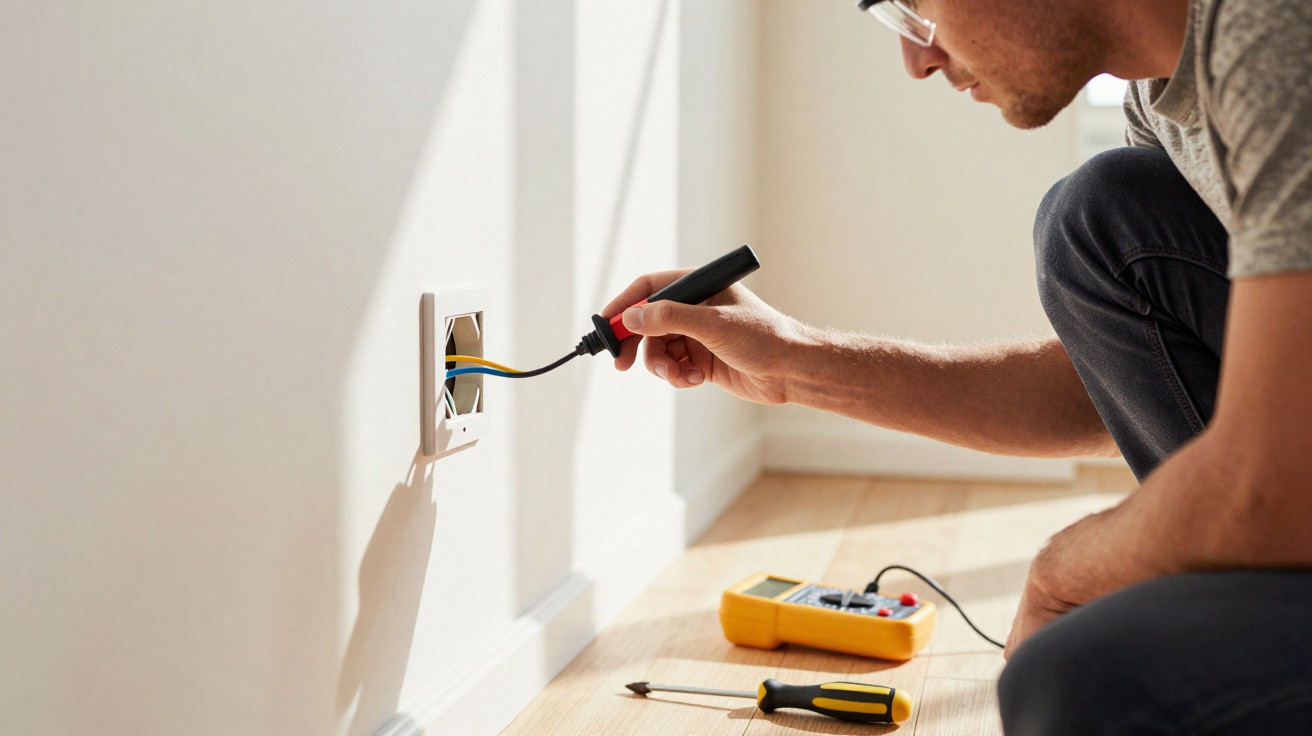
Wire colours can help you recognise different roles in an electrical installation, but they never replace proper testing. In standardised circuits, light blue indicates the neutral, green-and-yellow marks the protective conductor, and black is often used for the live (phase) conductor.
What do light blue, green-and-yellow and black mean?
Where identification is done by colour, the light-blue conductor is set aside for the neutral. It is part of the circuit and can carry current, so it must not be treated as harmless or handled without isolating the supply, testing, and using appropriate safety measures.
A green or green-and-yellow wire corresponds to the protective conductor, commonly called the earth. Its job is to provide a safety path for fault currents and to help protective devices disconnect the supply, reducing the risk of electric shock.
In general, the colours point to these functions:
- Light blue: identifies the neutral conductor when colour identification is used.
- Green: may be used exclusively to identify the protective conductor.
- Green-and-yellow: is also reserved for the earth/protective wire.
- Black: is one of the colours frequently chosen for the live (phase) conductor.
- Warning: colour on its own never proves what a wire actually does.
What is the difference between live (phase), neutral and earth?
An electrical installation brings together conductors, devices and equipment intended to distribute power. Within that system, colour coding helps professionals tell the neutral, the live (phase) conductor and the protective conductor apart during inspections and work.
Black, red, white, brown and other non-reserved colours may be used to identify live conductors, depending on the design. The live (phase) is the wire that is energised relative to earth and demands maximum care, because contact can cause a severe electric shock.
Why shouldn’t you rely only on wire colour?
Before any inspection, switch off the relevant circuit-breaker and keep other people away from the consumer unit. Even so, the switch position alone does not confirm the absence of voltage; that must be verified with suitable test equipment by a qualified person.
Switching off the circuit-breaker is only the first precaution.
The absence of voltage must be confirmed.
Older installations may have poorly labelled circuits, unexpected spurs or circuit-breakers that are connected to the wrong point.
Do not touch conductors or try to work out their functions by trial and error.
In older properties, improvised alterations or badly made joints, a colour may have been used for a different purpose than intended. For that reason, never assume a wire is safe just because of its outer sheath, and do not make connections based on assumptions.
Before any intervention, keep these warnings in mind:
- switch off the circuit-breaker for the circuit before going near any conductors;
- do not rely only on colour or the apparent position of the wires;
- do not touch exposed copper, even if the circuit-breaker seems to be off;
- do not carry out improvised tests using lamps, switches or metal objects;
- consult an electrician to identify circuits that have no standard or documentation.
What signs indicate problems with a socket?
Sockets that feel hot, smell of burning, crackle, spark or show dark marks should be taken out of use. Isolate the circuit without touching damaged parts and contact an electrician, as these signs may indicate a loose connection, overload or insulation failure.
The earth wire does not normally power the appliance; it provides protection if insulation fails. Cutting it off, removing it, or making a makeshift link to the neutral removes an important barrier to safety and can leave metal parts at voltage.
Stop using it and request an assessment if you notice:
- a socket, plug or faceplate heating up during operation;
- a burnt-plastic smell or discolouration of the socket;
- crackling, sparks or noises coming from the wall;
- a circuit-breaker tripping repeatedly with no known cause;
- loose pins or plugs that will not stay seated;
- lack of earthing confirmed by a professional assessment.
When is it necessary to call an electrician?
Anyone who has learned how to avoid mistakes when drilling a wall to hang pictures should also take hidden cables into account. Before drilling, confirm there is no wiring at that point and stop immediately if you have any doubt.
The safest summary is straightforward: light blue is usually neutral, green or green-and-yellow is protective, and black may be live (phase). However, only a professional assessment confirms a wire’s real function. Switch off the circuit-breaker, do not touch conductors, and call an electrician.






Comments
No comments yet. Be the first to comment!
Leave a Comment