
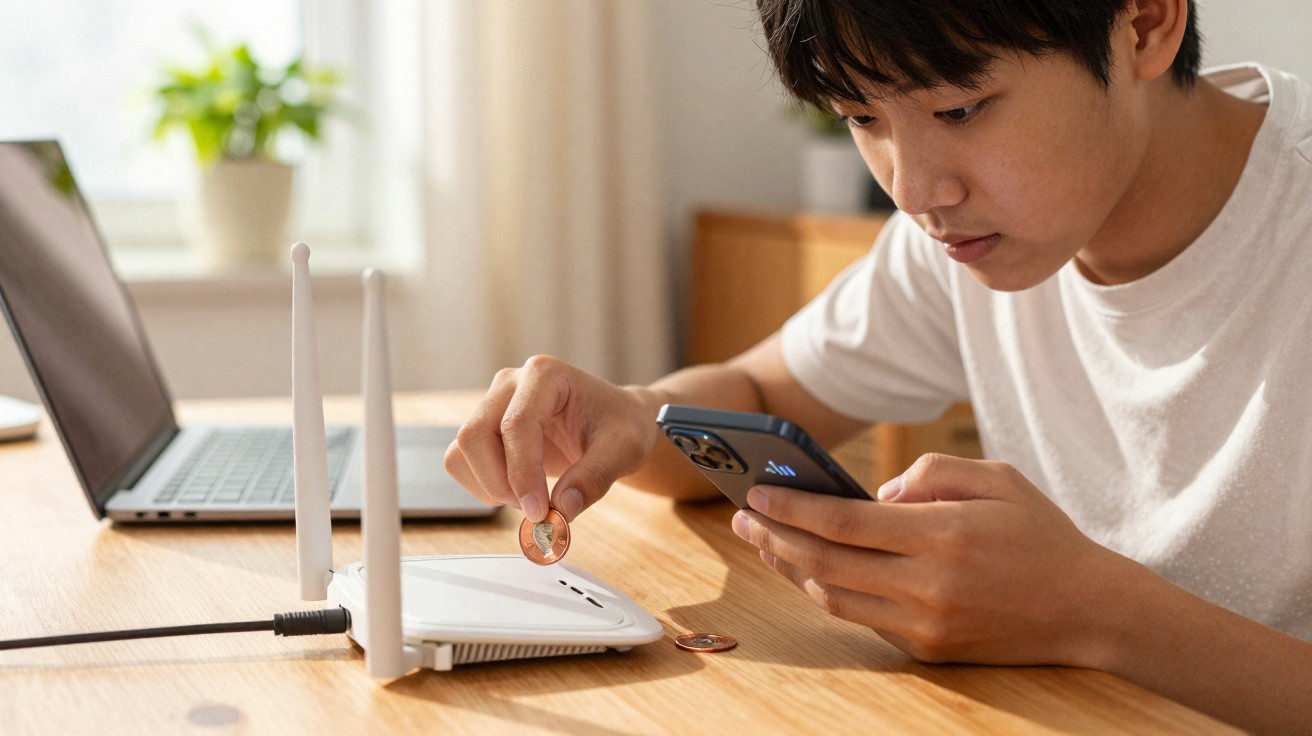
Placing a coin on top of the Wi‑Fi router is a widely shared tip that claims to aim the signal towards parts of the home where the connection is weak. The theory leans on the fact that metals can reflect electromagnetic waves, but an everyday coin is far too small to deliver a consistent, predictable improvement in wireless range.
Why do people recommend putting a coin on the router?
This suggestion comes from linking “metal” with the reflectors used in antenna systems. Because a coin has a metallic surface, some assume it can slightly change the direction of a fraction of the waves the router emits, concentrating them towards a particular spot in the house.
- It supposedly directs the signal towards a specific area;
- It might reduce drop-outs in a nearby room;
- It would not require any changes to network settings;
- It is an easy, no-cost experiment;
- It lets you try different placements on the device.
Can a coin change the Wi‑Fi signal?
Metal objects can, in fact, reflect, block, or scatter radio waves. For that reason, a coin placed near the antenna may slightly disturb the signal field, making the connection seem better in one location and worse in another.
The catch is that you cannot control this effect simply by resting a coin on the router. What happens depends on the frequency being used, the shape and placement of the antennas, where the router sits, and what obstacles exist around it. So while the trick can be tried, it does not work as a reliable booster.
How to test the trick without damaging the router
A coin should never block ventilation slots or sit near electrical connections. If someone wants to try it, they should choose a flat, unobstructed part of the casing, measure performance before and after, and remove the coin if the device starts to run hot.
- Check where the ventilation openings are;
- Do not place the coin touching any connectors;
- Always test from the same spot in the room;
- Compare speed, stability, and signal strength;
- Remove the coin if there is no noticeable improvement;
- Do not stack several coins on the equipment.
Why do some people notice an improvement in connection?
Even a small change in the position of a phone, the router, or the antennas can alter how the signal reaches a device. As a result, when someone places the coin and runs another test, they may record higher speeds even if the coin was not the real reason.
Fluctuations from the internet provider, the number of connected devices, and short-lived interference can also affect the outcome. That is why a single test is not enough to prove that the coin improved the network.
What is the most effective way to extend Wi‑Fi coverage?
The coin trick is often promoted as a quick experiment, but the more dependable options still involve placing the router in a central, elevated position with as few obstructions as possible. It also helps to keep it away from large metal surfaces, microwave ovens, aquariums, and very thick walls.
If the home is large or has multiple floors, mesh systems, access points, and wired connections deliver far more predictable results. A coin may slightly alter the signal under certain conditions, but it does not replace hardware designed to expand Wi‑Fi coverage.





Comments
No comments yet. Be the first to comment!
Leave a Comment