
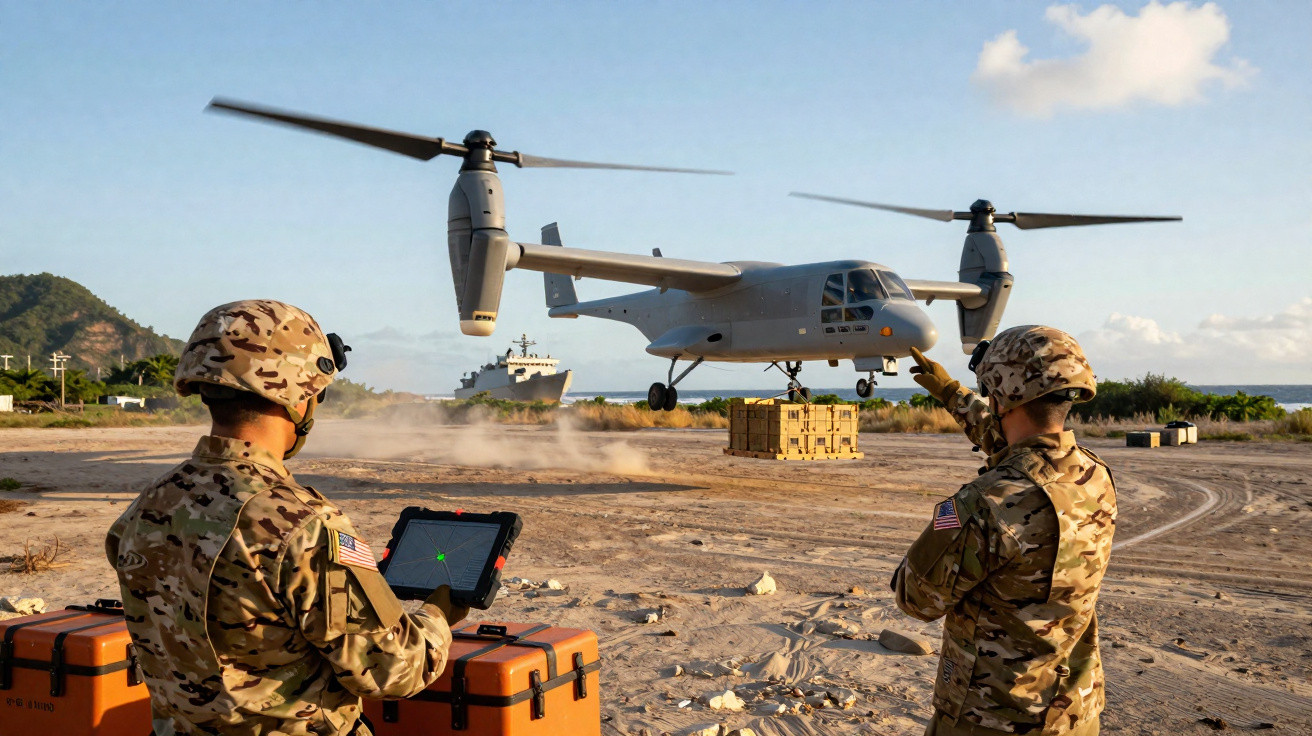
Airbus MQ-72C Logistics Connector for the US Marine Corps (USMC)
Airbus is working on the MQ-72C Logistics Connector for the US Marine Corps (USMC). In practical terms, the Logistics Connector is a drone helicopter: an autonomous vertical take-off and landing (VTOL) uncrewed aerial system (UAS) designed to move sizeable loads. That sort of lift can be crucial for armed forces that need to push equipment into contested areas or anywhere resupply by road is difficult.
Zona Militar spoke with Carl Forsling, Senior Business Development Manager for Airbus U.S. Space & Defense, about where the effort is heading and why militaries across Latin America should be watching it closely.
Programme timeline, award, and recent demonstrations
Although the initiative is still at an early stage, Airbus says the pace is quick. In May 2024, Airbus Naval Air Systems Command (NAVAIR) awarded Airbus a Phase I Other Transaction Authority (OTA) through the Naval Aviation Systems Consortium, based on Airbus’s uncrewed UH-72 Logistics Connector concept-derived from the UH-72 Lakota helicopter.
Forsling said Airbus has been chosen for rapid prototyping within the military acquisition process, adding that “the objective is to, in 60 months or less, develop a mature capability and turn it into a capability ready to be fielded.”
Airbus has already run demonstrations and plans additional events next year. The first demonstration took place in October 2024 at Marine Corps Air Station New River and Marine Corps Base Camp Lejeune. Another, more recent, demonstration was held this past May at Marine Corps Air Station Yuma.
Team Lakota Connector partners and autonomy testing
The work is being delivered through a collaborative set-up. Airbus is supplying the Logistics Connector airframe, built around the company’s H145/UH-72 helicopter. For autonomy and other key subsystems, Airbus is partnering with well-known defence firms: L3Harris, Shield AI, and Parry Labs.
A few months ago, Team Lakota Connector carried out the first autonomous helicopter test flight using Shield AI’s Hivemind autonomy package. That trial took place in Grand Prairie, Texas. Airbus confirms that a second autonomous test has already been completed.
Multiple mission-capabilities
The Connector’s core purpose is moving supplies across multiple operating scenarios-ship-to-ship, ship-to-shore, and into contested points on the battlefield. The baseline configuration displayed at recent defence events in Washington, DC, featured openings from the nose, the sides, or the rear, with internal rollers intended to speed up cargo handling and recovery.
Forsling explained that the aircraft can move “a couple thousand pounds of whatever you want to bring to the battle space,” including ammunition, food, and general supplies, as well as loitering munitions, missiles, and other systems (roughly 900 kg). He also told Zona Militar that, during one of the demonstrations, “we provided a cargo mockup with the basic frame that mimics the loading mechanism of the Lakota, so that Marines can practice loading and unloading cargo.”
Beyond logistics, Airbus is looking at further roles for the Connector, including search and recovery and medical evacuation. Forsling added that operating multiple Connectors could also support command and control (C2) by carrying C2 systems, sensors, and radars-extending network coverage and strengthening surveillance activities.
“Transporting cargo is the driving force, but as the capability matures, the opportunities will grow. We have the digital backup to adopt new missions we haven’t thought of,” Forsling said. “The limit is the creativity of the Navy, the Marine Corps, and the operational command,” he concluded.
A technology that Latin American militaries should monitor
Even at this early stage, Forsling argues the capability is worth tracking in Latin America. South America’s geography is demanding and diverse-deserts, major mountain ranges such as the Andes, and the Amazon rainforest-so a system like the Connector could deliver supplies (food, water, equipment, ammunition) to forward locations more quickly and with less risk than relying on river routes or hazardous flight corridors.
Forsling noted that sustained US military interest is important if the capability is to mature and costs are to fall. Still, with Latin American forces showing increasing interest in drone technology-Ecuador’s Air Force has recently formed its own drone squadron, and the Colombian Army now fields a drone battalion-the Logistics Connector could, he suggested, be evaluated as a longer-term procurement prospect for the next decade. “The mission applicability is wide not just for the US marines, US Navy or US forces in the Pacific,” Forsling highlighted. He emphasised that the system’s capabilities and potential uses are broad.
The US Marines are expected to make a decision on the programme’s future in the near term, and Airbus says it remains optimistic about being chosen to continue. Looking ahead, Forsling said: “Next year we would like to start doing heavy modifications to the aircraft and deliver a more fully missionized configuration,” alongside sensor integration and ground control.





Comments
No comments yet. Be the first to comment!
Leave a Comment