
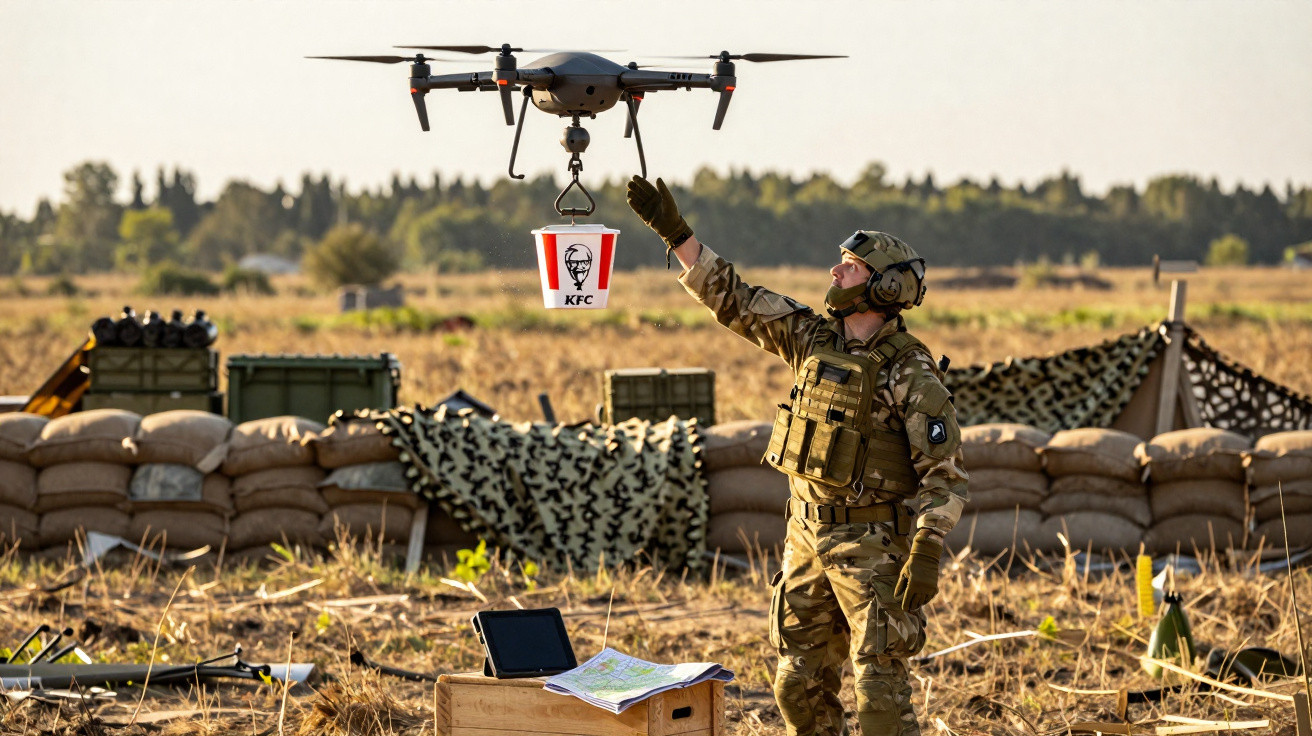
An unusual scene captured on the front line of the war between Ukraine and Russia has been widely shared on social media, drawing attention from defence and logistics specialists.
A heavy bombing drone known as the Heavy Shot-normally used to carry munitions and strike enemy positions-was repurposed to deliver a KFC meal to soldiers from Ukraine’s 3rd Special Operations Regiment. While the episode has a light-hearted edge, it also highlights how quickly unmanned air logistics are evolving in combat zones.
Footage of a Heavy Shot drone delivering KFC to the 3rd Special Operations Regiment
In a video circulated broadly by channels linked to the Ukrainian forces, the drone is seen carrying a bag resembling those used by delivery services such as Glovo and setting it down at a fortified position. The troops then unpack boxes of fried chicken and celebrate the meal, creating an unexpectedly ordinary moment amid a battlefield setting.
Heavy Shot drone capabilities and the frontline delivery mission
Built by the Ukrainian company Gurzuf Defence, the Heavy Shot was designed as a heavy bombing drone intended for night operations. It has a payload capacity of between 20 and 30 kg and an estimated range of around 20 km.
For this delivery, it carried a hot meal to an advanced location where travelling by road would have been extremely dangerous, given constant surveillance by enemy drones and exposure to Russian artillery range.
Unmanned logistics in Ukraine: supplies beyond weapons
More than a brief morale-boosting episode, the delivery points to a meaningful operational shift. Since the conflict began, large drones have been used to transport not only weapons, but also water, medicines, batteries, communications equipment, and other essential supplies to troops cut off or holding isolated positions.
Documents even indicate deliveries of electric bicycle parts, helping increase soldiers’ mobility in areas that conventional vehicles cannot reach.
The growing “kill zone” and why aerial resupply matters
As the so-called “kill zone” expands-areas where any ground movement can be quickly spotted and attacked-airborne delivery of small payloads has become a vital alternative for sustaining forward positions.
Specialists note that the conflict is accelerating logistics innovations that could later be applied in civilian settings, including deliveries to remote areas, emergency medical transport, and disaster relief support.
Using drones originally designed for combat as logistics platforms underscores the flexibility of these technologies and helps pave the way for autonomous aircraft development for the civilian market, particularly for hard-to-access operations.
Ukraine stands out as one of the world’s leading references in the military use of unmanned systems, having been among the first to create a dedicated unit focused on aerial, ground, and maritime drones.




Comments
No comments yet. Be the first to comment!
Leave a Comment