
Artificial intelligence (AI) is reshaping everyday life. It speeds up searching, supports learning, and makes it easier to stay connected. Yet there is a less visible side to this progress.
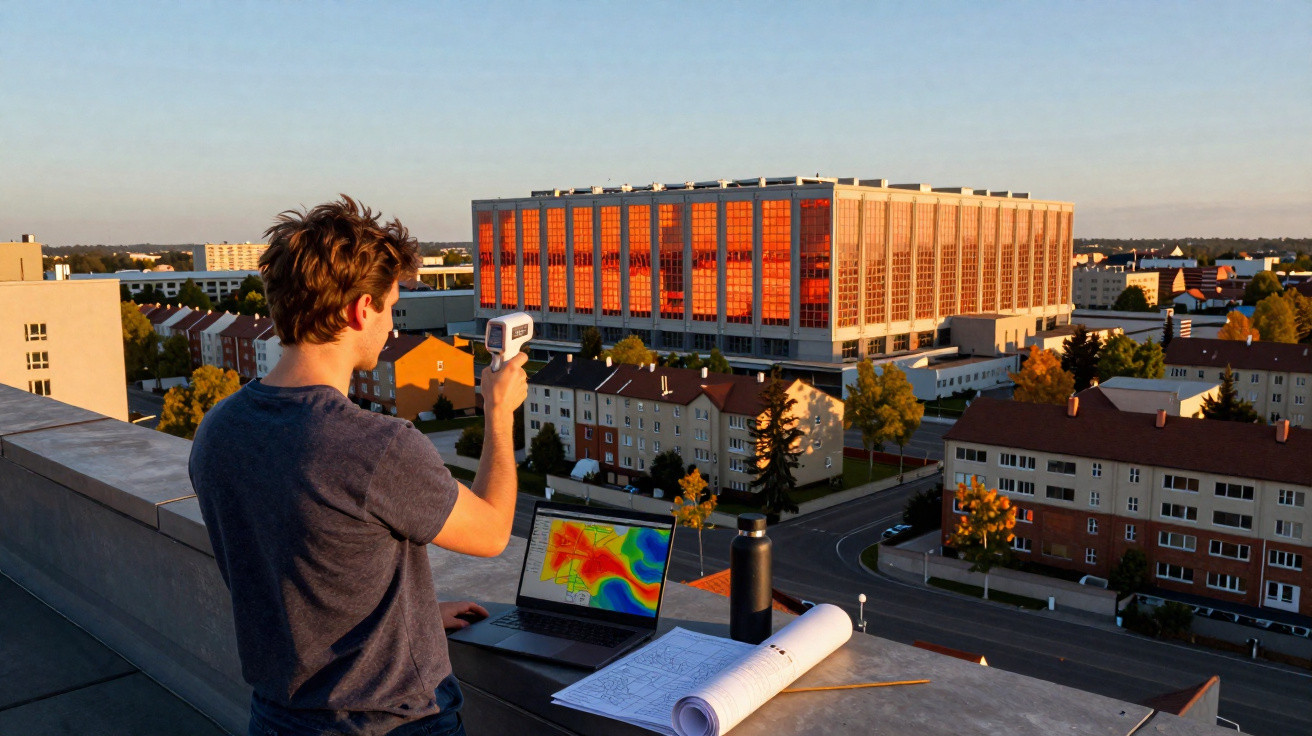
Around the world, vast facilities packed with high-powered computers run around the clock, and the heat they generate can warm the land beyond their walls.
The rapid growth of AI systems
AI is developing at pace, and organisations are chasing ever more computing power to run increasingly advanced tools. To satisfy that demand, companies are scaling up data centre infrastructure across the globe.
A data centre is typically a large building filled with thousands of computers operating non-stop. Property firm JLL reports that the number of these sites could double between 2025 and 2030.
This expansion helps push technology forward, but it also introduces a growing concern. Data centres draw huge amounts of electricity, and much of that energy ultimately becomes heat.
Crucially, the warmth is not contained indoors. It gradually disperses into the surrounding ground and air, lifting land temperatures in nearby areas.
A new type of heat effect
Researchers refer to this phenomenon as the data-heat-island effect. It echoes the way urban areas often feel warmer than rural villages: buildings and roads in towns retain heat, while in data centres, the machinery plays a similar role.
A team at the University of Cambridge examined the effect and found that once a data centre begins operating, the land close by becomes measurably warmer.
On average, the increase is about 2°C (3.6°F). In some locations, it is far higher, rising to above 9°C (16.2°F) - a striking change linked to a single source.
Even modest warming of the land can matter. It can alter how an area feels and influence the way people go about their lives.
A clear pattern emerges
Rather than visiting each site in person, scientists relied on satellites that estimate land surface temperatures from space.
They analysed records spanning the past 20 years and then aligned those temperature readings with the locations of thousands of data centres.
To avoid confusing the results, the researchers excluded busy cities that have many overlapping sources of heat. That decision helped isolate the specific impact associated with data centres.
What emerged was consistent: after a data centre came online, the surrounding land warmed.
Heat spreads far away
The study indicates that the warming is not confined to the immediate vicinity of the building; it can extend outward.
In some instances, the influence reaches as far as 10 kilometres (6.2 miles). Even at that distance, the land remains warmer than it was previously.
At roughly 7 kilometres (4.3 miles), the effect is still pronounced and only drops slightly. As a result, large areas can experience the change.
Real places show the impact
Evidence of this shift is already apparent in certain regions. Parts of Mexico and Spain have recorded unusual temperature increases.
These areas host many data centres and, over time, their temperatures have climbed by about 2°C (3.6°F).
The pattern does not line up with typical climate variations, which suggests data centres may be contributing. Comparable trends have also been observed in parts of Brazil.
Millions of people are affected
The issue is not limited to land temperatures. Many people live close to these facilities, often without realising what is nearby.
More than 340 million people live within 10 kilometres (6.2 miles) of a data centre, meaning entire communities sit within the reach of this effect.
For many residents, conditions may already be slightly warmer. The difference can be subtle, but it is present.
That extra warmth can shape day-to-day life: homes may require more cooling, electricity demand can increase, and over time, higher temperatures can affect comfort and health in ways that are difficult to dismiss.
Why data centres produce heat
Inside a data centre, thousands of computers are active every second, processing large volumes of data continuously.
All of that computation generates heat. Cooling systems work intensively to manage it, but they cannot capture everything.
Some warmth escapes and disperses into the nearby environment. With time, the heat can accumulate.
There is an added complication: not all the energy consumed is converted into useful computing. A significant portion becomes heat instead.
As AI keeps expanding, these systems will require still more power - and that means more heat as well.
Ways to reduce the heat
There are practical options, and efforts are already under way. One straightforward approach is to improve the efficiency of AI systems: less energy use means less heat produced.
Cooling technology is advancing too. Some facilities now use liquid cooling rather than air because it removes heat more quickly. In addition, specialised materials can help buildings retain less warmth.
Energy can also be managed more carefully. For example, systems can operate at reduced power when demand is low, cutting waste and limiting heat output.
Design choices matter as well. Better planning and smarter building design can reduce the overall data-heat-island effect.






Comments
No comments yet. Be the first to comment!
Leave a Comment