
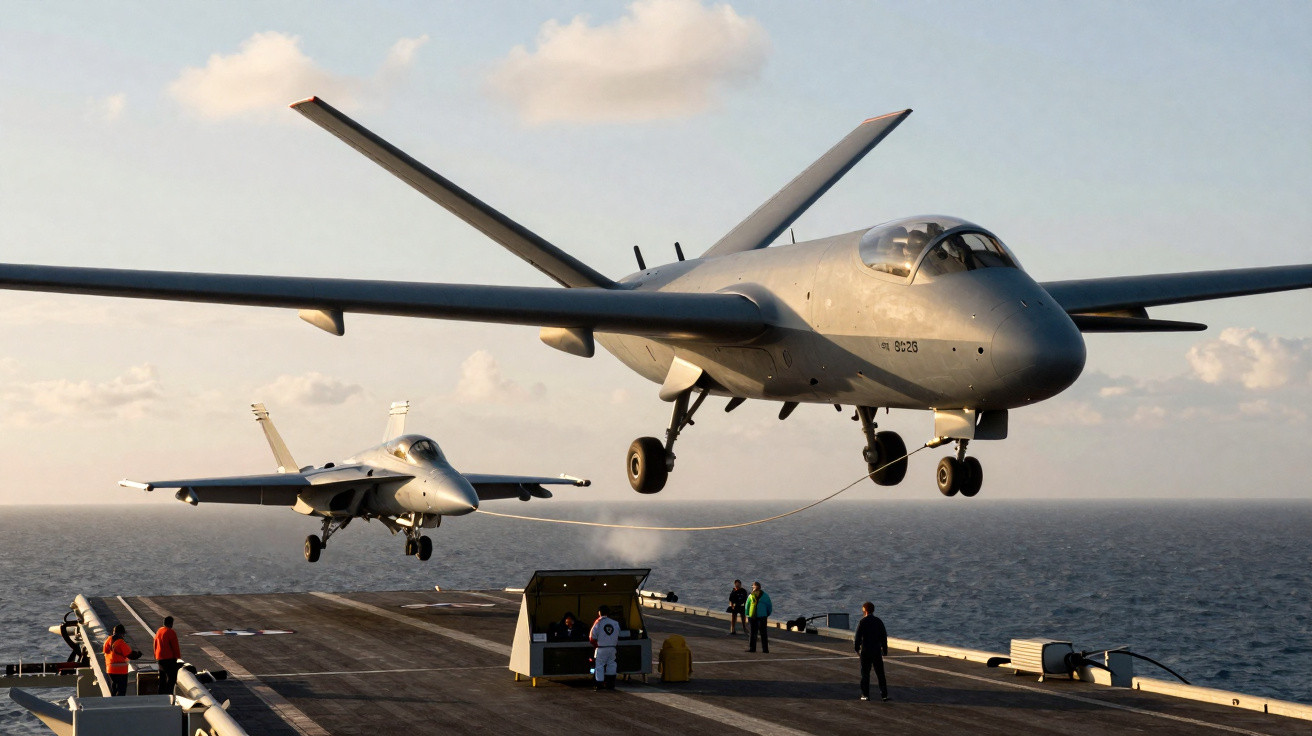
Second MQ-25A Stingray test flight from MidAmerica St. Louis Airport
The US Navy’s future MQ-25A Stingray aerial refuelling drone has successfully carried out its second test flight from MidAmerica St. Louis Airport in Mascoutah, Illinois, Boeing Defence confirmed in an official statement. The achievement strengthens the programme’s momentum after years of accumulated delays and marks another step towards operational service for the first uncrewed aerial refuelling platform in the history of US naval aviation. The Navy has described the system as the “scout” intended to lay the groundwork for the carrier air wings of the future.
How the autonomous UCAMS control set-up worked
Boeing reported that the sortie was flown autonomously, with company and US Navy vehicle pilots sending commands from the MD-5 Ground Control Station of the Unmanned Carrier Aviation Mission Control System (UCAMS). In the same vein, the aircraft autonomously managed propulsion, subsystems, guidance and flight controls needed to conduct operations with the landing gear both extended and retracted.
The flight also included three landing cycles and a fresh software load, featuring updates to the vehicle management system and the mission computer, intended to support upcoming flights that will expand the aircraft’s flight envelope.
Programme delays, milestones and costs
The wider context makes this second flight particularly significant. As previously recorded, the MQ-25A’s first flight took place on 25 April 2026, following repeated slips that pushed the start of flight testing throughout 2025. By late 2025, the Navy confirmed that the first flight had moved into early 2026 after the team completed an extended run of ground tests and system certifications. Prior to that initial flight, the programme had already finished structural testing, initial engine runs, flight software certification and autonomous taxi trials from Boeing’s production site in Mascoutah to the MidAmerica Airport runway.
The MQ-25A’s delay history is extensive. The effort grew out of earlier Navy carrier-based uncrewed aviation work, including the X-47B demonstrator and the cancelled UCLASS concept, before the service narrowed the requirement to a carrier-based tanker under the CBARS programme. In 2018, Boeing received an $805 million contract for four engineering development aircraft, while the company-owned T1 test aircraft first flew in September 2019 and later demonstrated aerial refuelling with an F/A-18 Super Hornet, an E-2D Hawkeye and an F-35C. Even so, initial operational capability-originally planned for 2025-has been deferred to 2029 according to Navy budget documents, with the first carrier deployment no longer expected in the near term due to delays tied to carrier availability and production.
Despite that record, 2026 has brought tangible progress. In May, the Navy announced the MQ-25A received the Pentagon’s Milestone C approval, formally entering the low-rate initial production (LRIP) phase. A Lot 1 contract for three aircraft is expected in summer 2026 and includes priced options for Lot 2 (3 aircraft) and Lot 3 (5 aircraft). The overall MQ-25A programme is estimated at $15.900 billion, with an approximate unit cost of $209 million, according to a Government Accountability Office (GAO) report published in June 2025.
As Zona Militar also noted, in late June the MQ-25A was embarked for the first time aboard the nuclear-powered aircraft carrier USS Nimitz (CVN-68), offering a visual preview of the role it will play within Navy carrier strike groups.
Carrier integration and planned capability
The MQ-25A is designed to operate out to 500 nautical miles (about 930 km) from the carrier while carrying roughly 15,000 lb (about 6,800 kg) of fuel, freeing F/A-18 Super Hornets from the tanker mission that currently accounts for between 20% and 30% of sorties across that fleet. In size, the aircraft is comparable to an F/A-18 in length and to an E-2 Hawkeye in wingspan, underlining the scale of the carrier-integration challenge. The aircraft carriers USS George H.W. Bush, USS Carl Vinson and USS Theodore Roosevelt are already being modified to accept the UCAMS ground control system that will operate embarked Stingray aircraft.





Comments
No comments yet. Be the first to comment!
Leave a Comment