
The sharp, staccato buzz from a rattlesnake’s tail is among the easiest warning sounds in the natural world to recognise. For plenty of animals, that noise alone is enough to make them stop in their tracks, retreat, or leave the vicinity.
What makes the rattle so persuasive? New research from the University of Texas at El Paso indicates that the sound functions as a highly effective, naturally occurring alarm.
The team found that a wide range of animals respond straight away to a rattlesnake rattle, even when they have never previously come across the snake.
The pattern appears to go beyond learning. Species that would naturally live in areas shared with rattlesnakes reacted more intensely, pointing to the likelihood that evolution has influenced how animals interpret this well-known warning signal.
The rattlesnake’s famous rattle
In the animal kingdom, the rattlesnake’s rattle stands out as an unusually distinctive signal. It is found only in rattlesnakes within the Crotalus and Sistrurus groups. The structure consists of hollow keratin segments that sit loosely together at the tip of the tail.
When the snake rapidly flicks its tail, those segments knock against one another, producing the familiar buzzing rattle.
For years, biologists have debated why the trait emerged. Some have proposed it could assist with luring prey, while others have argued it primarily functions as a warning that deters other animals.
To examine this second explanation, the new study focused on how different animals behaved when they were exposed to the rattling sound.
Building a robotic rattlesnake
The project was led by Dr. Océane Da Cunha at The University of Texas at El Paso. Rather than relying on live snakes, the researchers constructed a robotic rattlesnake designed to resemble - and act like - a real one.
Using a 3D printer at Fab Lab El Paso, engineers produced a model that replicated the defensive stance of a western diamondback rattlesnake (Crotalus atrox). To keep the audio authentic, the team fixed real rattles from deceased snakes to the robot’s tail.
A vibration motor concealed inside the body made the rattle shake whenever researchers triggered it with a remote control. This approach let the scientists present a realistic warning display while keeping the tests safe.
Zoo animals tested with robot
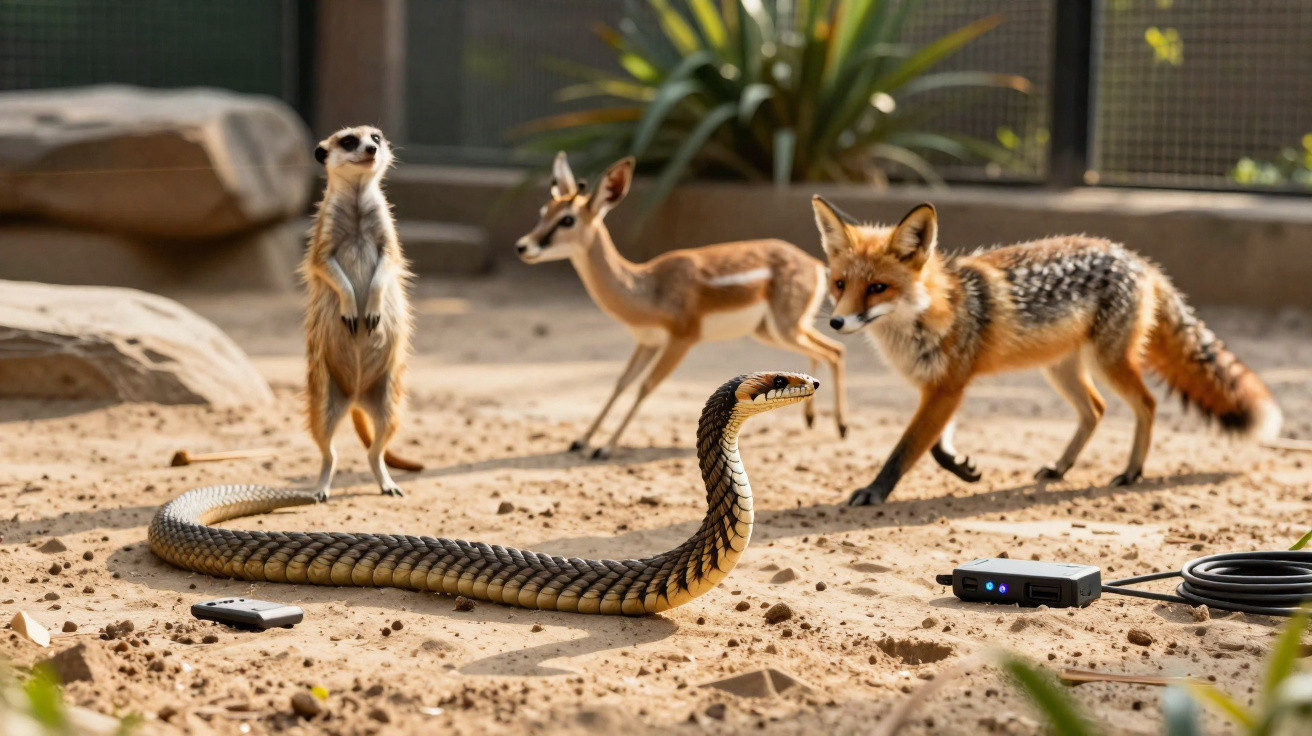
Trials were carried out at the El Paso Zoo in Texas. In total, the researchers observed 38 zoo-housed species, spanning mammals, birds and other forms of wildlife.
Each animal experienced three separate scenarios. First, food was placed in the enclosure with no snake model present.
Second, the robotic snake was positioned near the food but did not make any sound.
Third, the robot appeared again and, when the animal moved close, it produced the rattling noise.
The team filmed and assessed the responses using a four-level ranking system: no reaction, caution, surprise, or a rapid withdrawal from the area.
Animals react strongly to rattling
The results followed a consistent trend. When the rattle sounded, animals showed noticeably stronger fear-related reactions.
Some individuals paused and delayed approaching the food. Others abandoned the food and backed away. In many instances, the rattle prompted animals to move off quickly.
The silent model alone still generated a degree of wariness in some species. Even so, the combination of the visible snake model with the rattling audio produced the most pronounced responses.
Overall, the findings indicate that the full rattling display can alter how animals judge risk in their surroundings.
Animals show natural fear
One of the more striking outcomes came from the animals’ lack of prior experience. Every subject lived in captivity and had little to no contact with rattlesnakes. Yet, once the rattling began, many species still reacted in ways consistent with fear.
“These results suggest the rattlesnake rattle serves a dual purpose,” said Dr. Da Cunha. “Animals with no prior exposure to rattlesnakes still reacted strongly, which supports the idea that rattling acts as a deimatic, or startle, signal.
“The amplified response in species that share their present distribution with rattlesnakes points to an evolved, innate sensitivity to the rattle.”
In other words, the sound may set off an inbuilt startle response - a sudden alarm-like cue suggesting something dangerous could be nearby.
Animals near rattlesnakes react more
The researchers also contrasted species that naturally occur in areas with rattlesnakes against those from places where rattlesnakes are absent.
Animals originating from rattlesnake regions displayed stronger fear responses. In scientific terms, these are sympatric species, meaning their ranges overlap with rattlesnakes; those from non-overlapping regions are described as allopatric.
Given that the zoo animals were captive-bred and raised, the heightened sensitivity in sympatric species is more likely to reflect evolutionary pressures than individual learning. Over many generations, animals living alongside rattlesnakes may have developed an innate responsiveness to the rattle.
Snake uses many warning signals
A rattlesnake’s warning display is not limited to sound alone. When it feels threatened, the snake lifts its body, shakes its tail and produces the rattle.
Scientists refer to this as a multimodal display because it communicates through several senses at the same time. The audible buzz, the visible tail movement and the defensive posture reinforce one another to make the warning more compelling.
In nature, such combined signals are common where animals must convey danger rapidly.
Rattle evolved from tail shaking
Researchers think the modern rattle likely developed from a simpler behaviour seen across many snake species: rapid tail shaking when threatened. Over time, rattlesnakes evolved specialised tail segments, which turned that movement into the loud buzzing sound heard today.
The earliest form may have worked mainly as a startle display to deter predators. Later, it appears to have become a clearer warning that the snake is venomous.
“This research is an effective demonstration of scientific creativity and interdisciplinary innovation,” said Dr. Liz Walsh, the interim dean of the College of Science at the University of Texas at El Paso.
“Their findings not only illuminate rattlesnake behavior but also contribute broadly to our knowledge of animal communication and predator-prey interactions.”
Studying fear and warning signals
Taken together, the study supports the idea that the rattlesnake’s rattle operates as a powerful warning signal, helping both snakes and other animals avoid risky confrontations.
It also opens up further lines of enquiry about behaviour: how fear responses form, and how quickly these kinds of instincts can evolve.
Future work may also test which elements of the display have the greatest influence. The sound, the tail movement and the defensive posture may each contribute in distinct ways to the reactions researchers observed.





Comments
No comments yet. Be the first to comment!
Leave a Comment