
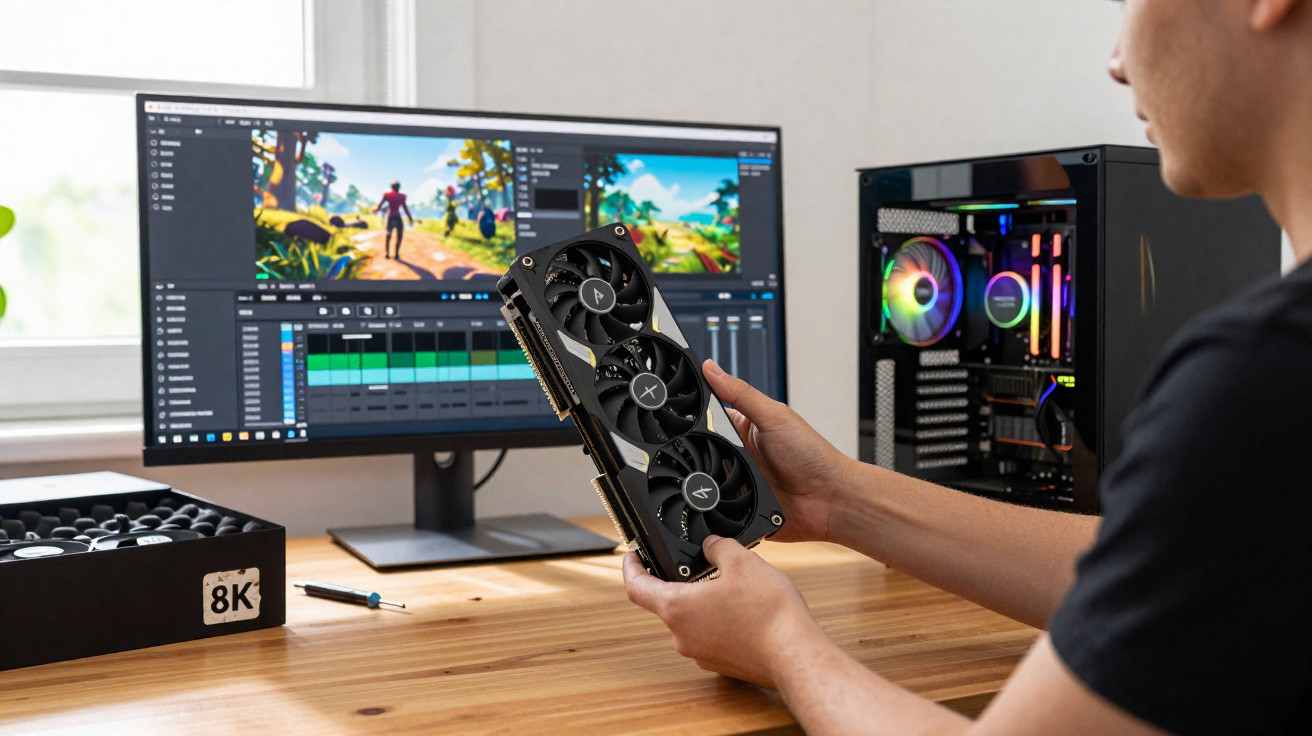
Until now, anyone trying to prepare a PC for today’s blockbuster games in 4K has usually had to spend heavily on a top-tier graphics card. With a deal that undercuts anything previously seen, one of the most interesting GPUs in NVIDIA’s new generation-the Gigabyte GeForce RTX 5070 Ti-suddenly moves much closer to what many players consider just about affordable. Content creators, too, may want to take a closer look.
Historic low price for the RTX 5070 Ti
The Gigabyte GeForce RTX 5070 Ti is widely viewed as an upper-class option for demanding gaming rigs and creative workstations. Under normal conditions, it sits firmly in the premium bracket-both in performance and in cost. As part of a current promotion, a major online retailer is listing it for 849,43 euros, which the seller describes as a historic lowest price for this exact model.
"Gigabyte’s RTX 5070 Ti drops to 849,43 euros-a record price for a graphics card clearly aimed at 4K gaming and creative workloads."
In practice, these discount windows rarely stay open for long. With a fresh generation like the RTX 50 series, prices often climb again once the first batch of deals sells out. If you were planning a significant upgrade anyway, it’s worth giving your system a quick once-over now: is the power supply strong enough, is there adequate case clearance, and do your monitors have the right connections?
RTX 5070 Ti: upper-class performance for Ultra HD fans
With its RTX 50 architecture, NVIDIA is pushing the next step in resolution, ray tracing and AI support. Gigabyte’s RTX 5070 Ti is aimed squarely at people who no longer want to stop at 1440p, and instead want to play in 4K with high detail settings and stable frame rates.
This card is clearly targeted at three groups:
- ambitious gamers focused on 4K and high graphics settings,
- streamers and content creators who rely on GPU-accelerated tools,
- PC users with older high-end cards (e.g. RTX 20 series or early RTX 30 series) who want noticeably more headroom.
In modern AAA titles with heavy ray tracing, older GPUs can run into their limits quickly. If you want to play, for example, Cyberpunk 2077, Alan Wake 2, or upcoming open-world games in 4K with effects enabled, the RTX 5070 Ti provides a far more future-ready foundation.
Technical specifications of the Gigabyte RTX 5070 Ti
A look at the specs makes it clear why this card is marketed so aggressively for Ultra HD:
| Component | Technical data |
|---|---|
| GPU | NVIDIA GeForce RTX 5070 Ti |
| CUDA cores | 8.960 |
| Video memory | 16 GB GDDR7 |
| Memory clock | 28 Gbps |
| Memory interface | 256 Bit |
| Boost clock | 2.497 MHz |
| Cooling | WINDFORCE 3X, three 80-mm fans |
| Slot | PCI Express 5.0 |
| Maximum resolution | 8K (7.680 x 4.320) |
| Connections | 3x DisplayPort 2.1b, 1x HDMI 2.1b |
| Recommended PSU | 750 W, 16-Pin power connector |
| Dimensions | 261 x 126 x 50 mm |
With 8.960 CUDA cores, the card offers ample compute power for traditional raster graphics, ray tracing and AI workloads. The 2.497 MHz boost clock sits slightly above the reference level and, paired with the new GDDR7 memory technology, leaves plenty of room for high resolutions.
Fast GDDR7 memory and powerful cooling
The move to GDDR7 is a defining feature of the RTX 50 generation. The 16 GB not only provides generous space for high-resolution textures; thanks to 28 Gbps speeds combined with a 256-Bit interface, available memory bandwidth rises significantly. That helps directly in scenes packed with objects, large open worlds and ray-tracing effects.
To keep that performance available consistently, Gigabyte uses its WINDFORCE 3X cooling system. Three 80-mm fans, a large heatsink and heatpipes are designed to keep the GPU under control even during sustained loads. In everyday use, that typically translates into lower temperatures, less frequent throttling, and-across many scenarios-a quieter sound profile than simpler cooling designs.
"If you want to play in 4K with ray tracing, you need not only raw GPU power, but also cooling that keeps clocks stable for hours."
Case planning matters: at 261 millimetres long, this isn’t a small card. In compact mid-tower cases, space can become tight-especially if a front-mounted radiator or multiple intake fans are installed.
Strong performance in games and creative applications
In day-to-day gaming, the RTX 5070 Ti primarily caters to players who have outgrown 1440p. At that resolution it has substantial reserves, and in many esports titles it can readily push very high triple-digit frame rates. In 4K, the focus shifts to high-to-maximum settings, including ray tracing-where AI features become particularly relevant.
DLSS 4 and Reflex 2 in focus
NVIDIA DLSS 4 renders games internally at a lower resolution and then uses AI to upscale the image. The result is a noticeable boost in frame rates while the picture remains sharp. In 4K especially, it can feel like you have fitted an even more powerful GPU.
NVIDIA Reflex 2 reduces system latency, so mouse or controller inputs appear on screen more quickly. For shooter players, battle royale fans and anyone playing competitively, millisecond-level responsiveness can decide who lands the first hit.
If you create content alongside gaming, you can benefit from RTX AI integration: video editing, effects work, 3D rendering or AI-assisted workflows can be accelerated on the GPU. The 16 GB of VRAM provides enough buffer for complex scenes or high-resolution timelines without projects constantly needing to offload.
What upgraders should check before buying
Before jumping on the deal, a quick hardware check is sensible. The key points are easy to run through like a checklist:
- Power supply: At least 750 Watt is recommended, including a 16-Pin power connector (or an adapter). Older PSUs can hit their limits here.
- Case size: 261 mm length, 50 mm thickness-measure compact cases to ensure drive cages or front fans aren’t in the way.
- Motherboard: A PCIe x16 slot is sufficient, ideally on a modern platform so the card isn’t held back by a CPU that’s too weak.
- Monitors: To make the most of 4K and high frame rates, you’ll need suitable displays with HDMI 2.1 or a current DisplayPort standard.
The card can drive up to four displays. That makes it appealing for streamers who keep a game, chat, recording software and a browser open at the same time, as well as for creative users running wide multi-monitor setups.
What does 8K support mean in practice?
On the spec sheet, the maximum 8K resolution stands out. In reality, most users are still playing at 1440p or 4K because suitable 8K monitors are rare and very expensive. In this context, 8K support is more of a signal that there is sufficient connection bandwidth and computing capability for very high-resolution displays or future scenarios.
What tends to matter more day to day is high refresh in 4K, such as 120 or 144 Hz. This is where features like DLSS 4 can help by easing GPU load while still delivering an exceptionally smooth image.
Who really benefits from this deal
At this current low price, the RTX 5070 Ti is most compelling for two audiences: gamers replacing an older upper-class card, and creators struggling with increasingly complex projects. If you are still using an RTX 2070, 2080, or an early RTX 30 series card and you’re tempted by 4K resolution or ray tracing, this offers a clear performance step up along with modern AI features.
On the other hand, if you only play in Full HD and don’t run particularly demanding titles, you’re unlikely to use much of the card’s potential. In those cases, a more affordable GPU is often enough. The RTX 5070 Ti becomes truly attractive when high resolutions, ray tracing, streaming or compute-heavy applications are on the agenda-then the promotion turns into a tangible upgrade for the years ahead.






Comments
No comments yet. Be the first to comment!
Leave a Comment