
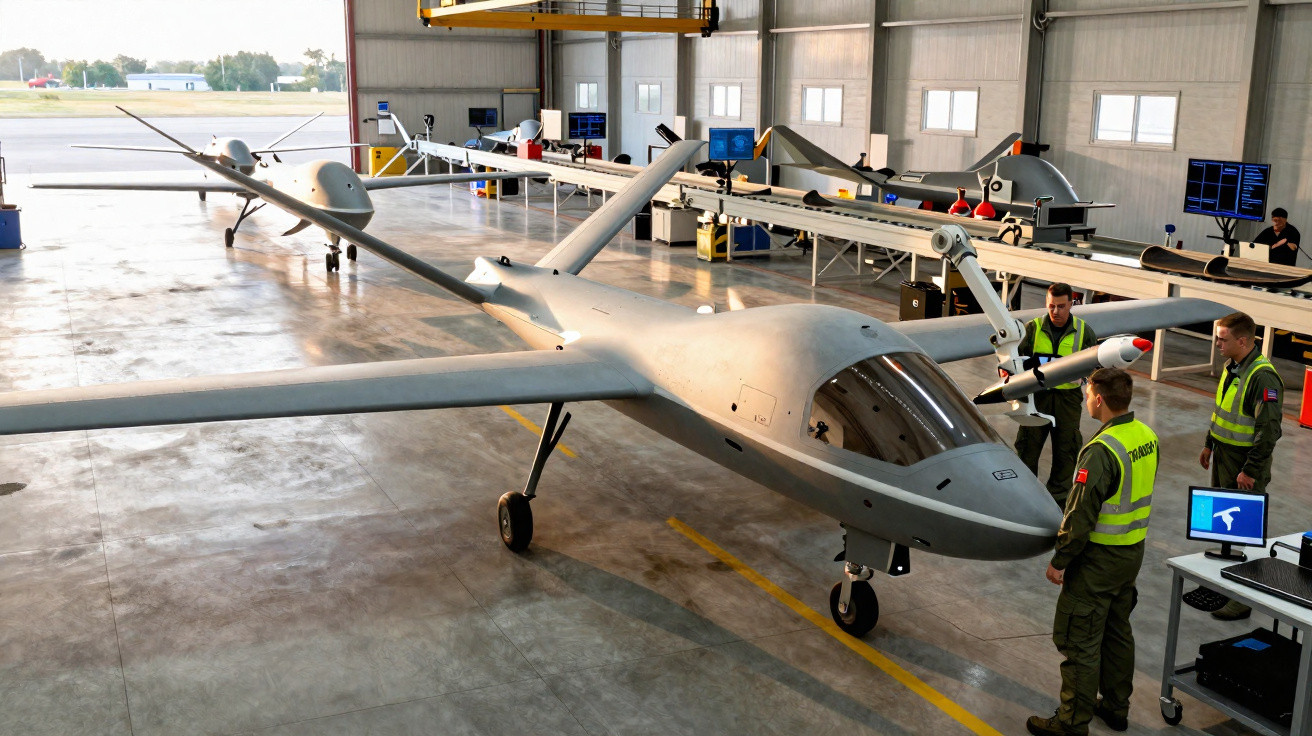
Series production gathers pace for USAF CCA combat drones
Series manufacturing of the U.S. Air Force (USAF) YFQ-42A and YFQ-44A new combat drones continues to move forward, marked by fresh industrial milestones. Anduril Industries has confirmed that the first Ohio-built YFQ-44A has rolled off its assembly line, while General Atomics has also begun producing its YFQ-42A-reinforcing a new phase of the Collaborative Combat Aircraft (Collaborative Combat Aircraft – CCA) programme.
Anduril shared the update via its official channels, stating: “557 days ago, Arsenal-1 didn’t exist. Today, the first YFQ-44A built in Ohio rolled off the production line”. With that announcement, the company effectively confirmed the start of series production for a platform intended to operate alongside crewed USAF aircraft.
Arsenal-1 accelerates the YFQ-44A manufacturing ramp
The first airframe produced at the Arsenal-1 facility in Pickaway County, Ohio, carries the state flag on its vertical stabiliser, alongside the slogan “Ohio, the birthplace of aviation”. Anduril notes that the aircraft left the line just four months after the site began operating-timing the firm presents as evidence of a scalable manufacturing approach.
After visiting the site, Ohio’s Governor also highlighted the milestone. “It was remarkable to see the first uncrewed combat aircraft built by Anduril in Ohio roll off the production line at Arsenal-1 in Pickaway County this morning. Congratulations to everyone involved in this important milestone for national defence”, the state leader said.
According to Anduril, its industrial plan is built around high-volume output enabled by straightforward designs, parts sourced through established supply chains, and manufacturing lines that can be reconfigured. The company argues that this model is intended to support sustained production of aircraft and munitions for high-intensity environments and protracted conflicts.
General Atomics begins YFQ-42A production for the USAF CCA
With Anduril’s YFQ-44A now moving through series manufacture and General Atomics starting production of the YFQ-42A, the USAF is pressing ahead with fielding a new generation of combat drones designed to fly alongside crewed fighters. Both aircraft represent the first phase of the CCA programme, aimed at expanding operational capability by integrating autonomous platforms into future air missions.
The CCA programme continues to add capability
The production start comes only weeks after both CCA designs took part, for the first time, in an Agile Combat Employment (Agile Combat Employment – ACE) exercise at Creech Air Force Base, Nevada. During the event, the Experimental Operations Unit (Experimental Operations Unit – EOU) flew multiple sorties, combined crewed and uncrewed aircraft, and ran a range of operational scenarios to keep refining programme requirements.
Flight testing and the AIM-120 AMRAAM milestone
Earlier, Anduril had indicated that the YFQ-44A entered production in late March. The drone then began flight trials with the Experimental Operations Unit at Edwards Air Force Base, California, in April, steadily widening its evaluation campaign.
Another notable step followed in mid-July, when a YFQ-44A prototype successfully carried out the first launch of an AIM-120 AMRAAM missile from Edwards Air Force Base. In that test, the Lattice autonomous system received target data and-after a human operator granted approval-conducted a Beyond Visual Range (Beyond Visual Range – BVR) engagement against a simulated target, confirming the full weapon-employment sequence.






Comments
No comments yet. Be the first to comment!
Leave a Comment