
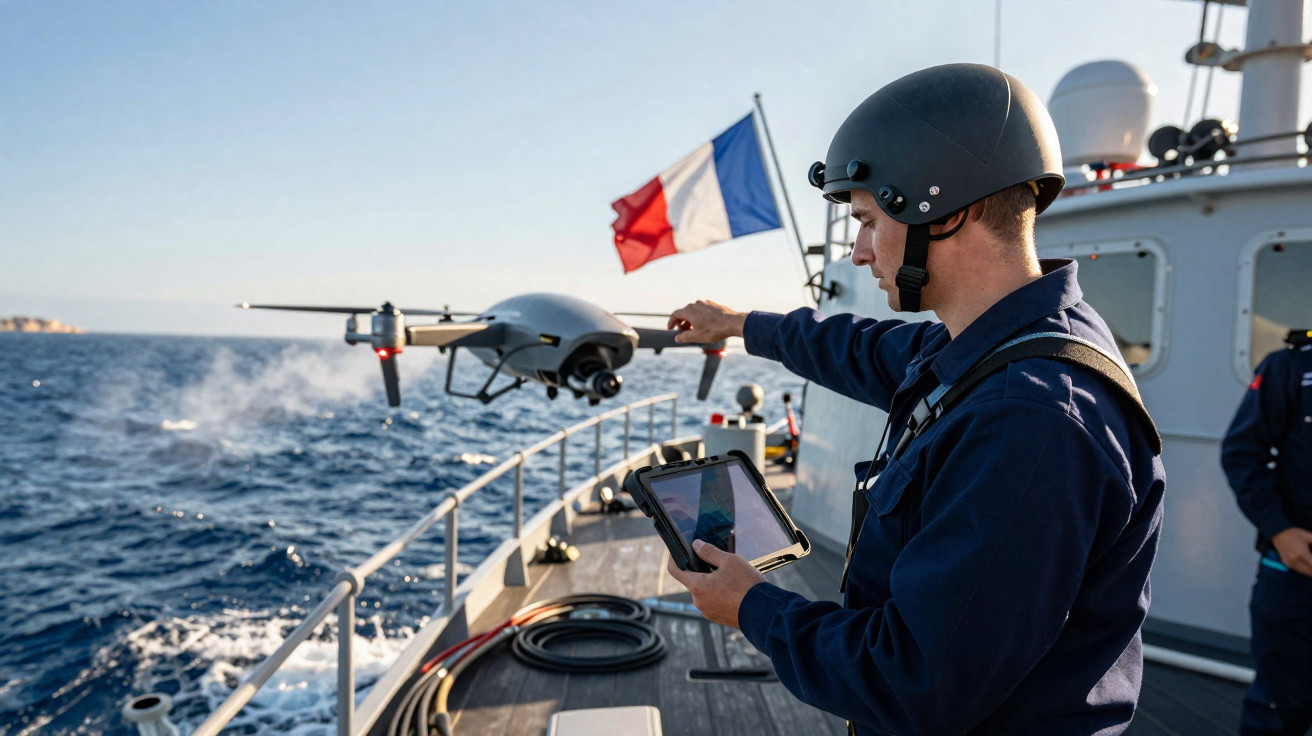
On the aft deck of a French Navy patrol ship, the wind is doing what it always does: making everything harder. The hull lurches, sea spray lashes the steelwork, and three sailors hunch over a delicate-looking mini-drone, their fingers stiff in the salty cold. In theory, this tiny aircraft should push the ship’s vision well past the horizon. In practice, every launch becomes a tense little ceremony: flimsy wings, tight timings, and a deck that refuses to stay steady for more than a heartbeat. One awkward slip and several thousand euros are gone over the side.
Now picture the same deck and the same swell, but the routine is different. One sailor steps out carrying a compact, toughened canister. There are no wings to unfold and no choreographed rush of specialists. He secures the tube, presses a button, and the drone does the rest on its own.
The Achilles’ heel is no longer the drone. It fades into the background.
A drone built for chaos, not calm seas
The French Navy has quietly begun embarking a new type of mini-drone that turns shipborne operations on their head. Rather than forcing crews to nurse a fragile UAV on a pitching deck, this system has been engineered from the outset for noise, pressure, and foul weather. It resides in a launch tube instead of a foam-lined case. It can launch and recover automatically, even while the ship is rolling and pitching.
On today’s warships, where sailors balance watchkeeping, maintenance and operational tasking, every avoided step matters. This drone was never intended for air displays; it is meant for the days when the sea ignores your plan.
With earlier mini-UAS, a flight from a small naval platform could be almost comically involved. The team might prepare the aircraft in a cramped space, inspect delicate control surfaces, carry it out by hand, then throw it into the wind at precisely the right moment and angle. Bringing it back could be worse: catch it in a net, snatch it before it skids, and hope GPS stays solid while the ship turns.
As tasking builds, crews start dropping sorties. It is not that the drone is unnecessary; it is that operating it becomes a burden. The French Navy’s new system tackles that problem directly: one sailor, one tube, a handful of checks, and an automated flight profile. That “extra eye” stops being something you save for calm conditions and becomes something you reach for instinctively.
The key leap is not some magic sensor suite or headline-grabbing range, even if overall performance is improving across the board. The change is practical: a mini-UAS that demands very little of the crew and almost no dedicated space. Ask sailors and many will admit, quietly, that equipment left unused turns into ballast. A drone that requires a team, a workspace and a strict timetable simply flies less. A drone that waits in a weatherproof canister on the rail, ready in five minutes, flies more.
More sorties translate into more overwatch during boarding operations, longer-lasting aerial awareness during rescues, and faster, clearer information during a tense approach to a suspect craft. The French Navy is not merely purchasing another piece of kit; it is gradually reshaping the everyday tempo on board.
From fragile toy to rugged tool: how the new system works at sea
The concept is straightforward: handle the drone more like a missile-only in reverse. Instead of coddling a lightweight airframe, the French Navy keeps it in a sealed canister fixed to the deck or superstructure. When required, the crew brings up a panel within the combat system, chooses a mission type, confirms a few parameters and authorises launch. A small gas generator or catapult propels the drone out of the tube; it then stabilises and climbs under its own control.
Recovery is equally procedural. There is no need for a net, hand launching, or a deck party running about in helmets. The aircraft flies a calculated return and either docks back with the tube or comes down in a designated capture area, guided by precise navigation and onboard intelligence. The sailor overseeing the sortie remains at a console rather than crouched over a wing in the wind.
Speak to engineers and officers involved and the same term keeps appearing: friction. Each extra person on deck, every additional checklist, and every cable that must be connected adds friction. On a small French patrol vessel deployed for long stretches in the Gulf of Guinea or the eastern Mediterranean, that friction is what suppresses drone use. Crews are already stretched thin, the weather rarely plays along, and the task list is never short.
One officer recently described his old mini-UAS as “a great idea that we almost never had the time to use.” With the new tube-launched model, they have begun carrying out short, opportunistic flights: a 20-minute look at a radar return at dusk, a quick sweep ahead before entering a narrow channel, a discreet check around a fishing fleet before sending a boarding party. The drone stops being a “big event” and becomes part of the watch officer’s normal toolbox.
Technically, this hinges on several important advances. Autopilots are now far better at countering ship motion and gusty winds than they were a decade ago. Navigation combines GPS with inertial sensors and, in some cases, visual cues from onboard cameras to bring the aircraft back accurately to a moving launch point. Battery management is more intelligent, giving realistic time-on-station and warning the crew before conditions become unsafe. Above all, mission planning has been reduced to trusted templates: follow a contact, orbit a location, scan a sector.
Be realistic: nobody is hand-building complex bespoke routes on a rolling bridge at 02:00. Useful sorties become more frequent only when crews are offered two or three dependable, one-click options they can rely on when everything else is demanding attention.
What changes for crews when the drone finally behaves itself
The first difference you notice on board is simply the space. Instead of a folding-aircraft set taking over half a workbench, the mini-UAS sits inside slim canisters bolted to the ship’s structure. There are no foam cases to strap down and no last-minute clearing of workspace. Because launch and recovery are tied into the ship’s sensors and combat system, the drone appears as just another tool on the tactical display alongside radar and surface search.
For the officer of the watch, the process becomes almost ordinary: an unknown track appears on radar, the drone’s orbit preset is selected, the safety bubble is checked, and the launch is authorised. Minutes later, live video is feeding in, and the bridge can decide whether to close, hail, or keep clear.
Many navies-including France’s-have learned the hard way that a drone that looks brilliant on paper can become dead weight at sea. Crews are fatigued, deployments are long, and training windows are limited. If the system penalises small mistakes, people start to avoid it. That is the familiar trap. In the way some French sailors describe this newer generation, you can sense a quiet relief: the machine carries more of the complexity, and the operator spends less time fighting menus and settings and more time interpreting what is happening.
There is still pressure, naturally. Weather can turn quickly, nearby helicopters or aircraft complicate airspace management, and salt air is relentless on electronics. Yet when the default assumption becomes “it will do its job unless we genuinely push the limits”, confidence rises-and confidence leads to more frequent, more assertive use.
The French Navy officer in charge of one trial summed it up in a single sentence: “We stop asking ourselves if we have the energy to use the drone, and start asking what we can learn from it on this watch.” That shift, from hesitation to curiosity, is exactly what naval planners were hoping for.
- Fewer hands on deck – The system can be run by one or two sailors, releasing others for watchkeeping, maintenance or boarding operations.
- Smaller footprint – Tube storage and automated launch free up valuable space on busy decks and in compact operations rooms.
- More missions flown – Reduced physical and mental effort turns the drone into a frequent tool rather than a once-a-week occasion.
- Better real-time decisions – Ongoing aerial views change how commanders handle suspicious vessels, rescues and dense traffic areas.
- Gentler learning curve – Streamlined interfaces mean new crew members can become useful far sooner.
From gadget to habit: what this says about the future of naval drones
A subtle shift is under way on these French ships. The drone is no longer the centrepiece rolled out for VIP visits or when a journalist comes aboard. Instead, it recedes into the background-more like radar or weather sensors: ever-present, sometimes irritating, and sorely missed the moment it fails. That is usually the clearest sign a technology has crossed from “nice to have” into essential equipment.
This new class of shipborne mini-UAS hints at a future in which drones are woven into every layer of naval activity, from fisheries patrols to high-end combat. When space and manpower are limited, tools that constantly demand attention gradually fall away. The systems that endure are the ones that fit quietly into the daily rhythm, still work for tired operators on difficult days, tolerate rough handling, and continue to provide useful information.
| Key point | Detail | Value for the reader |
|---|---|---|
| Operational simplicity beats raw performance | The French Navy’s new mini-UAS centres on tube launch, automated recovery and preset missions | Explains why easy-to-use technology often delivers more real-world impact than complex, fragile systems |
| Space and crew are the real constraints at sea | Compact stowage and single-sailor operation can matter more than an extra kilometre of range | Helps show how navies actually select and employ drones on crowded ships with overstretched crews |
| More flights mean different behaviours on board | Low-friction, regular use changes how officers think about surveillance, risk and decision-making | Offers a glimpse of how routine drones could reshape maritime security and search-and-rescue work |
FAQ:
- Question 1 What exactly is the “Achilles’ heel” of traditional shipborne mini-drones?
- Answer 1 It is usually not the aircraft’s performance, but the day-to-day handling. Launching and recovering a fragile drone from a small, moving deck is awkward and labour-intensive. Systems that require a team, a net, or extensive preparation often end up being used rarely, even if they look impressive on paper.
- Question 2 How does a tube-launched naval drone actually work?
- Answer 2 The drone is kept in a sealed canister attached to the ship. On launch, a small catapult or gas charge pushes it clear and upward, after which the autopilot takes over. It flies a pre-programmed mission and returns to a defined point, using advanced navigation to dock back into the tube or land in a controlled area nearby.
- Question 3 Why does the French Navy care so much about reducing crew workload?
- Answer 3 Modern warships rely on heavy automation and operate with relatively small ship’s companies who must balance navigation, maintenance and operations. Any system that demands a dedicated team or elaborate routines drains time and energy from core tasks. Reducing workload enables drones to be used more often and with greater safety.
- Question 4 Are these new drones only for combat missions?
- Answer 4 No. They are equally valuable for routine work: identifying fishing boats, monitoring pollution, securing harbour approaches, or helping find people in the water during rescues. The same hardware can support everything from day-to-day policing to high-tension encounters with suspicious vessels.
- Question 5 Will this kind of system appear on civilian or coastguard ships too?
- Answer 5 That is already beginning in some countries. Once tube-launched, easy-to-use drones prove themselves at sea, coastguards, customs services and even large offshore operators will be drawn to their small footprint and minimal staffing demands. The boundary between military and civilian maritime drones is thinning year by year.


Comments
No comments yet. Be the first to comment!
Leave a Comment