
“She says you need a Chinese name.”
Our fixer sits behind a desk at Beijing Airport, carefully converting my details into Mandarin on a daunting-looking form. In an instant, I am offered something for which millions would happily surrender their front teeth: the opportunity to pick my own name.
- Words: Tom Harrison // Photography: Rowan Horncastle
This feature first appeared in the October 2019 edition of Top Gear magazine.*
Nio ES6: driving across China on battery swaps
Rowan and I are in China to take an electric car you have probably never encountered on a very long journey. Nio is among almost 500 EV makers registered in the country. The firm has existed for five years and the ES6 is only its second production car. You may recall the EP9, which held the Nürburgring EV lap record for more than two years before Volkswagen's ID.R obliterated it, or perhaps Nio's moderately successful Formula E outfit. More likely, you will not: while Nio has a London office, it sells no cars in Britain - or anywhere beyond China.
[Large feature image, left]
Yet Nio is a serious operation. It trades on the New York Stock Exchange, while its chief executive, William Li, is a serial entrepreneur with a string of successful businesses to his name. It employs more than 9,000 people - three times Ferrari's workforce. And in its home market it is pursuing some particularly intelligent and intriguing ideas. Not necessarily through the cars themselves, at least not yet: the ES6 is an electric SUV in the same vein as the Audi e-tron, Mercedes EQC and Jaguar I-Pace. The interesting part is the ecosystem around it, specifically charging. Hence Rowan and I are in this poorly lit office, proving we can see and tell apart red and green, while applying for temporary Chinese driving licences. If you ever travel to China, this is an ordeal you should make every effort to avoid.
China is the world's largest market for ‘NEVs’, or ‘new energy vehicles’, a category covering both full EVs and PHEVs. Buyers purchased about 1.2 million last year - over half the worldwide total - against approximately 360,000 in the States and a paltry 60,000 or so in the UK. This year, the anticipated figure is 1.6 million, despite the government cutting subsidies that had enabled manufacturers to price their cars more keenly. The aim is to rationalise the industry by eliminating ‘inferior’ businesses.
Nio is not among them, although it has faced plenty of difficulties. These include a $390 million loss during the first quarter of 2019, abandoned plans for its own factory - JAC, another Chinese manufacturer, currently builds its cars - and a delayed new model.
[Large feature image, right]
The company's survival depends on, and may in turn be supported by, its 123-strong ‘Power Swap’ network. Positioned along three of China's busiest motorways and in its principal cities, these sites, together with the ES6's claimed 418 km range (322 km in reality), mean we can cover the roughly 1,287 km from Beijing to Shanghai without plugging in to recharge even once.
That is slightly irritating. Driving in China is such a nightmare that I would welcome a longer pause than the five or six minutes needed to exchange the ES6's battery for a charged replacement. Still, Beijing's traffic is virtually stationary as we leave, following a night in a hotel that could just as easily have been in Birmingham. Never have I been more pleased to find gridlock.
The stationary traffic does let us inspect the hordes of scooters flowing past on both sides. In most countries, so many two-wheelers would bring an ear-splitting chorus of two-stroke noise. Here, however, many are electric and consequently silent. Operating any internal-combustion motorcycle in China can be prohibitively costly; until recently, electric bikes did not even require a driving licence.
[Inline image gallery]
The buses are much the same. Diesel clatter is largely absent because most are electric, or at least hybrid. Shenzhen, a city with around 18 million inhabitants, supposedly operates more electric buses than New York, Los Angeles, Toronto and Chicago possess ordinary buses. Combined.
Even so, dense smog hangs over the city as the traffic begins to move and we tackle the maze of lanes, along with local drivers' absolute indifference to them. Strange, considering the degree of surveillance. Cameras positioned every few metres monitor transgressions - speeding, failing to wear a seatbelt or stopping where you should not - and issue penalties automatically. They flash when cars pass below, lighting up numberplates and putting the fear of God into nearby Europeans.
Chinese motorway services differ little from British ones: ample parking, dubious food and the related aromas, plus plenty of tat. There may be one or two EV charge points, although most are concentrated in major cities. Britain has just over 9,000 EV chargers; China has more than 400,000. From June 2018 to May 2019, the country installed an average of 11,000 each month.
Nio Power Swap stations and the ES6 battery
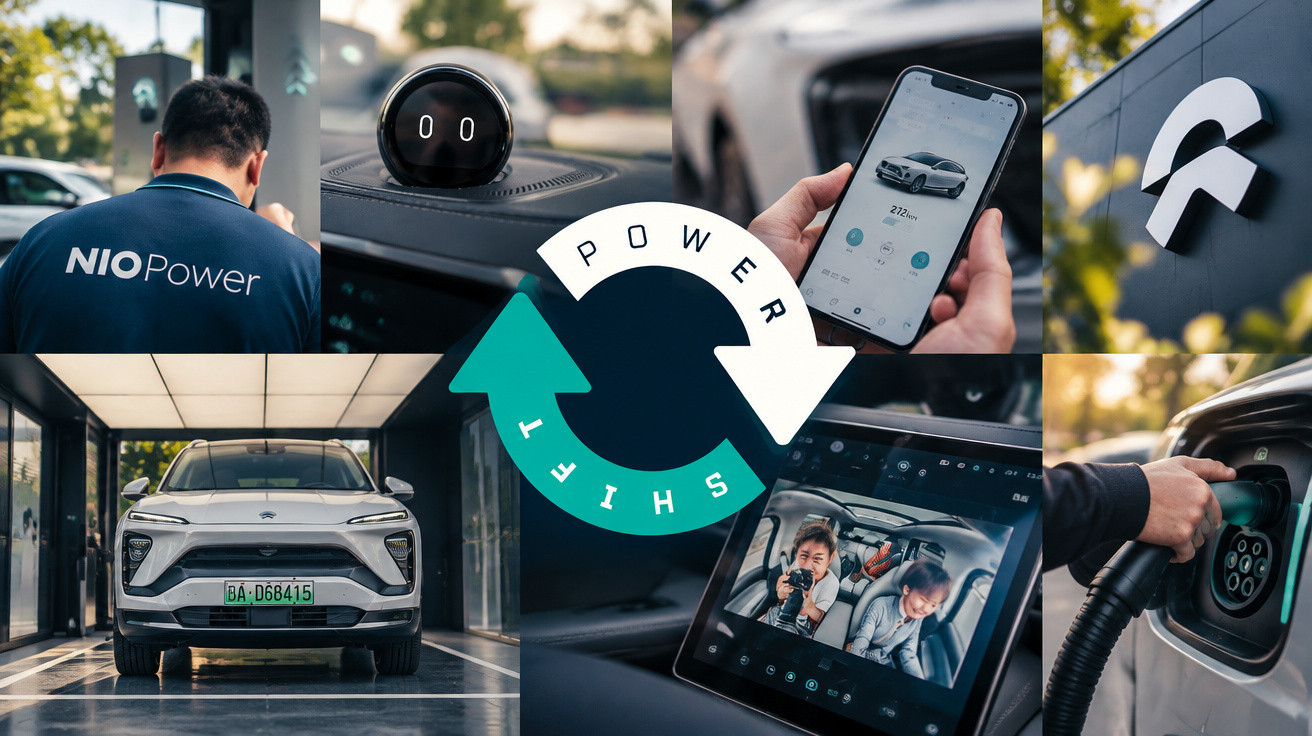
At a growing number of service areas, there are small silver Nio pods. Picture Apple opening a store in the heart of a conventional Middle Eastern souk and you will understand how out of place they appear amid the surrounding infrastructure. We pull up, climb out into stifling heat and immediately feel it. Beijing was hot and humid - every time I stepped from the car, my glasses steamed up - but this is on an entirely different level.
[Large feature image, left]
A man comes out of the pod, where he has been escaping the heat. He takes our keys, installs Nio-branded covers over the steering wheel and seats, then accurately reverses the car up the ramp into its bay. Next comes the unusual bit. He steps out and vanishes into a small side room. Our ES6 is lifted, its nearly exhausted battery is unbolted and a fully charged unit fitted in its place. Once the car returns to the ground, the man reappears, gets in, drives it from the pod and returns the key to me. In comfortably under ten minutes, we have a fully charged EV - and two astonished Englishmen.
We will repeat the process another five times before reaching Shanghai. A swap is 180 RMB - around £21 - and is paid for using the excellent, all-encompassing Nio app. Although everything is automated, every station has staff on duty around the clock. Each pod holds up to five batteries, sufficient for as many as 70 customers daily. This attendant says he has completed more than 20 swaps in two days, so the technology is no curiosity. It is genuinely used: some 50 per cent of all Nio owners have tried it.
At the next swap site, a couple of hours farther along, we meet Wang Hao. He arrives to replace the battery in his ES8 just as our ES6 is being raised. He says he regularly travels from Beijing to Shanghai and back, and that he exchanged his Audi Q7 for the Nio because it is considerably greener. Quite literally in one respect: Chinese EVs and hybrids have green numberplates, while standard ICE cars wear blue ones.
[Large feature image, right]
Numberplates are integral to the success of NEVs in China. To cut congestion and improve appalling air quality in major cities, the country restricts the number of plates those cities can provide to residents. You must demonstrate that you possess a plate before buying a car, and obtaining one for an EV or hybrid is both easier and cheaper than securing one for a conventional internal-combustion car. Restrictions also bar ICE vehicles from certain places at particular times, adding to the appeal of EV ownership. That is why Wang bought his Nio: it allows him to enter Shanghai whenever he wishes.
While Chinese NEV sales are rising year on year, new-car sales overall are declining - and have been for roughly the past year. To reverse that trend, certain cities are expanding their supply of numberplates by as much as 60 per cent. Traffic, shmaffic.
Wang's enthusiasm reminds us that we should consider the ES6 itself, having spent several hours inside it. It is essentially his ES8 with five seats rather than seven: an Audi e-tron rival that costs less than half as much as a Tesla Model X in China. Our range-topping Premier Edition is the equivalent of around £58,000, while prices begin at about £42,000. Unsurprisingly, it shares a few traits with the Californian machine.
Its door handles extend to greet you, there is no power button - simply press the brake pedal and drive - and a large portrait-format touchscreen dominates the cabin. Nio goes beyond Tesla with ‘Nomi’, a voice assistant represented by a small swivelling head atop the dashboard. It turns to look at you when you speak and can display dozens of facial expressions. Naturally, everything is in Mandarin and there is no option to change it to English.
[Image carousel]
The cabin both looks and feels remarkably polished, and the powertrain does too. The all-wheel-drive ES6 comes with either a 70 or 84kWh battery. Ours has the former; 536bhp and all-wheel drive deliver 0–100 km/h in 4.6 seconds. It provides the familiar instant EV shove in near silence, aside from a faint whine and artificial UFO sounds below 32 km/h, intended to stop smartphone-absorbed pedestrians from walking into your route.
How the Nio ES6 drives from Beijing to Shanghai
Fed up with the repetitive motorway - China has the world's largest motorway network - we leave in pursuit of more engaging roads. They are occupied almost exclusively by maniacs. Yet the occasional empty stretch exposes the ES6 as something less than perfect for unruly driving. Its softness makes it sufficiently comfortable in town, but brings lax body control on motorways and country roads, where it bounces along with limited grace. Markets have different requirements; if the ES6 ever came to Europe, this would need addressing.
We stop for the night in one of those ‘small’ Chinese cities unknown beyond the country's borders, despite having more inhabitants than the whole of Greater London. We then continue south towards the Yangtze River. Following several more battery exchanges at increasingly pleasant service stations, we arrive in Shanghai, having driven an electric car around 1,287 km in the same time you would need to make the trip in a petrol car.
[Large feature image, right]
More modern and westernised, Shanghai displays its wealth more openly than the capital. That is why the ‘Nio House’ feels more at home here. These are the brand's dealerships and, effectively, clubhouses: current owners can relax in the coffee shop, library or children's play area, even rent office space, while potential buyers can purchase cars.
Here, we have time to consider the journey. Battery swapping is unquestionably one answer. A system of this kind could work in Europe, helping reduce demand on traditional charging infrastructure as more people choose - or are compelled - to exchange conventional cars for EVs or plug-ins. The freight industry would welcome it, as would EV doubters unwilling to tackle charging's perceived complications. That is among Nio's motivations for creating this network: swapping a battery feels more like refuelling than charging. It is somehow less daunting.
Nio Power chief Shen Fei says batteries could be standardised in effect, then leased separately from the cars in which they are installed. That could make EV ownership cheaper for almost everyone, substantially reduce the purchase price of the cars and help make battery swapping a practical proposition for the many rather than the few.
It would only take some cross-border, cross-company collaboration. The sort of arrangement that might have let me retain Tom Harrison when we arrived at Beijing Airport and use my existing International Driver Permit. ‘Wheel Fire’, signing out.





Comments
No comments yet. Be the first to comment!
Leave a Comment