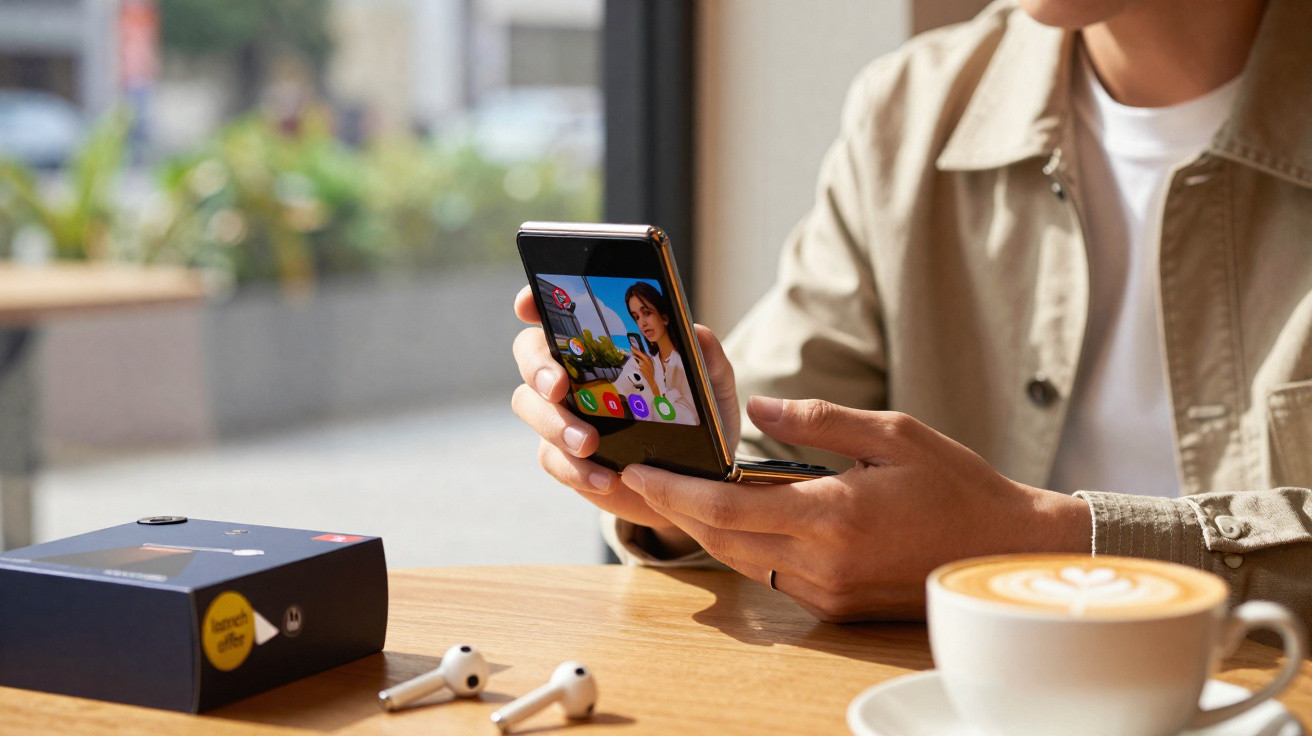
Motorola has launched its Razr 70, a rival to Samsung’s Flip. While it struggles to genuinely take on the latter, its launch offer makes it an attractively priced foldable smartphone.
When foldable smartphones come to mind, Samsung’s Galaxy Z Flip and Fold are usually the first devices people think of. Other brands have nonetheless entered the market with some very good products, including Oppo, Google, Honor and Motorola. It is Motorola that concerns us here, with the Razr 70: a Flip-style clamshell smartphone that places major emphasis on design.
Motorola is going big for the release of its new jewellery-like phone. Its official price may be off-putting (€999, or €200 more than a Z Flip 7), but its actual price at the time of writing is very different. The Motorola website currently lists the Razr 70 at €799, putting it back into the right price bracket against its rivals. It also comes with Moto Buds Loop earphones, a Moto Watch and Moto Tags: accessories worth more than €300 in total.
Can that package make the Razr 70 competitive, despite specifications that have barely changed from its predecessor? That is what this full review sets out to establish.
An unchanged but effective design
From a purely structural perspective, Motorola has opted for pragmatism: the chassis is unchanged from the previous model. It therefore measures 171.30 x 73.99 x 7.25 mm and weighs 188 g, shrinking to 88.08 x 73.99 x 15.85 mm when folded in half. It is only marginally larger than a Z Flip 7.
A brief note on the conditions of this test: as a man, I have a wardrobe full of trousers with large pockets. As a result, I have never really felt the practical appeal of the Flip format. I can absolutely understand its benefit for people whose pockets can barely hold a lighter, however, or for anyone who casually throws their smartphone into a bag.
Its build quality has nothing to envy from the market leaders. Motorola knows what it is doing just as well as Samsung, with a sturdy hinge that does not give way, a narrow gap between the two halves when folded, and even an IP48 rating promising solid protection against water and dust particles larger than 1 mm. Being old enough to remember clamshell phones before the iPhone arrived, though, I regret that modern models are so difficult to open one-handed. The minimal space between the folded halves and the stiffness of the hinge mean it can be done, but the movement is far less natural than it was back then. On ergonomics, I also find the volume buttons slightly too small and too close to the power key for effortless blind operation. That button doubles as a fingerprint sensor, chiefly allowing the phone to be unlocked in one movement while folded.
The Razr 70 instead seeks to stand apart through its finishes. The aluminium frame and glass on both displays are smooth, while the lower section of the rear is covered with a textured, rubber-like material in Pantone colours: Bright White, Hematite or the striking, less conventional Sporting Green. It is a welcome touch of originality.
Two displays for twice the pleasure
One of this format’s main attractions is having two screens: a foldable inner display and a smaller outer one for quickly checking a notification, for instance. Motorola has not overlooked the technical side. Inside is a 6.9-inch pOLED panel in a 22:9 format, taking up most of the available space. It has a Full HD+ definition of 2640 x 1080 pixels and an LTPO-enabled refresh rate ranging from 1 to 120 Hz. The crease is discreet, although still noticeable when light catches it or when a finger runs across it. Outside, the 3.6-inch display covers 65% of the available surface around the lenses, and its quality is nothing to be ashamed of. It supports HDR10+ and Dolby Vision, even if its compact size does not make it a cinema-night screen.
My chief complaint with this type of smartphone lies in the chosen formats. The main panel’s elongated 22:9 ratio is very well suited to scrolling through social media, but considerably less so to videos, which are framed by substantial vertical black bars on either side. The small display is best limited to viewing and replying to notifications, plus minor adjustments such as changing music, even though it supports many apps. Its size and format inevitably constrain it, especially as the camera lenses take up a meaningful amount of room, sometimes cutting into the interface or text. You can launch everything, but not everything is optimised for this format. Having instant access to widgets is a real delight, though.
Motorola claims a 3,000-nit peak brightness, achievable only across a small area and under very specific conditions. In practice, the display rarely-if ever-reaches that level, but it remains reasonably legible in direct sunlight. Its plastic coating, inherent to the format, is prone to reflections, while also attracting dust and showing fingerprints very readily.
Adequate performance
Continuing our look at the hardware, the phone houses a MediaTek Dimensity 7450X processor, a rival to the Snapdragon 7S Gen 4, alongside 8 GB of RAM and 256 GB of storage. That clearly places it at the lower end of the mid-range. It still offers Wi-Fi 6E and Bluetooth 5.4, although neither is the newest available standard.
The Razr 70 has no difficulty with light or well-optimised games. Asphalt, for example, runs at 60 FPS with every setting at maximum. Much the same applies to Diablo Immortal, which experiences a few slowdowns during area changes and intense fights but remains perfectly playable with graphics set to “high”. Even the demanding Fortnite is playable, despite occasionally substantial drops in frame rate and texture loading that can be seen during gameplay.
The biggest weakness of this chip and its Mali-G615 MC2 GPU is its energy inefficiency and the resulting effect on battery life. Under demanding loads, the handset gets warm and its battery level visibly falls. Fifteen minutes of Fortnite costs 7% battery.
Pleasant software with support that is too short
Despite these occasional performance hitches, day-to-day use is impressively smooth. The Android 16 base is not overloaded and remains very close to Google’s own approach, although there are around half a dozen pre-installed apps-namely Perplexity, LinkedIn, Facebook, Instagram, Amazon Music and Opera-plus around a dozen mini-games for the secondary display. The latter do not appear in the app drawer and occupy only a few MB of the phone’s storage.
The built-in generative AI model alone takes up almost 1 GB of the 256 GB available. There is a reason for that: alongside the already present Gemini, Moto AI is given particular prominence. The app uses an LLM to create images from a prompt and/or sketch, generate an audio playlist, provide a briefing on notifications, or record, transcribe and summarise an audio file.
To be honest, I would rather Motorola had spent the money invested in this unsettling avatar factory on keeping the software updated for longer. With only three years of major updates and five years of security patches, Motorola is among the poorest performers in the market. By comparison, Samsung promises seven years of updates for its Flip. More than twice as long!
Even with that shortcoming, Motorola’s interface is appealing for its smoothness and its useful extra features. Bring your hand close to activate the outer display, swipe a finger over the power button to open the notification panel or zoom, split the screen in two with three fingers, or shake the phone twice to switch on the torch: there is no shortage of gestures, and they add welcome everyday simplicity.
Motorola Razr 70 photography and video
Compared with a conventional smartphone, foldables are generally more limited in their camera setup because space is needed for other components, such as the hinge and outer display. It is therefore no surprise to find only two cameras on the Razr 70: a wide-angle and an ultra-wide-angle unit, each paired with a 50 MP sensor. Zooming consequently requires hybrid magnification, whether digital or sensor cropping, or simply moving physically closer to the subject.
The Razr 70’s camera is what might be called “neither good nor bad”, or the opposite. Depending on the conditions, it can produce a shot with disappointing detail, overly vivid or washed-out colours according to the light source and lens used-the ultra-wide is less precise than the main camera-or natural, very well-balanced photos with perfectly managed exposure. In a word: inconsistent. Personally, I really like its warm, high-contrast rendering, but the focus is too unreliable to trust it blindly. Even without a telephoto lens, 2x is perfectly acceptable. Beyond that, things become more difficult.
The front camera follows the same pattern. Its 32 MP sensor can capture high-quality, well-exposed and perfectly sharp selfies, but it can also deliver slightly blurred results affected by a white haze that destroys contrast. It is more useful for video calls in any case, since the outer display makes it easy to use the main camera module for self-portraits. It makes sense to take advantage of that, as it is one of the format’s key attractions. Motorola also lets users enable animations on the secondary display to draw children’s attention while photographing them, and automatically starts a countdown when the phone is turned around for a photo, so there is no need to search for the shutter button.
This additional screen, combined with the unusual form factor, is also handy for video, particularly vlogs. Simply fold the smartphone to 90°, start recording and film yourself without needing a tripod or risking the phone sliding away mid-shot. It is a shame that quality is capped at 4K30, or FHD60. The Z Flip 7, meanwhile, goes up to 4K60.
Battery
Despite its compact format, the Razr 70 still contains a 4800 mAh battery. Combined with its mid-range chip, this means it does not fall short against a traditional smartphone. Its energy loss during demanding tasks does hold it back, however. It is fairly easy to get through a day and a half, or even two days, with basic use, but the battery tends to melt like the world’s glaciers during global warming as soon as a game is launched.
Charging reaches 30 W, which does not sound especially impressive on paper. Even so, it is enough to fill almost the entire battery in around 45 minutes. Only the final few percentage points significantly extend the timer. Another positive is that the Razr 70 supports 15 W wireless charging. It is slow, but it will at least satisfy the Qi diehards.
Our verdict on the Razr 70
The Motorola Razr 70 is a convincing foldable. It has plenty going for it, particularly its design, displays and feature-rich software layer.
It does nevertheless have some significant drawbacks, including inconsistent photography and software support that is far too short to compete with the market’s biggest names. The issue is that, having arrived later, it faces the Galaxy Z Flip 7 in the same price bracket, even though Samsung’s model launched at a higher price. At an identical price, it is difficult to choose it over Samsung’s benchmark, unless the bundle with the earphones and watch is genuinely valuable to you. If so, be quick!
Motorola Razr 70
€799
Overall score: 7.1
| Category | Score |
|---|---|
| Design | 9.0/10 |
| Performance | 7.0/10 |
| Photography | 7.5/10 |
| Battery life | 7.0/10 |
| Value for money (excluding promotions) | 5.0/10 |
What we like
- Successful design
- Comprehensive outer display
- Smooth system packed with features
- Wireless and “fast” charging
What we like less
- The Z Flip 7 at the same price
- Uneven photo quality
- Too few updates
Buy the Motorola Razr 70









Comments
No comments yet. Be the first to comment!
Leave a Comment