
Grasslands perform vital work that often goes unnoticed: they provide feed for livestock, lock carbon into the soil, and sustain a substantial proportion of land-based biodiversity.
The concern is that grassland degradation can begin through subtle changes well before it becomes visible. Once bare ground, erosion or extensive dieback can be clearly seen, a severe decline may already be under way.
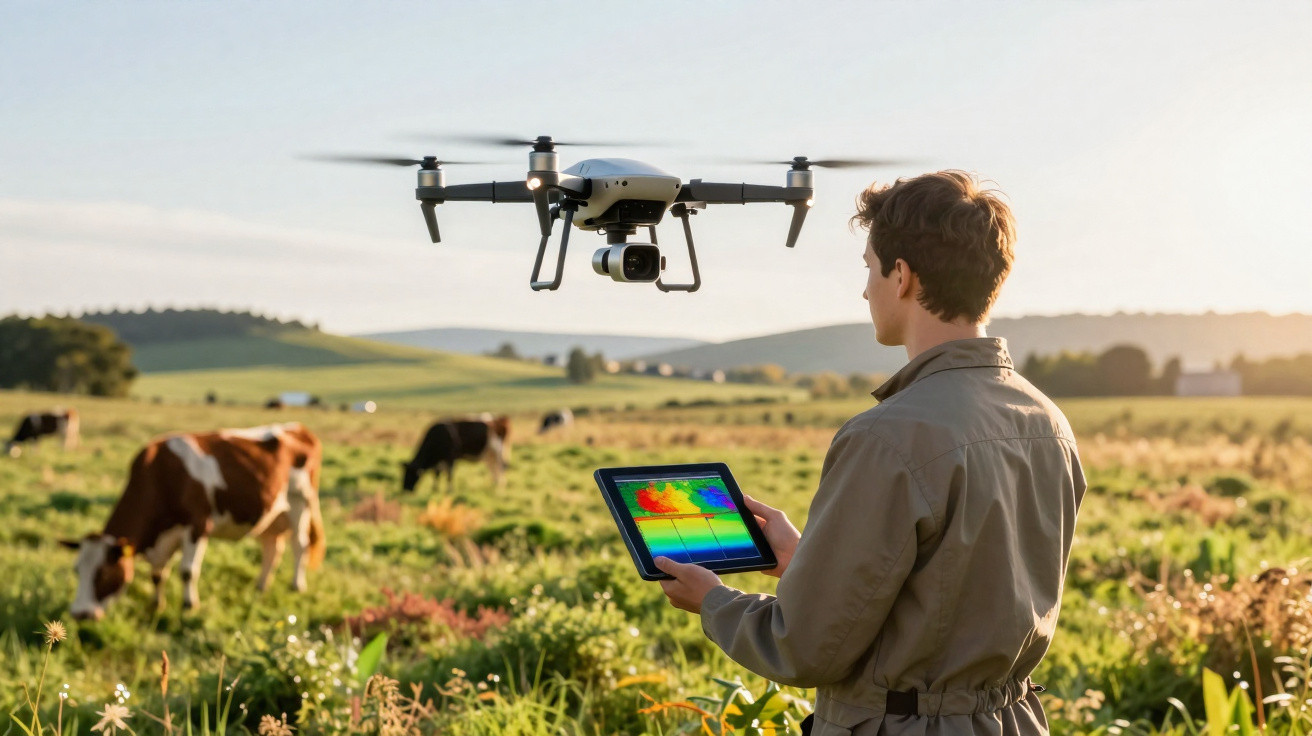
New research indicates that drones could help identify these earlier changes. They can estimate the quantity of plant matter covering the ground and identify shifts in plant traits.
Drones could also show how plant communities are structured at varying grazing intensities. The research was carried out by a collaboration led by Peking University.
The team evaluated the method at the Xilin Gol Grassland Nature Reserve in Inner Mongolia, China.
Grazing impacts are complex
Livestock grazing ranks among the most common human pressures affecting grasslands globally. Yet grazing cannot always be neatly described as either “good” or “bad.”
In certain ecosystems, moderate grazing may promote biodiversity and stop a small number of dominant species from taking over. More intensive grazing, however, is frequently associated with reduced productivity and substantial changes in the species that prevail.
Monitoring is especially difficult because grazing alters more than the amount of vegetation present. It can drive plants towards alternative survival strategies, affecting leaf chemistry, physical structure, nutrient levels and the relationships between species.
Conventional field surveys can document these features, but they are time-consuming, costly and difficult to extend across broad areas. Hyperspectral remote sensing may offer an alternative.
Beyond standard drone images
Ordinary drone imagery can provide considerable information about vegetation cover and greenness. Hyperspectral imaging provides more detail.
Rather than collecting only a small number of colour bands, it records extensive data from many narrow wavelengths. This spectral “fingerprint” can be associated with biological characteristics including nutrient concentration, leaf thickness and carbon composition.
For this study, researchers investigated whether hyperspectral data collected by drones could reliably estimate aboveground biomass as well as several plant functional traits.
They further assessed whether these trait patterns could show how grasslands respond across a gradient of grazing pressure.
Long-term grazing experiment
The research drew on a long-term grazing experiment established in 2013, comprising four treatments: grazing exclusion, light grazing, moderate grazing and heavy grazing.
This framework matters because it enables a clear comparison. Rather than inferring grazing pressure from indirect evidence, the researchers measured ecosystem responses under known conditions.
They combined drone flights with field observations and then assessed how accurately the drone data reflected conditions on the ground.
Plants adapt to heavy grazing
Drone observations estimated aboveground biomass and several plant functional traits with useful accuracy.
Along the grazing gradient, biomass generally fell as grazing intensity rose, most notably in heavily grazed plots. This result is unsurprising, but the ability of hyperspectral drone data to record it remains important.
The trait changes accompanying the reduction in biomass were more notable. Several traits related to nutrients generally declined with heavier grazing, whereas characteristics including leaf thickness and leaf carbon content tended to rise.
The researchers interpret this as a shift towards strategies that better tolerate stress: plants built to be tougher, rather than necessarily to grow faster or contain more nutrients.
This is ecologically plausible. Where grazing pressure is intense, plants that invest in more robust leaves and resistance to stress may be favoured, even if this reduces productivity.
Traits link tighter under grazing
The research also showed that stronger grazing tightened the relationship between traits and biomass.
As grazing pressure rose, plant traits became more closely associated with the amount of biomass the ecosystem was able to sustain.
Functional diversity – the variety of strategies used by plants – also showed a more positive relationship with biomass at greater grazing intensity, indicating that a mix of strategies supports productivity under harsher conditions.
The researchers examined trait networks, or the ways traits are connected within a community, and found that weaker links were associated with lower biomass under heavy grazing.
Under these circumstances, the community became less “integrated” in the way its traits aligned, and this corresponded with worse biomass outcomes.
Taken together, the findings indicate that changes in traits and community organisation may provide early warnings before ecosystem collapse becomes apparent.
Smarter grassland monitoring
“This study shows that monitoring grasslands may benefit from looking beyond how much vegetation is present, to also understanding how plant traits and community structure change under grazing pressure,” said lead author Yiwei Zhang from Peking University.
A grassland may look “fine” on a straightforward greenness map while its plant community is subtly reorganising in ways that diminish resilience.
The study does not suggest that drones should replace fieldwork. Instead, hyperspectral drone monitoring could support conventional surveys and make it possible to monitor large areas more regularly.
Its wider implication is a move beyond using a single measure, such as total plant cover, towards a more diagnostic assessment. That involves determining which plants are prospering, which traits are becoming more common and how the community is being reorganised.
This is particularly relevant in places where field monitoring cannot readily be scaled up. If drones identify early changes in traits before severe degradation occurs, managers may be able to act sooner by modifying grazing, rotating pasture use or safeguarding vulnerable areas.
The research is published in the Journal of Remote Sensing.






Comments
No comments yet. Be the first to comment!
Leave a Comment