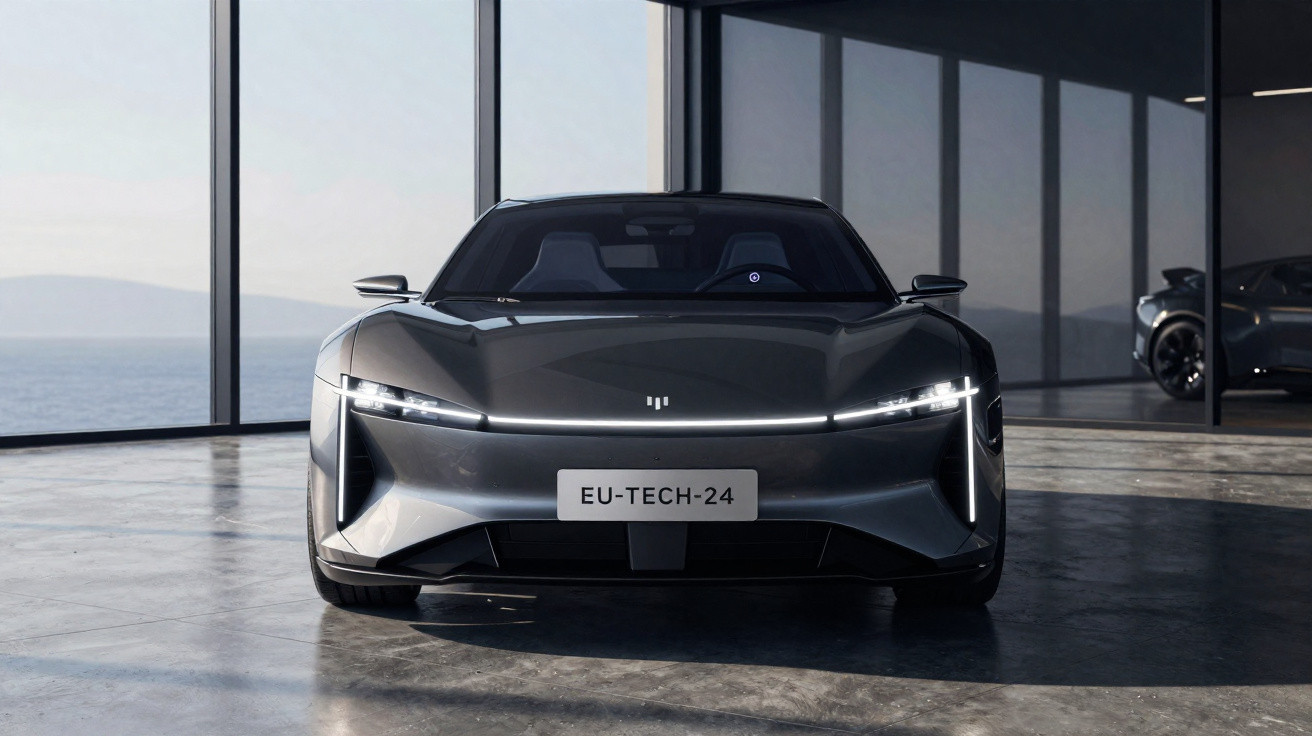
A genuine change is coming for every new vehicle.
This marks a significant development for the motor industry. From 7 July, the interiors of all new cars registered in the European Union, including France, will have to feature an infrared camera able to monitor drivers’ eyes and sound an alarm if they become distracted.
According to TF1, the camera may be positioned on the rear-view mirror, near the steering wheel or on the driver’s side of the passenger compartment. The equipment can identify a range of behaviours, including using a smartphone while driving, falling asleep or looking away from the road for too long. France’s leading television channel reports that it activates after four seconds when the vehicle is travelling above 50 km/h.
Infrared driver-monitoring cameras in new cars
This legislation also places strong emphasis on pedestrian and cyclist safety. AEB technology, which is designed to detect collision risks, is becoming compulsory on every new vehicle, including motorhomes.
From 10 km/h, the system uses radar and lasers to detect an obstacle or another vehicle, then automatically applies emergency braking. Vehicle bodies will also need to include a larger protective area intended to reduce head injuries in a collision. This measure has primarily been developed for urban areas, where crashes involving vulnerable road users are common.
The cost of the mandatory AEB technology
However, these systems do have drawbacks, beginning with their price. Our colleagues put the additional cost at between €400 and €800 per vehicle, adding further to the final bill. European authorities are therefore considering exempting certain city cars from the rules.
New mandatory equipment in Spain
As a reminder, since 1 January 2026, Spain’s Directorate-General for Traffic has required vehicles to carry a V-16 beacon. This is a light that can be placed on the roof without leaving the vehicle, warning others of a hazard and making the vehicle immediately visible in the event of an accident or breakdown.
The V16 warning beacon officially came into force on 1 July 2021. Since then, it has existed alongside the traditional warning triangle. Although both devices remained permitted until January 2026, the V16 beacon has now become the only authorised option.
In practical terms, this small emergency flashing light has a magnetic fitting, allowing the driver to attach it to the vehicle roof in just a few seconds. Unlike a warning triangle, there is no need to leave the vehicle and walk several metres, sometimes in critically poor visibility, to set up the device. More information on the subject is available in our previous article here.















Comments
No comments yet. Be the first to comment!
Leave a Comment