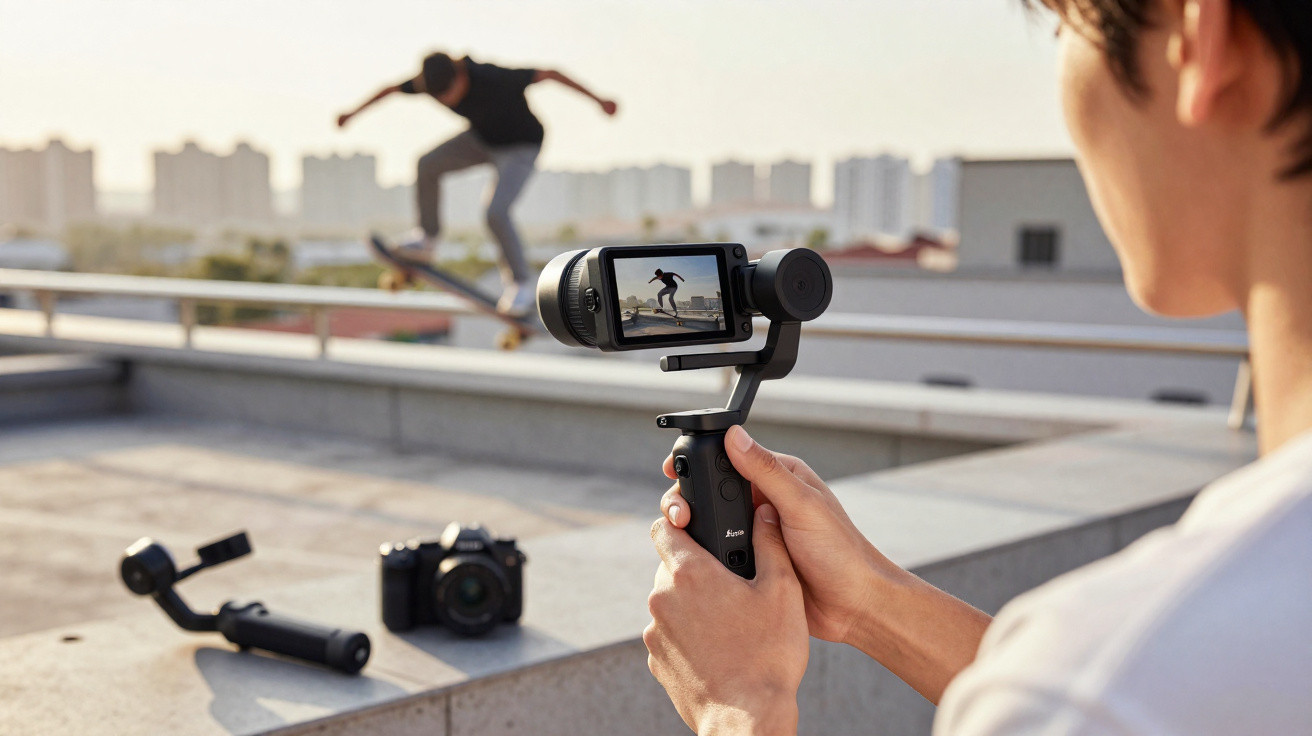
Insta360 built its reputation on 360 cameras and action cameras. It is now setting its sights on the compelling world of pocket cameras with built-in gimbals, DJI’s traditional stronghold. For its first attempt, the manufacturer has not held back. Co-designed with Germany’s Leica, the Luna Ultra combines twin Summicron lenses, a 1-inch sensor, 8K video, a detachable OLED touchscreen and, naturally, AI throughout.
On paper, the Luna Ultra looks like a high-performance machine. But how does it actually fare out in the real world, whether on holiday or when creating content for social media?
To find out, I obtained a review unit and spent almost two months using the newcomer. Read on for the full review.
Insta360 Luna Ultra: best prices
Starting price: €729
| Retailer | Discount | Price | |
|---|---|---|---|
| Amazon | -2% | €713 | View offer |
| Cdiscount | €728 | View offer | |
| FNAC | €729 | View offer | |
| Darty | €729 | View offer |
Premium build and thoughtful details
My first impression was a pleasant surprise: the Luna Ultra is more compact than I had expected. Its shape is reminiscent of a large Posca-style marker pen, with the motorised gimbal projecting from the top and the two Leica lenses clearly visible. To be honest, it also has something of a resemblance to Wall-E, Pixar’s likeable little robot. At 233 g, it can almost disappear into a jacket pocket, or, at a push, the pocket of loose shorts.
My Cosmic Black review model, also available in Stellar White, has an exemplary finish. As the camera is fairly short, Insta360 includes a kind of miniature grip that attaches beneath the base. It makes the camera more comfortable to hold, while adding a standard 1/4-inch thread and a tiny fold-out tripod for placing it on a table. The Creator Pack supplied for this review also included a Power Grip: a slightly longer version of the grip with an additional battery.
Detachable screen
The 2-inch rotating OLED touchscreen acts as both a viewfinder and a gateway to the settings interface. It sits alongside two programmable function buttons, a zoom slider, a shutter button and a small clickable joystick. All these controls are mounted on a detachable plate that becomes an HD live-view remote control. This lets me operate the camera from up to around 20 metres away. It is a simple idea, but nobody had implemented it on this type of product before.
In practice, its usefulness becomes obvious from the first solo shot. I can position the camera at ground level for a low-angle shot that would normally require me to contort myself to frame it. Here, I control everything remotely while standing up, screen in hand. Straightforward and effective. The detachable display is ideal for framing and starting recording, although its resolution is a little limited for extremely precise composition.
That is not a major issue, and I quickly adapted to it. When removed from the camera, the remote runs on its own battery, so its endurance is inevitably shorter. With intensive use and screen brightness capped at 75% - difficult to reduce in July sunshine - it lasts between 45 and 55 minutes. After that, it needs to be reattached to recharge.
Two Leica lenses, no compromises
The main module combines a 1-inch sensor with a 20 mm f/1.8 lens in 35 mm-equivalent terms. The telephoto module, meanwhile, uses a 1/1.3-inch sensor and a 60 mm f/2 lens. Switching between them is handled by the slider: a quick push jumps straight from 1x to 3x, or 20 mm to 60 mm, bypassing the intermediate values. For a gradual zoom, simply keep pressure on the control. Either way, the Luna Ultra delivers optical zoom up to 3x, then “lossless” zoom to 6x, followed by AI processing up to 12x.
A gimbal camera may offer every imaginable feature, but none of it matters if image quality is lacking. Fortunately, the Luna Ultra delivers on its promises. By default, footage is bright, slightly saturated and mildly flattering to the eye, with the distinctive Leica look available through the Natural, Vivid and Chrome profiles. That is entirely fitting for a product aimed at creators working quickly.
Switching to 10-bit I-Log produces a flatter image, but provides substantially richer material for colour grading. This is ideal for videographers who need to work in post-production. They will also value ACES support - a colour-management standard widely used by filmmakers - and the inclusion of timecode. Personally, I do not need all of that for my own use.
8K at 30 fps is impeccable, although it is not necessarily essential. For this review, I spent most of my time recording in 4K. Results are excellent in daylight and in decent lighting. What about at night? PureVideo mode, available up to 4K at 60 fps, removes digital noise with formidable effectiveness. Night-time street scenes remain clean and detailed, and the AI processing seems highly refined to me. Naturally, it cannot match what a full-frame sensor can achieve. Yet for a pocket camera, the results are undeniably very good.
The inclusion of genuine optical zoom produces markedly better images than the digital zoom offered by DJI’s Osmo Pocket 4. That is hardly surprising, as the real rival is the Osmo Pocket 4P, which is due to launch soon.
Deep Track 5.0: locked onto the subject
Another particularly welcome feature is the subject-tracking quality. Known as Deep Track 5.0, it follows the same operating principle as the brand’s 360 cameras. Simply select an object or face on the display and the gimbal handles the rest. Everyday obstructions, such as trees and posts, do not fool the tracking system, which remains locked onto its subject whatever movements I make.
The Luna Ultra offers several modes - automatic tracking, tracking with active zoom, group tracking and smart framing - and all are equally effective. Active zoom deserves particular credit: it intelligently adjusts the focal length on its own to maintain consistent framing as I move closer to or further away from the subject.
The mini grip incorporates a micro tripod and standard 1/4-inch thread at its base © Marc Mitrani for Presse-citron
Stabilisation comes from a 3-axis mechanical gimbal combined with electronic stabilisation. It removes shakes in every situation, including at maximum zoom, where even the slightest vibration would normally be disastrous. I walked, ran, climbed stairs and even filmed from a bicycle without noticing any flaw in the smoothness. Whether strolling through town or out on a walk, I captured shots I would never have thought possible without a 360° camera or more substantial equipment.
Battery life and audio: good, but not quite perfect
The 1,550 mAh battery is rated for up to 4 hours of recording. Real-world results are a little less impressive, though not dramatically so. Prioritising 4K, with the screen on and active tracking used 50% of the time, the battery gave me just over three hours of active use. Adding the Power Grip included with the kit allows the camera to last through a full day of walking or filming.
Fast charging is another positive. It requires a Power Delivery charger, but takes the battery from 0 to 80% in around 20 minutes - roughly the length of a break. The 47 GB of internal storage is very welcome, although it is best supplemented with a microSD card, up to 1 TB, to avoid any issues during a long shoot.
The four built-in microphones deliver entirely acceptable audio indoors or in calm outdoor surroundings. Once wind picks up, however, the wind protection quickly reveals its limitations. That is probably why the Creator Pack includes a Mic Pro, the brand’s new wireless microphone. It connects directly to the camera without requiring an additional receiver, and features a colour E-ink display that can be customised with an image. It comes with a conventional, and above all effective, windscreen.
Like the manufacturer’s other cameras, the Luna Ultra works with the Insta360 companion app, so I quickly found my bearings when generating videos, editing them manually or using AI. Although the app continues to gain features, it has not become more complicated. I like the Flash Cut editing templates, but especially the manual editing options it offers.
More advanced videographers can use Insta360 Studio, the Mac/PC editing software, which is particularly effective when recording in LOG. Finally, the Luna Ultra is compatible with Insta360 Cloud: videos it creates can be uploaded automatically when the camera is connected to a charger.
Subscribe to Presse-citron
Insta360 Luna Ultra: best prices
Starting price: €729
| Retailer | Discount | Price | |
|---|---|---|---|
| Amazon | -2% | €713 | View offer |
| Cdiscount | €728 | View offer | |
| FNAC | €729 | View offer | |
| Darty | €729 | View offer |
My verdict on the Insta360 Luna Ultra
For a first venture into unfamiliar territory, the Luna Ultra is a clear success. Insta360 has not simply copied DJI’s Osmo Pocket; it has enhanced the formula with meaningful additions for content creators. The twin-lens setup with telephoto lens and the screen-remote, which makes it easier to record from unusual angles, are good examples. Its flawless stabilisation and the quality of footage in low light also deserve praise.
For all its appeal, the Luna Ultra is not perfect - at least not yet. The windscreen needs updating to become genuinely effective, and the detachable mini remote would benefit from improved battery life.
Priced at €929 in the Creator Pack, which includes a wireless microphone, a wide-angle optical add-on, a Power Grip, a carry case and several accessories - or €729 for the base pack - the Luna Ultra is slightly more expensive than the DJI Osmo Pocket 4P in an equivalent configuration. It stands out, however, thanks to a companion app that I find more polished than DJI’s offering, as well as its great ease of use. If you are looking for an excellent pocket gimbal camera for vlogging and travelling light without compromising on quality, it deserves very serious consideration.
Insta360 Luna Ultra rating
€729
Overall score
9.5/10
What we like
- Image quality
- Stabilisation
- Detachable screen
- Ease of use
What we like less
- No weather sealing
- Windscreen could be improved





Comments
Henrytadly
Авторские букеты — идеальный способ выразить эмоции, удивить близкого человека или подчеркнуть важность момента https://artcraftbouquet.ru/articles/tag/parfyum-dlya-doma
Закажите букет в интернет-магазине «Мосцветок» и подарите настоящее эстетическое удовольствие вместе со свежими цветами https://artcraftbouquet.ru/magazin/product/aromatika-603
? Навыки работы с инструментами – использование флористических ножей, секаторов, проволоки, флористической губки (оазиса), упаковочных материалов https://artcraftbouquet.ru/magazin/product/ng-918
Авторские букеты живых цветов — это не просто композиции, а настоящие произведения флористического искусства, созданные с учетом современных тенденций и индивидуальных пожеланий https://artcraftbouquet.ru/magazin/folder/cvety-dlya-lyubimoj/p/8
В интернет-магазине «Мосцветок» (Москва) вы можете заказать уникальные букеты, которые подчеркнут стиль, настроение и особенность любого события https://artcraftbouquet.ru/articles/tag/na-den-rozhdeniya
Кто работает с цветами? Это, конечно, флорист https://artcraftbouquet.ru/magazin/folder/bukety-na-yubilej/p/1
Однако его деятельность не ограничивается только составлением букетов https://artcraftbouquet.ru/magazin/folder/bukety-cvetov-prosto-tak/p/6
Он отвечает за выбор цветов, их гармоничное сочетание, создание стильных и оригинальных композиций для праздников, свадеб, торжественных мероприятий и декора интерьеров https://artcraftbouquet.ru/articles/post/istoriya-dareniya-cvetov
Кроме того, флорист может заниматься оформлением витрин магазинов, выставочных залов, ресторанов и офисных помещений https://artcraftbouquet.ru/magazin/folder/bukety-dlya-kollegi/p/7
Профессиональный флорист должен уметь не только красиво компоновать растения, но и учитывать их свежесть, совместимость и уход за ними https://artcraftbouquet.ru/articles/tag/zimnie-bukety-2025
Например, некоторые цветы быстро теряют влагу, а другие выделяют вещества, которые могут ускорить увядание соседних растений https://artcraftbouquet.ru/articles/tag/uhod-za-cvetami-zimoj
флористический нож https://artcraftbouquet.ru/articles/tag/bukety-v-korobkah
Кусачки, тонкогубцы и плоскогубцы для работы с проволокой https://artcraftbouquet.ru/magazin/product/aromatika-616
MichaelKed
На основе согласованного дизайн-проекта рассчитываются цены и сроки изготовления готовой мебели https://mebel-er.ru/partners
В зависимости от пожеланий клиента, срок установки и доставки мебели можно менять https://mebel-er.ru/about
Гибкие сроки доставки предоставляют компании Mebellain, A https://mebel-er.ru/for-designer
Brugeiro, Лиман https://mebel-er.ru/privacy-policy
Ассортимент готовой мебели на рынке позволяет быстро подобрать доступные и разнообразные варианты предметов интерьера https://mebel-er.ru/
Академ Мебель https://mebel-er.ru/portfolios/mebel-dlya-spalni
Производители эксклюзивной мебели на выставке
Индивидуальная сборка предполагает установку уникальных поворотных механизмов, создание мебели-трансформера https://mebel-er.ru/partners
Например, раздвигающиеся по мере роста малыша кровати сэкономят родителям время и деньги https://mebel-er.ru/portfolios
Письменные столы с мобильной столешницей подстроятся под рост ребенка, снизив риск заболеваний спины в будущем https://mebel-er.ru/portfolios/dusevye-i-vannye-komnaty
Качественная подгонка деталей мебели из цельной древесины защитит готовые изделия от рассыхания, деформации и прочих внешних воздействий https://mebel-er.ru/portfolios/gostinnye
Самостоятельная сборка эксклюзивной мебели не может гарантировать ее износостойкость https://mebel-er.ru/portfolios/dusevye-i-vannye-komnaty
Эксклюзивная детская мебель на заказ
LarryScase
Заработок брокера чаще всего зависит от комиссионных, а не от фиксированного оклада https://белый.москва/
В Москве начинающие специалисты могут зарабатывать от 100 до 150 тыс https://белый.москва/cookie-policy
рублей, а с опытом от 300 тыс https://белый.москва/zhk-very
до 1 млн рублей https://белый.москва/zhk-champine
В регионах зарплаты могут быть ниже — от 100 до 400 тыс https://белый.москва/projects
рублей https://белый.москва/zhk-vnukovo-country-club
Зарплата брокера на статусе ИП зависит от количества сделок и процента комиссии, установленного девелопером https://белый.москва/zhk-very
Выявление потребностей клиента и подбор объектов, соответствующих его бюджету https://белый.москва/zhk-ever
Благодаря тому, что брокеры очень хорошо знают рынок и его представителей, иногда самые лучшие предложения по недвижимости приходят сразу к ним, а не появляются в открытом доступе https://белый.москва/zhk-lunar
Из этого становится понятно, что риэлтор имеет больше полномочий, чем агент по недвижимости https://белый.москва/cookie-policy
Например, у него есть возможность заниматься юридическими вопросами, делать запросы в государственные органы, то есть он может досконально проверить квартиру на ее юридическую “чистоту” https://белый.москва/cookie-policy
Это зачастую помогает избегать неприятных ситуаций, связанных с наследниками и другими людьми, которые могут претендовать на приобретенное жилье https://белый.москва/cookie-policy
По данным hh https://белый.москва/projects
ru, на III квартал 2024 года было размещено более 12 тыс https://белый.москва/projects
вакансий для брокеров, что на 11% больше по сравнению с аналогичным периодом 2023 года https://белый.москва/zhk-vnukovo-country-club
При этом на одну вакансию приходится всего два резюме, что ниже нормы, так как обычно на одну вакансию приходится от четырех до восьми резюме https://белый.москва/
Leave a Comment