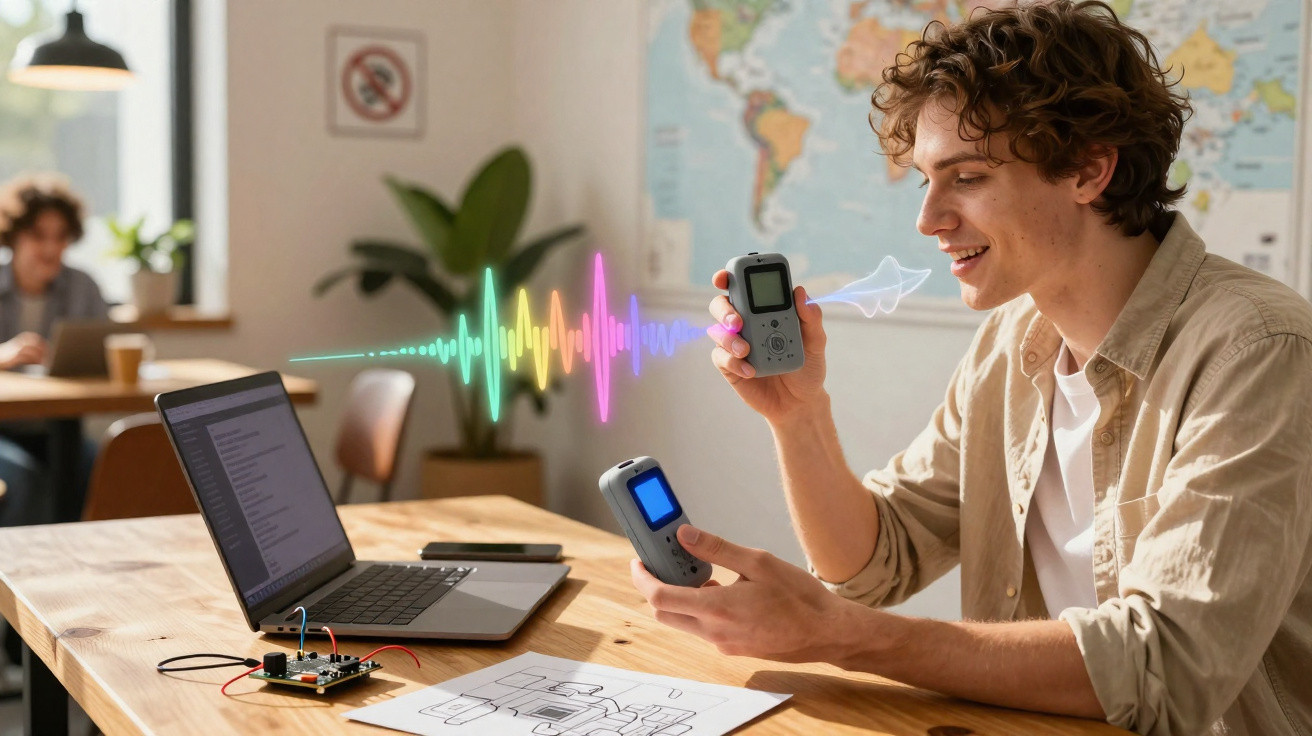
Google has published instructions for building a voice translation device that works offline. Through this demonstration, the company highlights the usefulness of its open Gemma models, as well as the strengths of its Antigravity coding tool, which was used to create the translator’s software.
Would you like a translation tool that works everywhere, including when you have no internet connection? Gemma Translator, a new device developed by Google employees, could be for you. Unlike the company’s Google Pixel smartphones or smart speakers, however, this translator is not sold through Google’s website. Gemma Translator is instead an openly available DIY project. To get one, you will need to buy the components and install the software developed by Google.
Building the Gemma Translator offline voice translator
“Every component is commercially available and easy to find: a Raspberry Pi 5, a power bank, a small touchscreen, a mini speaker and a micro-keyboard with a language selection wheel. Everything is assembled in a bespoke 3D-printed case,” the company says. Google explains the entire process on a GitHub page it has published. If you manage to build this small gadget yourself, you will have a portable device capable of translating conversations and, once set up, operating without internet access. You can therefore use translation whatever the quality of your network.
Subscribe to Presse-citron
A demonstration of Gemma and Antigravity’s capabilities
Offline operation is possible because, rather than using Gemini, the device relies on Gemma 4 E4B, one of Google’s open models. Gemma 4 E4B’s advantage is that it can run locally on a small computer, making certain AI features available without calling on Google’s cloud. Beyond this practical benefit, local models also offer a privacy advantage, as conversation transcripts do not need to be sent to Google’s servers.
Antigravity used to create the translator software
The project also showcases the capabilities of Google’s Antigravity coding tool. As a reminder, it enables developers to speed up software creation with assistance from artificial intelligence models.
What we think
Google often releases DIY projects to showcase its latest technologies. One of its best-known DIY projects was Cardboard, which offered a mini virtual reality experience using a cardboard box, lenses and a smartphone screen.
When it was promoting Google Assistant, which has now been replaced by Gemini, Google also published instructions allowing anyone to create a smart speaker connected to that voice assistant.












Comments
No comments yet. Be the first to comment!
Leave a Comment