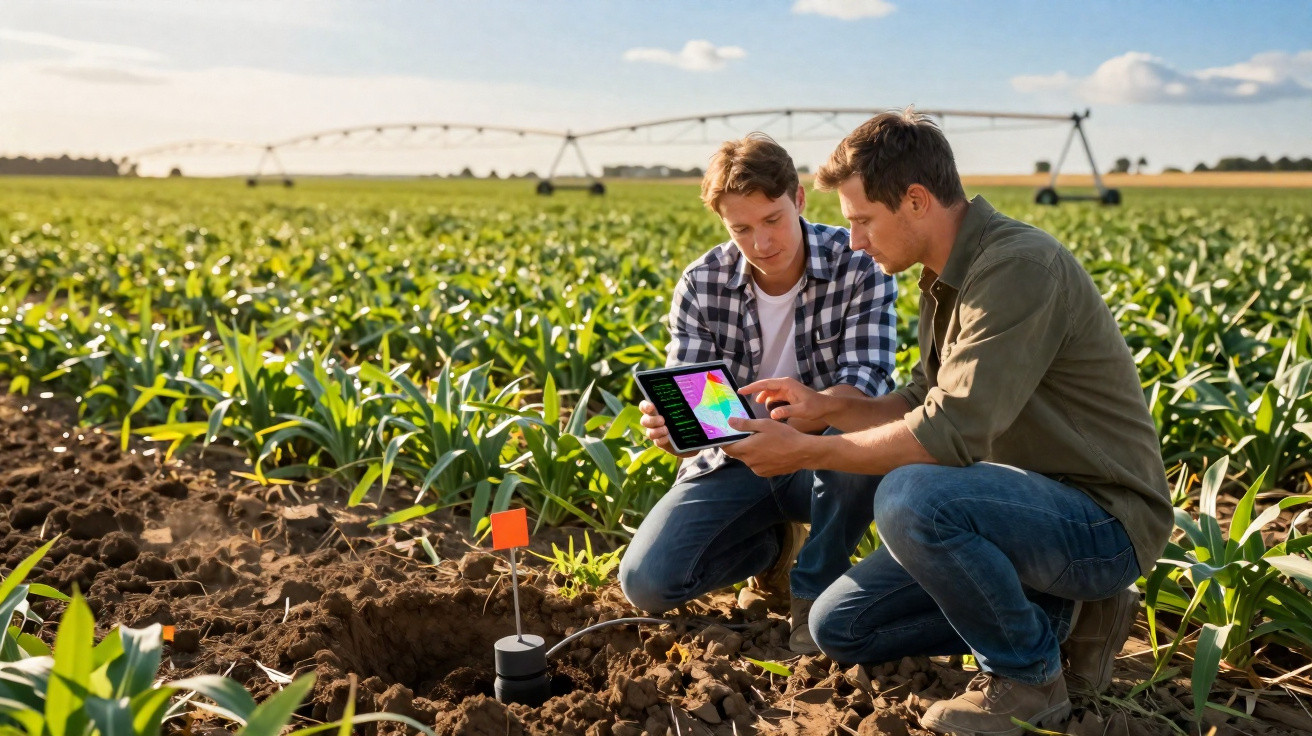
Researchers have found that underground sensors paired with artificial intelligence can forecast soil moisture close to plant roots to within 5 percent of actual measurements 95.49 percent of the time.
The result brings irrigation management nearer to the unseen soil conditions that reveal when crops genuinely lack water.
Underground warning signals
In a trial area of roughly 93 square metres, five buried probes recorded shifts in moisture at the depths where crop roots absorb water.
Using this information, Shamala Maniam and fellow researchers at Multimedia University (MMU) demonstrated that the system could monitor below-ground conditions with notable consistency.
As readings were taken 15 and 30 cm beneath the surface, the predictions reflected the part of the soil most relevant to plant stress, rather than relying solely on surface dryness.
The findings are sufficiently robust to improve irrigation choices, although underground conditions can still change rapidly when the weather shifts suddenly.
Why soil moisture depth matters
Topsoil may appear dry even when deeper soil continues supplying a plant with water. Equally, rain can leave the surface wet while roots are still lacking moisture.
Moisture around the roots is important because most crop stress starts at the point of water uptake, several centimetres below ground level.
Agriculture already accounts for about 70 percent of freshwater withdrawals worldwide, meaning poorly timed irrigation can rapidly lead to substantial waste.
More accurate information from deeper soil does not increase the available water supply, but it can help farms avoid applying water at unsuitable times.
How the field monitoring system worked
The researchers installed the probes on a cocoa plot in Perak, a state in western Malaysia, at intervals of about 3 metres.
Each probe measured the soil every ten minutes, while nearby equipment recorded rainfall, air temperature, humidity and sunlight at 30-minute intervals.
Solar panels powered the network, while a straightforward star configuration transmitted data via a single central probe before uploading it to the cloud.
Gaps and inconsistencies in the data were significant, as software based on timing learns from sequences and disrupted patterns can quickly reduce forecast quality.
Learning soil moisture patterns
To convert the measurements into predictions, the team used long short-term memory, a type of artificial intelligence designed to process ordered sequences.
Rather than assessing each measurement in isolation, the model learned the ways in which recent moisture levels, rainfall, heat, humidity and sunlight generally changed together.
Rainfall, evaporation and water uptake by roots can produce effects several hours later, allowing the software to identify delays instead of reacting only to immediate variation.
In use, the system acted less like an on-off trigger and more like a continually updated estimate of whether soil would become wetter or drier.
Heavy rain disrupts patterns
Difficulties emerged during intense rainfall, when moisture levels rose sharply in irregular bursts unlike the more stable patterns observed on most days.
These uncommon spikes caused the original model to diverge further from the measured trend, despite its good performance during quieter periods.
A modified training approach, known as Huber loss, reduced the influence of rare, extreme errors and marginally improved the model's ability to follow real conditions.
However, even with this change, sudden rain continued to reveal limitations, indicating that predictions may weaken when soil moisture changes too rapidly.
What practical accuracy means
The headline result does not indicate that the system reproduced every minor increase and decrease in soil moisture with the same level of precision.
Rather, the majority of forecasts remained sufficiently close to the observed readings to inform when irrigation should occur and how much water to apply.
A more demanding test found that the model accounted for only a proportion of the natural variation across the plot.
In practical terms, it was dependable enough for decision-making despite not being completely precise at every point in time.
Guidance before automation
Although described as smart, the prototype did not independently operate pumps or valves during the trial.
It collected data, predicted short-term changes in moisture, and delivered the results to a dashboard that could help people make irrigation decisions.
Comparable systems already assist irrigation scheduling in other studies, where sensor-led timing can limit overwatering and reduce plant stress.
This distinction is important for farms: decision-support tools are easier to introduce at present, whereas full automation requires additional equipment and confidence in the technology.
Expanding beyond one plot
The design of the field trial also imposed limits, as it covered approximately 93 square metres and was confined to a single plantation environment.
Five probes were adequate for this small site, but larger farms or land with more varied conditions would require additional sensing locations.
A network of relay connections could become important as well, since the simple star arrangement used in the study works best over short distances.
These restrictions do not undermine the findings, but they clarify why the researchers intend to conduct longer trials in larger fields.
Beyond irrigation timing
Further seasons of data will show whether the model remains dependable during drier periods and more severe spells of wet weather.
Using the system across a wider area could also establish how effectively one forecast performs when soil types vary substantially within the same farm.
The hardware can accommodate further sensors, potentially linking water information with fertiliser application and plant nutrition.
Over time, this wider set-up could develop the system from a single irrigation aid into a more comprehensive farm decision-making tool.
From trial plot to farming practice
Buried sensors and software that accounts for time performed well in this trial because they targeted the moisture experienced by roots, rather than a broad surface-level substitute.
Should future tests confirm the results across more seasons and larger farms, irrigation may become more accurate, less wasteful and simpler to plan.
















Comments
No comments yet. Be the first to comment!
Leave a Comment