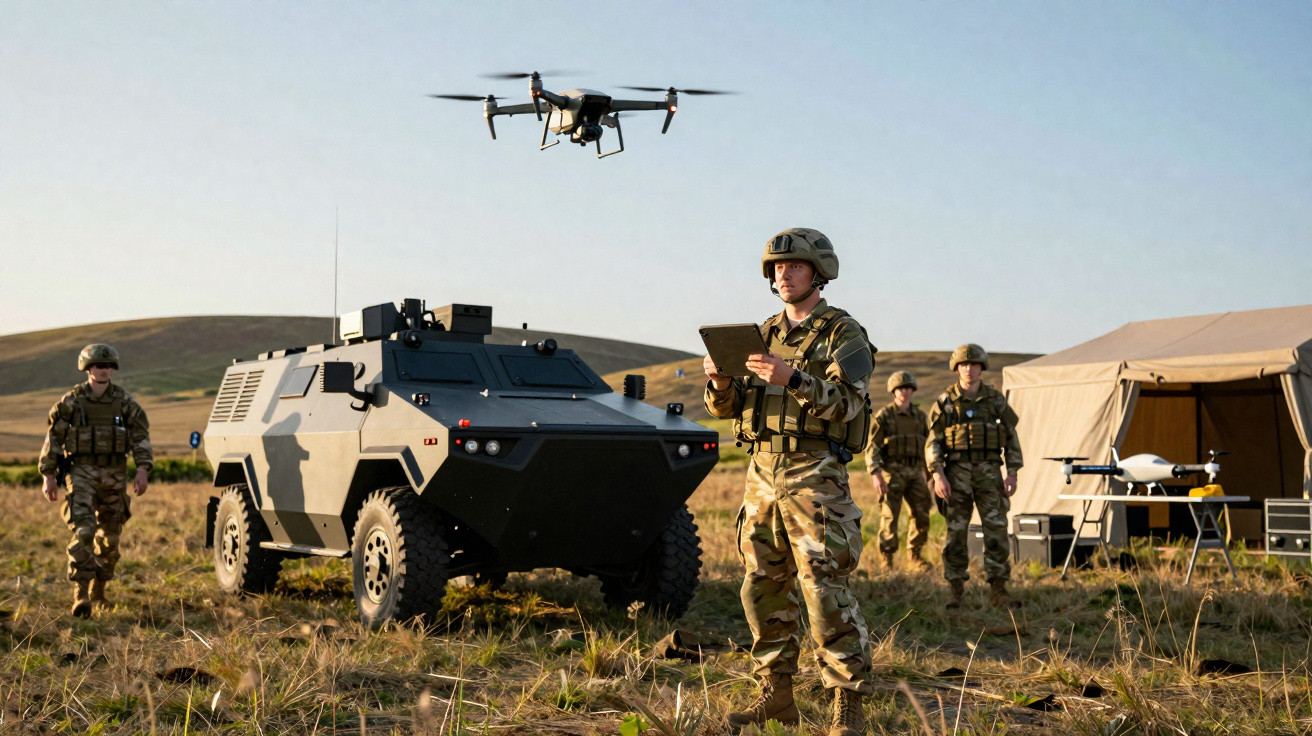
British Army trials future combat capabilities at Salisbury Plain
The British Army recently conducted a series of advanced trials at Salisbury Plain, bringing together drones and armoured vehicles to assess the combat capabilities of its future force. The strategic event convened senior military leaders and defence-industry representatives, with the primary aim of validating emerging technologies and operational concepts. During the demonstrations in Wiltshire, particular emphasis was placed on incorporating uncrewed systems into the modern battlefield to improve the effectiveness of land forces.
Held alongside an armoured vehicle exhibition, the event saw Major General Olly Brown, commander of 3rd (UK) Division, underline the value of working alongside the private sector in preparation for high-intensity scenarios. He stressed the urgency of readiness in response to current global threats, as well as the requirement for robust partnerships in military technology development. “We face a demanding challenge to be ready to fight, disrupt and destroy a Russian warfighting structure. We cannot do this alone; we must do it with our mission partners,” Brown said, adding that the Army would neither generate capability nor succeed on the battlefield without industry support.

The British Army’s integrated weapons network
The programme offered immersive experiences that placed attendees in a simulated combat setting, enabling them to see at first hand the progress made by the so-called “Iron Division” alongside its technology partners. In addition to static simulations, a live demonstration showed the coordinated interaction of autonomous armoured vehicles, uncrewed aerial systems and infantry troops. This tactical integration is intended to sharpen the operational response in conflict environments where agility and real-time information are decisive.
The strategic vision of the Chief of the General Staff (CGS), General Sir Roly Walker, was also presented during the working sessions. It is centred on reshaping the Army into a more lethal and resilient force. The plan outlined by British command calls for a substantial change in the makeup of firepower and the employment of combat platforms. Under the new doctrine, traditional assets will be supplemented on a large scale by autonomous technologies and low-cost systems.
Armoured Expo 2026 saw 3rd (UK) Division showcase how it will fight in the near future, using an integrated weapons network.
Read more ⬇️ https://t.co/j1I4N1hyzH
A three-part model for British Army firepower
Under Walker’s vision, the force’s combat power will be divided into three parts to ensure sustainability during prolonged operations. The plan envisages 20% of the force consisting of traditional, highly resilient armoured vehicles, while 40% will rely on reusable uncrewed systems such as robots and drones. The remaining 40% of firepower will comprise low-cost, single-use drones and missiles, designed for mass production and to overwhelm opposing defences.
The combination of these three elements - armoured platforms, reusable uncrewed systems and expendable assets - is regarded as essential to establishing an armoured force able to operate effectively within the North Atlantic Treaty Organization (NATO). Bringing these capabilities together is intended not only to improve troop survivability on the ground, but also to strengthen offensive capacity in complex theatres of operations. This model seeks to align the United Kingdom with the collective-defence standards of the Atlantic Alliance.

At the close of the activities, participating companies held technical workshops to display equipment that remains under development. These sessions allowed soldiers to test prototypes in realistic conditions and give engineers immediate feedback for refining the tools. Direct engagement between the end user and developer is considered a key accelerator for military innovation and for rapidly adapting to the demands of the current operational environment.
Although the Salisbury Plain activity has concluded, the programme of joint work between the British Army and industry will continue in the coming months. The intention is to sustain a continuous flow of technological innovation, ensuring that future combat capabilities are ready for challenges posed by electronic warfare and new weapon systems. Ongoing modernisation remains the central priority for maintaining the force’s strategic relevance internationally.
















Comments
No comments yet. Be the first to comment!
Leave a Comment