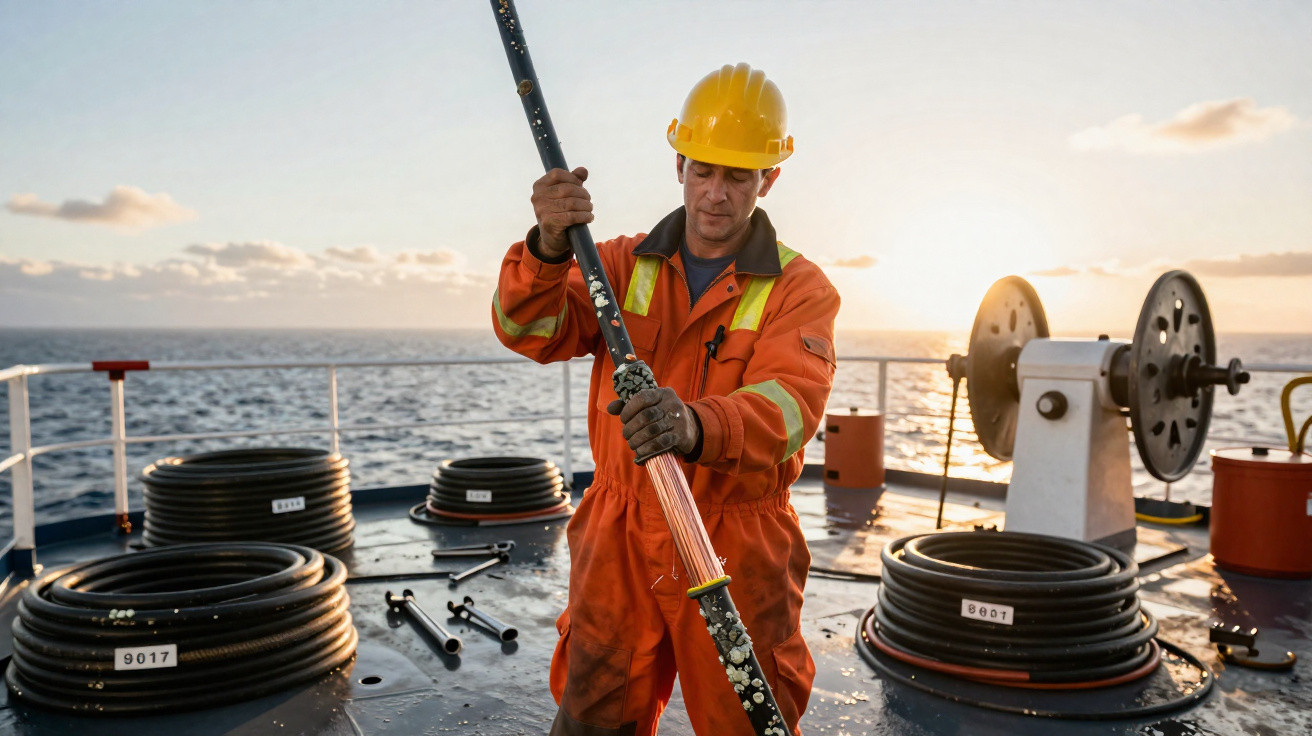
Far out in the Atlantic, a work vessel slowly hauls an unremarkable black cable aboard. What resembles an old industrial hose is actually a landmark of the digital age: the first transatlantic fibre-optic cable, which transformed data traffic between Europe and the United States in the late 1980s. This pioneering line is now being permanently removed from the seabed, making way for the network’s next generation.
How a fibre-optic cable crossed the Atlantic
The cable was installed in December 1988 by a consortium led by AT&T, British Telecom and France Telecom. At the time, its premise was radical: rather than sending electrical signals through copper, it would transmit a beam of light through optical fibres. Tiny pulses of light could suddenly carry far more data than the thick copper conductors used in earlier submarine cables.
For the telecommunications industry, this represented a leap forward. Connections between North America and Europe could now carry not only telephone calls, but also data volumes previously thought unimaginable. In a highly symbolic event, science-fiction author Isaac Asimov spoke by video conference from New York to audiences in Paris and London – foreshadowing the everyday use of Zoom and Teams decades later.
“For the first time, the Atlantic was bridged by a cable designed for fibre optics from the outset – a break with the copper era.”
Its success arrived so quickly that it surprised even the engineers. In under 18 months, the cable was operating at the limit of its capacity. Demand from financial markets, media companies and early internet services demonstrated just how urgently the technology was needed. The industry began building at scale, eventually creating a dense global network of modern fibre-optic cables.
From technical star to silent legacy on the seabed
The pioneering cable’s success story did not last indefinitely, however. Each new cable installed along similar routes increased competition, while transmission standards continued to become faster. When a major fault occurred, an expensive repair was required. In 2002, the decision was made to take the line out of service.
It then lay unused on the seabed for around two decades. Normally, many decommissioned cable sections are simply left where they are. They are considered safe, cause no immediate disruption and are difficult to recover. Across the world, this quiet infrastructure is estimated to total around two million kilometres of retired submarine cable. Part of this “buried archive of internet history” is now being retrieved for economic and strategic reasons.
Why recovery is worthwhile: copper, steel and recycling
Fibre-optic cables are often seen by the public as simple light conductors. In reality, deep-sea cables contain considerably more material, above all valuable metal components. Copper was long used for the protection of sensitive optical fibres and for repeater technology, surrounded by steel armouring and plastic sheathing.
Copper in particular is becoming a focus of raw-material policy. The International Energy Agency has long warned of potential shortages from the next decade onwards. The energy transition, electric mobility and the expansion of electricity and data networks are increasing demand, while the mining sector can only expand supply to a limited extent.
- Copper can be recycled with little loss of quality.
- The cables’ steel casing can be reused by industry.
- Polyethylene sheathing is suitable for making recycled plastic.
This combination is precisely what makes the old Atlantic cable a lucrative recycling asset. Recovered materials return to the production cycle, rather than costly raw materials remaining a permanent legacy on the seabed.
A risky task: bringing a deep-sea cable aboard
Grasping a cable several thousand metres below the surface may sound straightforward, but it is an extremely delicate operation. Technicians must first establish its exact position. Old nautical charts, historic installation records and modern sonar systems help them trace its route.
Once the section has been located, heavy grappling tools are deployed. Suspended on steel cables, they are lowered from the ship to the seabed. Like a hook on a fishing line, they search for the cable and lift it part of the way upwards. A relay-like process then begins, with one section after another brought on deck.
“To prevent the optical fibres from breaking, the crew coils the cable manually, one section at a time – monotonous but crucial precision work.”
The work rarely takes place in postcard-perfect weather. Off Portugal, winter storms and Atlantic swells regularly create difficult conditions. In heavy seas, the cable is constantly moving and the forces on grappling equipment and winches increase. For the current mission, planners have already had to alter the vessel’s route because the hurricane season began unusually early.
The internet’s invisible arteries
When considering global connectivity, many users first think of satellites. In reality, almost all intercontinental data traffic still travels through submarine cables. Estimates put the figure at more than 95 per cent. Streaming, cloud backups and financial transactions primarily pass through optical fibres beneath the water’s surface.
Satellite constellations are growing, but cannot match modern fibre-optic cables in capacity, latency or reliability. Underwater cables remain the backbone of global infrastructure for vast quantities of data. The Atlantic section now being recovered is simply the beginning of a development that continues today.
What happens to the newly available route
When old lines are removed, room becomes available for new routes. Historic cable paths are often considered proven: they offer favourable seabed conditions, predictable storm patterns and known risk areas. Operators use this experience to lay modern high-performance cables in similar corridors.
This enables connections with substantially higher bandwidth, lower latency and better resilience. Data centres, stock exchanges and major cloud providers are pressing for such upgrades, as milliseconds in data transmission now have measurable financial consequences.
Why old cables remain relevant – even after recovery
For people working with digital infrastructure, cables such as this are more than scrap; they are also archives of technological development. Their construction reveals how engineers decades ago addressed challenges including pressure, salt corrosion and shark bites. Put simply, every cable design reflects the priorities of its time: maximum robustness or low cost, high capacity or rapid installation.
These examples offer valuable lessons for new projects. Which materials lasted longer than expected? Where did premature damage occur? Which protective layers proved excessive? Engineering teams analyse such findings and use them to adapt the planning of future networks.
Key terms explained
- Fibre optic: A hair-thin strand of specialised glass that carries light signals. Essential for fast internet connections.
- Transatlantic cable: A submarine cable directly linking North America and Europe. These lines usually run between the US east coast and Western Europe.
- Bandwidth: The maximum quantity of data that can be transmitted per second. The higher it is, the more streams, files and requests can be handled simultaneously.
Risks, disputes and opportunities in deep-sea recycling
Recovering old cables is not without debate. Marine conservationists point out that any intervention on the seabed can affect sensitive ecosystems. Even where a cable has been unused for decades, surrounding life has adapted to it. Some countries also fear that recycling could be used as a pretext to search for mineral deposits.
On the other hand, pressure is growing to use metals already available rather than open new mines in sensitive regions. Every tonne of copper recovered from old lines reduces the need for newly mined material. Politically, the key question is therefore which cables should be recovered and which are better left as dormant legacy infrastructure.
A new market is gradually emerging for operators and states: specialist companies offer to identify and assess decommissioned lines and, where the balance is favourable, recover them professionally. At a time of rising raw-material prices and an ever more data-hungry network, the current operation off Portugal could be only the first in a whole series of such missions.
















Comments
MichaelKed
Основа различий: подход к производству
Мебельная фабрика MipoLine производит корпусную мебель на заказ, реализуя проекты любой сложности https://mebel-er.ru/portfolios/raznoe
Основные направления деятельности компании - производство мебели для дома и для бизнеса по индивидуальным размерам https://mebel-er.ru/for-designer
Современное оборудование с ЧПУ, накопленный опыт, высококачественные материалы и отлаженный сервис позволяют решать нестандартные задачи, создавая продукт, аналогичный крупным отечественным и иностранным производителям https://mebel-er.ru/portfolios
Несмотря на это, продажа эксклюзивной мебели часто зависит от репутации фирмы-изготовителя и количества успешно выполненных заказов https://mebel-er.ru/contacts
Что считается эксклюзивной мебелью? Это те предметы, которые уникальны и, чаще всего, изготовлены штучно https://mebel-er.ru/terms-of-use
Иными словами, это та мебель, которую сделают под конкретные запросы только для заказчика, а не для серийного выпуска https://mebel-er.ru/
Естественно, такая мебель не может быть низкого качества, иначе в чем тогда смысл?
Дизайн-проекты такой мебели ограничены только воображением малыша https://mebel-er.ru/portfolios/myagkaya-mebel
Можно заказать декоративные элементы, отражающие увлечения ребенка https://mebel-er.ru/portfolios/mebel-dlya-spalni
Например, кровать в виде машины, стеллаж с декоративными якорями https://mebel-er.ru/portfolios
Производители эксклюзивной мебели широко представлены на выставке «Мебель» https://mebel-er.ru/portfolios/myagkaya-mebel
Здесь можно увидеть самые разные компании, специализирующиеся на изготовлении стильных столов, стульев, мягких гарнитуров https://mebel-er.ru/privacy-policy
При создании детской мебели производители используют нетоксичные составы для обработки древесины https://mebel-er.ru/portfolios/dusevye-i-vannye-komnaty
Например, компании Альфа-Пегас, Билтекс и ДенВуд предлагают широкий ассортимент мебели из гипоаллергенных материалов https://mebel-er.ru/portfolios/dusevye-i-vannye-komnaty
Leave a Comment