
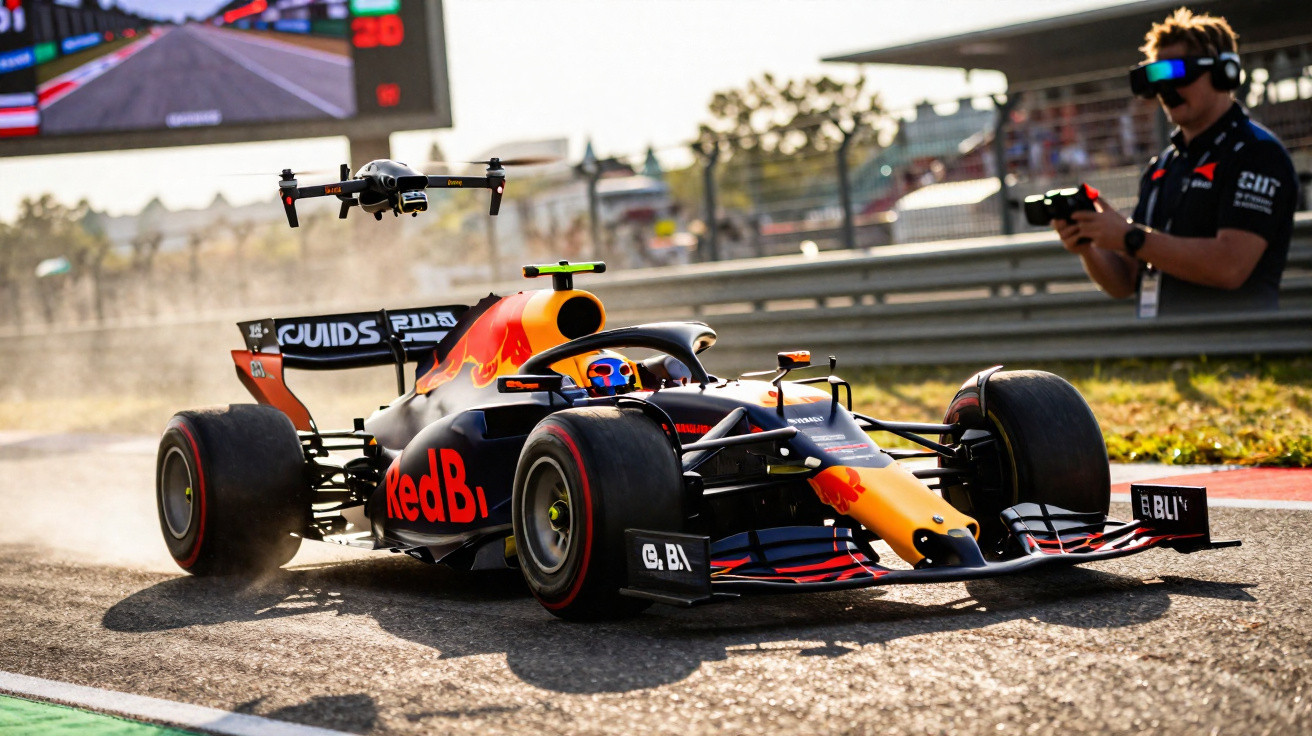
Max Verstappen has finally found the one flying machine that can stay with him above the tarmac: an extraordinary drone, born from a partnership between a Dutch team of enthusiasts and Red Bull’s engineers.
For more than a year, Red Bull worked alongside FPV drone specialists Dutch Drone Gods to build the fastest FPV drone in the world. The objective was simple on paper and brutal in practice: film a Formula 1 car for a full lap without being dropped.
Chasing Max Verstappen’s RB20 at Silverstone (2024)
In 2024 at Silverstone, the machine went after Max Verstappen as he drove his brand-new RB20 (see video below). The drone managed to sit on his tail, hitting insane peaks of more than 310 km/h on the straights. It was a world first: a one-take shot following a single-seater for an entire lap, just a few metres from the rear wing.
Breaking 350 km/h live at the Austrian Grand Prix (28 June 2026)
The feat was repeated this weekend, on 28 June 2026 at the Austrian Grand Prix-only this time it cleared 350 km/h, and the footage was broadcast live during the race. That kind of viewpoint instantly makes onboard cameras and helicopters feel dated, because neither can deliver the same sensation of flying in formation with the drivers.
Subscribe to Presse-citron
Red Bull Drone 1 (RBD1): a missile through the air
Named Red Bull Drone 1 (RBD1), development began in 2023, and the Dutch Drone Gods were handed what they describe as a technically absurd brief from Red Bull’s engineers. The drone had to launch forward with the punch of an F1 car and then hold full throttle for an entire lap-more than a minute of extreme strain for its components.
While a handful of privately built FPV drones can now touch the wild speeds of modern single-seaters, they can only do it for a few seconds before batteries or motors overheat-and, in the worst cases, catch fire.
On top of that, it needed to carry a high-definition, broadcast-grade camera capable of delivering flawless images at those speeds, and do so without being thrown off by the huge air vortex generated by the car’s rear wing when it is flat-out.
The final requirement was handling: it had to be absolutely spot-on for the pilot, so it could mirror the sharp acceleration and deceleration cycles at the entry to a tight corner. To slow down without running into the car, the pilot must come off the throttle and abruptly redirect propeller thrust into the turn, while anticipating every braking point.
From first prototype to race-ready reliability
The first prototype was already a success. After its first Silverstone clip in early 2024, it built experience in the Rookies Cup and in WRC during 2025, before chasing MotoGP bikes around the Red Bull Ring in the summer of that same year.
Since those early flights, Dutch Drone Gods and the engineers at Red Bull Advanced Technologies continued refining it for the Austrian Grand Prix 2026. The RBD1 had been flirting with 350 km/h since day one, but this time the priority was reliability-so it could follow a real race. That meant reworking internal airflow through its missile-shaped structure.
To make the images suitable for live transmission, it also incorporated an HD broadcast transmitter, sending a clean video feed directly to Formula 1’s TV production team. Even with those upgrades, the RBD1 still weighs under 1 kg, and its power-to-weight ratio is outrageous: it reaches 300 km/h in four seconds, twice as fast as a Formula 1 car.
A small drone at the centre of this weekend’s duelling
This weekend it was thrown right into the thick of it. On lap 11 of the Austrian Grand Prix, it filmed a flat-out battle on the Red Bull Ring’s roller-coaster layout. The broadcast images (see clip below) delivered a striking angle: in a single diving shot, Lewis Hamilton’s Ferrari and Max Verstappen’s Red Bull could be seen fighting wheel-to-wheel, rising and dropping with the circuit.
So will F1 adopt the RBD1 permanently as a broadcast tool, alongside crane cameras and other systems? Not necessarily. For Dean Locke, Formula 1’s broadcast director, it is impossible to have a craft travelling at 350 km/h flying above the crowd-or crossing the track-because it is simply far too dangerous. At most, he can picture it being used on a few carefully selected sections, such as the long straights in China or Austin, where it poses no risk to spectators.
For now, then, it remains an extra for viewers unless the FIA updates its regulations-but the visual impact is well worth it.





Comments
No comments yet. Be the first to comment!
Leave a Comment