
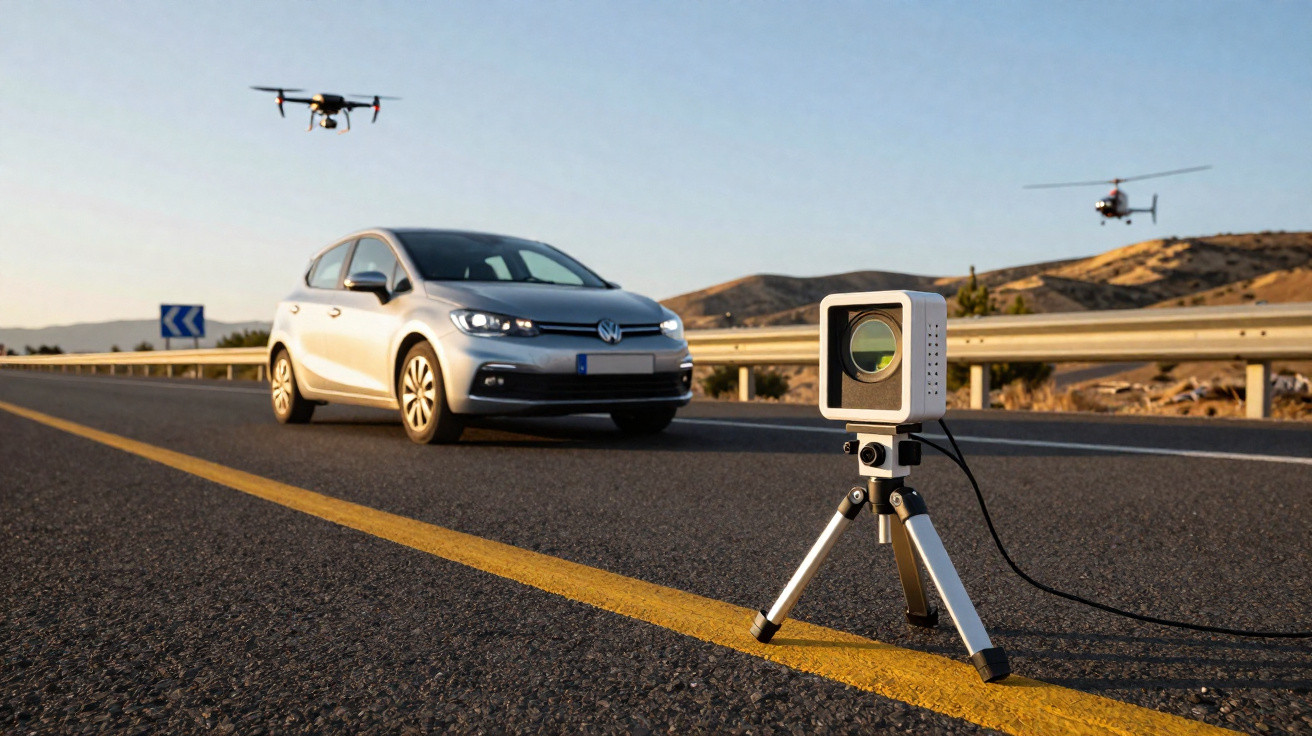
Anyone driving to the Costa Brava, Andalusia or the Balearic Islands this spring would do well to keep their right foot under control. Spain’s traffic authorities have overhauled enforcement: away from obvious roadside speed boxes and towards mobile, hard-to-spot devices, plus aerial monitoring that many tourists simply don’t factor in.
New invisible Velolaser speed camera makes heavy right feet twitchy
At the heart of the new approach is a device already making waves in Spain: the so‑called Velolaser. The name may sound harmless; the results are anything but.
"The Velolaser is so small that many drivers don’t consciously notice it even at 80 km/h - at 130 km/h, even less so."
These units fit into a rucksack and can be set up in almost any location. Common deployment spots include:
- behind crash barriers on motorways or dual carriageways
- on the back of road signs
- on small tripods in tall grass at the edge of the carriageway
- mounted discreetly on unmarked police vehicles
From a German perspective, it is reminiscent of mobile speed trailers or laser checks - only smaller and far more adaptable. Spain’s traffic authority, the DGT, is fully leaning into that mobility: positions change constantly, so sat-nav alerts and community apps such as Waze or speed-camera apps are much less able to provide reliable warnings.
Measuring long before the driver even spots the unit
Technically, Velolaser systems use laser beams that reach much further than traditional fixed radar pillars. According to the authority, they can capture vehicles from more than 1 km away. By the time a driver finally notices the small box by the roadside, the vehicle has already been recorded.
The process is straightforward and unforgiving: the sensor checks speed several times per second, ties the reading to the vehicle, photographs the number plate in high resolution and transmits the data to the control centre. Officers tend to choose long, seemingly benign straight stretches - exactly where holiday drivers, after hours in traffic, are tempted to go “just a bit” faster.
"The idea is: don’t brake because you’ve spotted a speed camera - don’t speed in the first place, because the camera could be invisible."
Surveillance from the air: helicopters and drones in constant use
Spain’s new strategy does not rely only on camouflage at ground level. A second pillar operates overhead: a small fleet of helicopters and drones monitoring large parts of the road network from above.
Helicopters with high-performance cameras
Spain runs around a dozen specialist traffic helicopters. They typically fly at roughly 700 metres and are barely noticeable from inside a car. The cameras on board can zoom in clearly on number plates and lane positions from several hundred metres away.
Officially, the system can track vehicles without difficulty between 80 and 350 km/h and keep them in view as long as they remain in the monitored zone. This produces video and image sequences that can be used to document offences in a legally robust way - from clear speeding to dangerous overtaking manoeuvres.
For foreign holidaymakers, that is a particular trap: you often do not realise a helicopter is focusing on you at all. The penalty notice arrives at home weeks later, and the Spanish drive ends up feeling far more expensive in hindsight.
Drones as silent checkpoints
On top of that, the DGT has several dozen drones in operation. They fly much lower than helicopters, often at around 100 metres, and can be piloted remotely. Range and flight time are limited, but they make up for it with agility.
"Part of the drone fleet is now officially approved to penalise traffic offences directly from the air - without a patrol car needing to wait at the roadside."
In practical terms, that means the drone records the incident, captures the number plate, relays the data to the control centre, and the penalty process is initiated there. The driver typically learns nothing until the notice is issued.
Drones are especially suited to:
- country roads with a high accident risk
- motorway sections close to tourist hotspots
- areas where risky overtakes are common
- bottlenecks or diversions in peak holiday traffic
Why Spain is cracking down so hard on speeding
This push is driven by accident statistics. During holiday periods, Spain repeatedly sees serious crashes on motorways and high-speed routes. Excess speed is among the most frequent contributing factors, especially over long weekends such as Easter or during August.
Rather than simply installing more fixed cameras, the authorities are banking on unpredictability. The DGT’s assumption is that if drivers no longer know where checks will be carried out, they are more likely to adjust their behaviour consistently.
There is also an acceptance issue: traditional cameras lose public buy-in when motorists feel they can “game” the system. Hidden measurements remove much of that opportunity. The message is clear: enforcement can happen anywhere, not only at familiar roadside boxes.
What holidaymakers from Germany, Austria and Switzerland should know
For travellers from the German-speaking region, it is worth considering the practical implications. Many rules are broadly similar to those on major roads in central Europe, but the combination of hidden devices and aerial monitoring significantly changes the risk profile.
| Aspect | Spain | Typical perception among holidaymakers |
|---|---|---|
| Type of enforcement | hidden Velolaser units, helicopters, drones | “A few fixed cameras on the motorway” |
| Warning apps | only of limited use due to the devices’ high mobility | “The app will flag anything that matters” |
| Fine for speeding | scale from a fine to points deductions, also relevant for foreigners | “Hardly ever pursued abroad” |
| Evidence | high-resolution photos and videos from ground and air | “Nothing happens unless you’re stopped on the spot” |
That last point in particular is often underestimated: Spain exchanges data with other EU countries. Fines are therefore very likely to land in letterboxes in Munich, Linz or Zurich. Ignoring them frequently results in reminder fees.
Typical scenarios on Spanish motorways
A plausible holiday routine looks like this: you spend hours in a tailback, inching along a packed autopista. Eventually the jam clears and the road opens up. Many drivers then accelerate well beyond the permitted 120 km/h to “make up time”.
That is precisely where officers like to set up a Velolaser on a tripod behind a crash barrier. The laser picks up the car from far away, long before the driver even thinks about lifting off. If you are travelling at 150 km/h at that point, you have already lost by the time you start scanning the verge.
At the same time, a helicopter may be operating further back on the same stretch, checking for tailgating or drivers using the hard shoulder to squeeze through. Drones are most often used in areas with frequent slip roads, or on mountain sections where dangerous overtakes occur regularly.
What the technology means - and how to avoid stress
The kit involved may sound futuristic, but the takeaway is simple: stick to the limits and you have little to worry about. If you do not, the odds of slipping through unnoticed have dropped sharply.
Two terms often come up in connection with these newer systems:
- Laser measurement: instead of radar radio waves, the Velolaser uses light pulses. These measure distance to the vehicle over a short interval with high precision, and calculate speed from that.
- Homologation: in this context, it means the drones are officially approved as evidence, providing a legally valid basis for issuing fines.
If you are driving to Spain, a few straightforward habits help:
- treat speed limits seriously, especially on long straight sections after traffic jams
- plan realistic journey times rather than trying to “win back” minutes
- use cruise control or a speed limiter to prevent unconscious creeping acceleration
- rely on roadside signs, not warning apps
Many drivers do not notice how quickly holiday mood can translate into speed. Music on, conversations flowing, the sea almost in sight - and suddenly the speedometer is well above 130. With these newer, hard-to-detect systems, a brief lapse in attention can have noticeable consequences.
On the other hand, the shift can bring benefits too. If more drivers genuinely travel at 120 instead of 150 on Spanish motorways, the accident risk falls, queues caused by collisions ease, and emergency services face less strain. Driving calmly at a steady pace often gets you there barely any later - just with a lower pulse and no fine waiting to be paid.




Comments
No comments yet. Be the first to comment!
Leave a Comment