
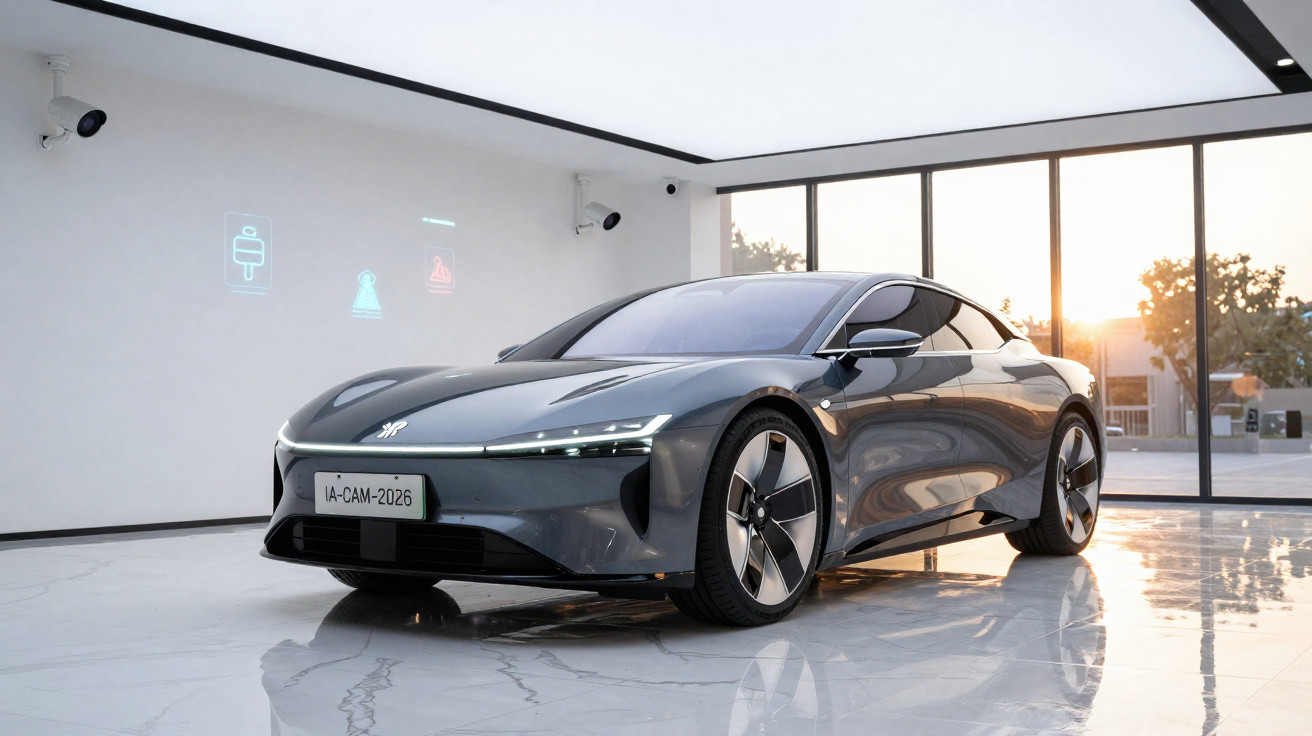
It happens in a split second, before your brain has even caught up with your right foot.
A brief, white burst on a dull Tuesday morning. A gentle “ping” from the dashboard. Then the instant, sinking twist in your stomach. There’s no patrol car in sight. No officer. Just a tall, unassuming box by the kerb, observing you pass like a bored security guard with flawless recall.
Forty-eight hours later the penalty arrives in your inbox, complete with a pin-sharp image: your car, your registration plate, your speed, and your face half washed in the light from your phone screen. There’s no one to reason with. No space for human judgement.
That’s the moment it clicks: the road is no longer only somewhere you travel. It’s turning into a data field.
When the flash feels colder than usual
Most of us recognise the feeling: you open a fine notification and your heart drops. With AI-powered traffic cameras, it lands with a different kind of weight.
These systems don’t blink, don’t tire, and don’t glance away for a coffee. They log speed, lane discipline, red-light violations, phone use and even seatbelt habits, around the clock. For some people, that sounds like modernisation and fewer injuries. For others, it carries a different scent altogether.
All at once, that roadside pole stops being just street furniture. It starts to feel like a watchtower.
Across a number of European cities, trial schemes are already turning stretches of the network into something like an open-air test site. In the Netherlands, AI cameras have been deployed to identify motorists using their phones, zooming in on thousands of windscreens each day. In the UK and Australia, pilots have paired high-resolution cameras with machine learning to spot seatbelt non-compliance and distracted driving at motorway speeds.
The outcome is predictable: tens of thousands of additional fines in a timeframe no human team could match. Some locals applaud the reduction in risky behaviour. Others say they were caught off guard, describing a round-the-clock “fine factory”. In one town, the council even had to lengthen call-centre opening hours to handle the surge of angry drivers disputing automated penalties.
Backers of AI cameras say this is simply the next, sensible step in road safety. Speed and distraction cost lives. Machines notice what people miss. The equation looks straightforward: more detection leads to fewer offences, which should mean fewer collisions.
But the tidy logic hides a price tag. Every extra pixel captured on the carriageway can still reveal a slice of someone’s private life: who they travel with, where they go late at night, what sort of vehicle they drive. These AI systems don’t just search for individual infringements; they identify patterns.
And once patterns are stored, they are difficult to erase - or to keep under control.
How to live with AI cameras without losing your mind
There’s a plain, practical reality here: AI cameras are here to stay. They will become clearer, cheaper and more common. So the first survival tactic is unglamorous but effective: learn what, specifically, these systems are looking for where you live.
Most councils and regional authorities publish (often with little fanfare) lists of camera sites and categories: speed, red light, bus lane, phone use. Spend ten minutes, once, checking. It’s not about trying to outsmart enforcement. It’s about understanding the rules of a game that’s already being played around you.
Then adopt one straightforward habit: drive as though the camera is always running - because it is.
When new enforcement technology appears, drivers tend to follow a familiar path: disbelief, frustration, and then reluctant adjustment. First you swear at the cameras. Next you hunt for loopholes. Over time, you modify your behaviour on the streets you know are covered, while staying sloppy everywhere else.
That’s the snare. Safety becomes a performance you put on only when you suspect you’re being observed. The blunt reality is: nobody really follows every rule, every minute, on every road. Yet AI cameras have no interest in your “nearly always”. They only need the single moment you slip.
It’s more useful to admit your weak points - the “just one quick text at the lights”, the “I’m running late, I’ll push it a bit” - than to rely on any gadget designed to warn you.
The next practical step is shared rather than personal. If you’re concerned about a drift from safety into blanket monitoring, your strongest lever is still public participation. Hearings, local consultations, and even chaotic online arguments can delay, redirect or reshape how these systems are introduced.
“Technology doesn’t decide whether we end up in a safer city or a controlled city,” says one digital rights lawyer I spoke to. “Policy does. And policy bends when enough people push.”
- Ask your local council what data AI cameras store, and for how long.
- Support rules that require anonymisation once a fine is processed.
- Demand independent audits of AI error rates and bias.
- Push for visible signage where smart cameras are in use.
- Question any move to link traffic data with unrelated databases.
Let’s be frank: nobody reads privacy policies for enjoyment. Still, those dry clauses are exactly where the boundary between safety and surveillance is quietly set.
The thin line between safer roads and watched lives
The rise of AI traffic cameras is about more than speeding or jumping a red light. In a few square centimetres of hardware by the roadside, it concentrates some of the most difficult questions of our era. How much autonomy are we prepared to exchange for protection? Who is allowed to see our movements, and for what reason? What if a tool designed to reduce crashes becomes a blueprint for monitoring everything, everywhere?
For some people, the calculation is settled: if AI cameras make drivers behave and save even a small number of lives, the unease is a fair trade. For others, it feels like a slow tightening - the sense that every “smart” upgrade quietly normalises constant scanning as the entry fee for modern life.
This argument won’t be resolved by a single court decision or one protest. It will drift through family dinners, council meetings, viral posts and breaking-news alerts. It shows up in that jolt when the flash fires and you wonder not only, “What will this cost me?”, but also, “Who’s watching me - and where does it end?”
| Key point | Detail | Value for the reader |
|---|---|---|
| AI cameras never “look away” | They operate 24/7, tracking speed, distraction, and more with machine learning | Helps you understand why fines are rising and what behaviour is most at risk |
| Rules can still be shaped | Local policies decide what’s recorded, stored, and cross-referenced | Shows where your voice and participation can still change the system |
| Driving habits must adapt | Consistent, not “camera-only”, safe driving reduces both risk and stress | Gives you a realistic way to live with AI enforcement without feeling hunted |
FAQ:
- Question 1 Can AI traffic cameras really recognise my face or just my number plate? Many current systems prioritise registration plates and vehicle behaviour, but some pilots also capture images of drivers to identify phone use or seatbelt compliance. Whether your face is analysed or retained depends on local law and the contracts signed with technology suppliers.
- Question 2 Are AI camera fines easier or harder to contest? Often, they’re harder, because the system produces clear, time-stamped photos and data. You can still dispute mistakes - the wrong plate, a cloned vehicle, a technical malfunction - but the scope for “officer discretion” is largely gone.
- Question 3 Do these cameras really improve road safety or just raise money? Research from multiple countries indicates that stronger enforcement reduces certain crash types, particularly at known high-risk locations. At the same time, revenue can be substantial, which is why openness about safety outcomes versus income is important.
- Question 4 What happens to my data after I pay the fine? It varies significantly. In some areas, images are deleted once the penalty is processed. In others, data may be kept for months or years. In many jurisdictions, you have the right to ask what is retained and for how long.
- Question 5 Could AI cameras be used one day to track protests or daily movements? In technical terms, yes: tools designed for traffic can also be used to follow people. Whether that happens depends on political decisions, legal constraints and public resistance - which is why the debate you join now may matter more than the fine you’ve just paid.



Comments
No comments yet. Be the first to comment!
Leave a Comment