
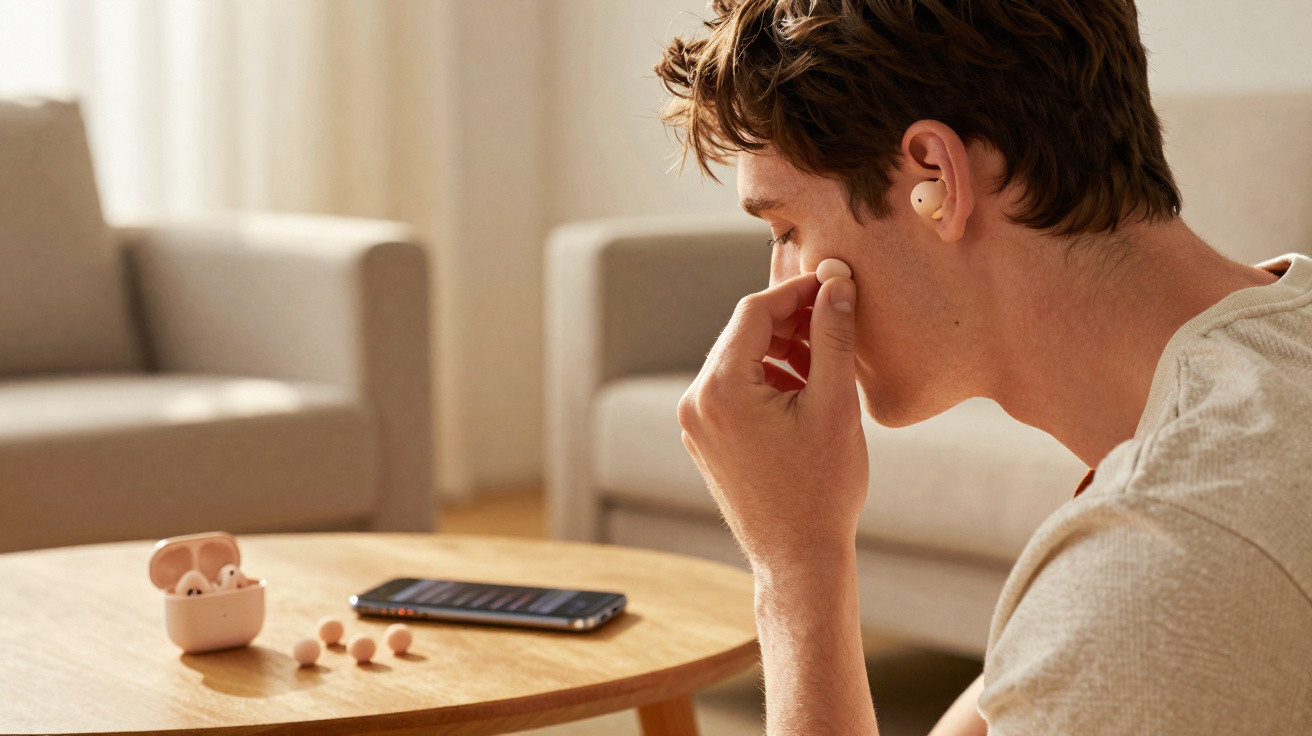
She flinched, rubbed the inside of her ear, then pushed the buds back in with that defeated look that says, “I’ve got no choice.” Anyone who loves music but has sensitive ears knows the routine: buy a new set of buds, hope they won’t hurt, then give up after a few days of stinging cartilage and irritated ear canals.
During our lab sessions and day-to-day trials, I started making a quiet mental count. Who could keep earbuds in for an entire workday? Who gave up after a couple of songs? The trend was harsh and unmistakable: if your ears are in pain, sound quality doesn’t matter.
That’s why we went looking for Bluetooth earbuds that don’t just perform well, but genuinely feel comfortable-options for small ears, picky ears, and allergy-prone ears. And the results of our testing took me by surprise.
What “comfort” really means when your ears are the problem
The first thing that stood out in our sessions was how differently people explained discomfort. Some described a creeping “pressure” after 20 minutes, as if the earbud were slowly expanding. Others said the tips felt abrasive, even when the silicone was supposedly soft. One tester summed it up by saying, “Feels like someone’s poking my skull from inside.”
We laid out more than a dozen Bluetooth models along a long table-household names, smaller newcomers, workout-first buds, and pairs designed for desk work. Everyone listened to the same playlist at the same volume for the same one-hour window. The only variable was what each person had in their ears.
It became clear that comfort wasn’t a luxury feature. It was the difference between using the product and abandoning it. And the best performers weren’t always the priciest.
One moment has stayed with me. A tester with eczema in and around her ear canal turned up carrying a small pouch she called her “ear emergency kit”: moisturising drops, hypoallergenic wipes, spare foam tips. She normally can’t manage more than 25 minutes before the itching kicks in.
In the first round, she tried a well-known rigid, stem-style pair. She made it 14 minutes. Her exact words: “These feel like Lego pieces jammed in my ears.” Then she swapped to the first of our top performers: light buds with ultra-soft oval tips and a shallower fit.
When I checked in at around 40 minutes, she didn’t hesitate. “Honestly? I forgot I had them in,” she said. By the end of the session, she’d worn them for almost two hours-only taking them out once to speak. For her, that was a minor miracle.
Once we analysed the test notes, the patterns showed up quickly. Earbuds with short, angled nozzles and several tip shapes repeatedly ranked better for comfort on sensitive ears. Meanwhile, models with bulky housings or deep, bullet-style insertion often failed, even when the audio performance was outstanding.
Weight and materials mattered far more than most spec sheets suggest. The best Bluetooth earbuds for sensitive ears tended to share three qualities: very light bodies (under 5 grams per earbud), soft silicone or memory-foam-style tips, and a seal that didn’t “cork” the ear canal. The more an earbud tried to dominate the ear canal, the more likely it was to hurt.
According to our tests, these Bluetooth earbuds are the best for sensitive ears
Over weeks of everyday wear-commutes, long workdays and late-night TV sessions-four models repeatedly earned the highest comfort scores from testers with sensitive ears. The most consistent all-day option was a compact set with pill-shaped buds, almost no sharp edges, and a surprisingly gentle seal. Its advantage came from tips that flex and slightly collapse rather than pushing back against the ear canal.
Another favourite-particularly for very small ears-used a semi-open design. There’s a bit more sound leakage, but the reduction in pressure is significant. Several testers who normally avoid in-ear buds altogether managed full work shifts in these. One of them even ordered a pair on his phone during the test week, which is about as strong a review as you’ll ever see.
For runners and gym-goers with tender ears, a sports-focused pair caught us off guard in a good way. Slim, flexible ear wings hugged the outer ear, meaning the ear canal didn’t have to take as much of the burden. They didn’t “disappear” in the same way the ultra-light buds did, but they spread contact across more points-something sore-eared testers genuinely valued.
We didn’t rely only on chatty “How do they feel?” feedback. We logged wear time, how often people fiddled, and that familiar move where someone subtly loosens one earbud to let a little air in. The most comfortable earbuds were the pairs people stopped touching altogether. They stayed put through Slack calls, washing up, dog walks, and even while lying on a pillow.
On average, our top-performing pair stayed in for more than three hours before anyone felt they needed a break. The least comfortable set? People gave up at 18 minutes. The gap had nothing to do with codecs or glossy marketing promises. It came down to whether your ears felt under attack.
Across all sessions, three design choices predicted success nearly every time. First, nozzle angle: slightly forward and down, following the canal’s natural path instead of driving straight in. Second, centre of gravity: when more weight sat closer to the ear’s entrance rather than hanging outside, buds felt less “levered” and caused less pain over time.
Third was how the tips behaved against skin. Softer, thinner silicone conformed to tiny irregularities, while thicker tips tended to rub and build heat. One of the best-performing sets used two-layer tips: a softer inner ring where it meets the canal, paired with a firmer outer ring to maintain the seal. The sensation was strangely unnoticeable-almost as if your ears had quietly called a truce.
How to choose (and wear) earbuds when your ears fight back
If you’re shopping for Bluetooth earbuds and your ears irritate easily, ignore a good chunk of the marketing and focus on three visible things: the shape, the nozzle length, and the range of tips. Prioritise a rounded design and avoid nozzles that look like long spikes. A few millimetres can decide whether you last through a podcast or make it comfortably to bedtime.
Next, look at what comes in the box. Three tip sizes is a solid start; multiple materials is better still. Some testers only found real relief after switching to third-party foam tips that compress and expand gently. It’s like swapping in your own insoles-just for your ears.
When the earbuds arrive, trial them at home first. Keep sessions short, volume low, and don’t pressure yourself to “justify the purchase” on day one. Your ears need time to adjust to a new visitor.
How you insert them matters too. It sounds obvious, but the classic “shove and twist” approach is a recipe for discomfort if your ears are sensitive. Instead, rest the tip at the entrance to your ear canal, lift the top of your ear slightly with the opposite hand, and let the bud slide in at a gentle angle. Then let go. Small changes can make a big difference.
If you feel sharp pressure immediately, trust that signal. Drop down a tip size or move to a softer material. And don’t chase a perfect, studio-tight seal if your skin is already flaring. A seal that’s good enough-and lets your ears breathe-is better than flawless bass that buys you three days of soreness.
Let’s be honest: hardly anyone does this perfectly every day, but giving your ears “off days” helps. Switch between earbuds and open speakers when you can. If you wake up with tenderness, skip earbuds in the morning. Your playlists will still be waiting at lunchtime.
“The most telling thing,” one tester told me, “was when I forgot to take them out before bed. My ears used to feel like they’d been through a boxing match. With these, I just fell asleep on the pillow and didn’t think about them at all.”
That low-drama, almost boring comfort is the real standard-not the wow factor at unboxing, but how your ears feel on day 30. To keep our testing consistent, we ended up using a simple checklist on a whiteboard:
- Can I wear them for a full episode of a show without fiddling?
- Do my ears feel hot, itchy, or under pressure after 20 minutes?
- Can I lie on my side with one ear on a pillow without pain?
- Do I dread putting them back in the next morning?
If you’re mentally ticking “yes” for the first three and “no” for the last one, you’ve probably found a keeper.
Living with sensitive ears in a wireless world
We’re surrounded by tiny speakers we’re meant to wear like clothing: earbuds for work calls, earbuds at the gym, earbuds on the walk home. On a good day, that feels like freedom. On a bad day-when your ears are sore and red-it feels like a design problem no one bothered to solve. The aim of our testing wasn’t only to name winners; it was to find options that let people enjoy wireless listening without wincing.
If your ears are fussy, you’re not being dramatic. It can be biology: cartilage shape, skin sensitivity, old infections, allergies, or even how your jaw moves when you talk. The right Bluetooth earbuds quietly work with that reality rather than fighting it. They sit lightly, keep away from irritated skin, and don’t demand a perfect fit to sound good.
On a train, I watched a man in his sixties put in one of the top-tested pairs. He looked briefly surprised, then noticeably relieved-like someone had loosened a tie that was a bit too tight. No performance, no “wow”. Just a subtle shift from putting up with sound to actually enjoying it. In the end, that’s the real test: not which earbuds look the most futuristic, but which ones let you forget they’re there long enough to get lost in a song again.
| Key point | Detail | Why it matters to you |
|---|---|---|
| Earbud shape and weight | Light, rounded buds with a short, angled tip | Reduces pressure and pain for sensitive ears |
| Tip quality and variety | Multiple sizes, soft silicone or memory-foam-style tips | Helps you match the fit to your actual ear canal |
| Wearing habits | Build up gradually, take breaks, switch to a speaker sometimes | Protects skin and limits irritation and inflammation |
FAQs:
- Are there Bluetooth earbuds that don’t go deep into the ear canal? Yes. Look for semi-open or shallow-fit designs with short nozzles. They sit closer to the canal entrance rather than deeper inside.
- What are the best ear tips for very sensitive skin? Ultra-soft silicone or memory-foam-style tips are usually the safest bet. Hypoallergenic third-party tips can also help if standard silicone irritates you.
- Can sensitive ears handle noise-cancelling earbuds? They can, but active noise cancelling can increase the “plugged” feeling. Choose models with gentle ANC and very light buds, and begin with short listening sessions.
- Why do my ears hurt after only 20 minutes with new earbuds? It’s often a combination of poor shape match, tips that are too large, and firmer materials. Try smaller or softer tips, adjust the angle, and don’t force a deep seal.
- Is it bad to wear earbuds all day if my ears don’t hurt? Comfort is encouraging, but your ears still benefit from breaks. Even without pain, giving them air and turning the volume down now and then helps protect hearing and skin over time.





Comments
No comments yet. Be the first to comment!
Leave a Comment