
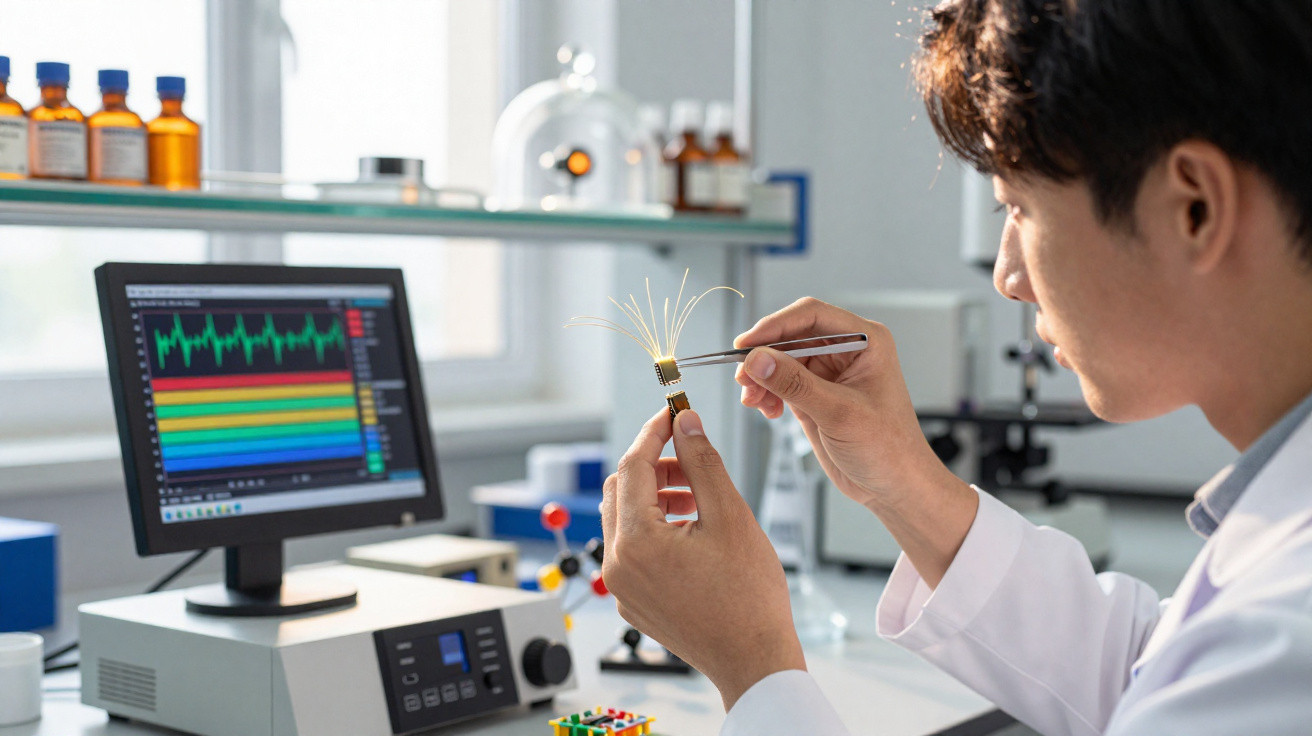
Researchers report an artificial memory that can be switched with currents below 10 nanoamps while maintaining hundreds of stable states - a pairing that could allow AI hardware to learn and retain information using much less electricity.
AI and artificial memory
In test structures made from a very thin oxide film, the device’s resistance shifted gradually in many fine increments, rather than snapping between values in abrupt jumps.
At the University of Cambridge, Dr. Babak Bakhit demonstrated that brief one-volt spikes were sufficient to drive this controlled, step-by-step response.
Crucially, the tuned changes persisted through repeated operation, instead of quickly fading after a short burst of use or degrading into unstable behaviour.
That repeatability suggests the component is more than a one-off laboratory effect, and it raises the key question of how it can operate at such low power.
Why power drains
Much of AI computing’s energy demand comes from today’s chips constantly moving data back and forth between separate memory and processing units.
Hardware inspired by the brain - where storage and computation happen in the same place - could reduce energy consumption by as much as 70 percent.
A memristor, an electronic component whose resistance depends on its history, is designed for precisely this kind of local, in-place operation.
The Cambridge device switches at currents roughly a million times lower than some more conventional oxide-based alternatives.
A steadier switch
Traditional oxide memories often depend on nanoscale conductive filaments that repeatedly form and rupture, a mechanism that can make switching erratic and difficult to control.
In this work, no aggressive “forming” step was required, because the resistance could be adjusted by subtly shifting a barrier at the material interface.
As charge redistributed and small numbers of oxygen and nitrogen ions drifted, the barrier height moved up or down in measured, repeatable steps.
This smooth adjustability enables intermediate resistance levels rather than a simple binary flip - a capability that matters for learning-oriented computing.
States that lasted
Measurements showed the device continued functioning for more than 50,000 switching cycles, and it retained its programmed resistance values for about a day.
The stability arises because many trapped charges contribute collectively, instead of relying on a single delicate path to carry the effect.
Across 50 devices, the separation between resistance levels stayed large enough to keep stored values clearly distinguishable even after repeated cycling.
That kind of dependable performance is a prerequisite if large arrays are ever to train models without continual calibration and correction.
Learning from spikes
When driven with repeated one-volt pulses, the device’s effective electrical weight increased or decreased in small, consistent increments.
In neuromorphic-style systems, this gradual updating is important because learning is built from many small adjustments rather than one sweeping rewrite.
Even after about 40,000 spikes, the response remained steady, and the device also obeyed timing-dependent rules used in unsupervised learning.
These features make it better suited to adaptive hardware than memories limited to switching simply between on and off.
What moved inside
Microscopy and spectroscopy pointed towards the same origin: an interface where one layer supplies positive carriers while the neighbouring layer supplies negative carriers.
This boundary behaves like a p–n junction - an electronic barrier between opposite charge types - and it began in a strongly depleted state.
Positive pulses lowered the barrier by shifting charge and oxygen-rich defects, whereas negative pulses raised the barrier again.
Because the entire interface took part, the effect stayed uniform across the component instead of concentrating in a single weak point.
Why chemistry mattered
Strontium was not merely an additive: it helped hafnium oxide support positive charge, rather than behaving only as an insulating oxide.
Titanium reduced the material’s energy gap, making that positive-charge conduction easier to sustain under oxygen-rich growth conditions.
Together, this chemistry produced a very high resistance in the resting state, then delivered a tuning window above 50 once pulses were applied.
Although high resistance might sound unhelpful, it is exactly what keeps the current tiny and the energy cost low.
The hottest problem
A major obstacle remains before this approach can be manufactured at scale: the films currently have to be grown at around 700 °C.
That temperature is beyond typical comfort zones for standard chip fabrication, preventing an easy drop-in to existing production lines.
“This is currently the main challenge in our device fabrication process,” said Dr. Bakhit.
Addressing this constraint could be as decisive as the underlying physics, since manufacturing realities often determine which promising devices ultimately prevail.
Next steps for artificial memory
If the growth temperature can be reduced, these artificial memories could be packed into dense arrays that both train and run models directly where the data sits.
That would tackle one of the biggest overheads in AI hardware: moving information around before meaningful computation even begins.
“These are the properties you need if you want hardware that can learn and adapt, rather than just store bits,” said Bakhit.
So far, the researchers have not demonstrated a complete chip or a full network, meaning the potential still depends on the next engineering advances.
The study lays out an uncommon combination within one materials system: ultra-low current switching, stable multi-step tuning, and brain-like learning behaviour.
That combination will only matter if it withstands real-world chip manufacturing, but it points towards AI hardware that can remember using far less energy.





Comments
No comments yet. Be the first to comment!
Leave a Comment