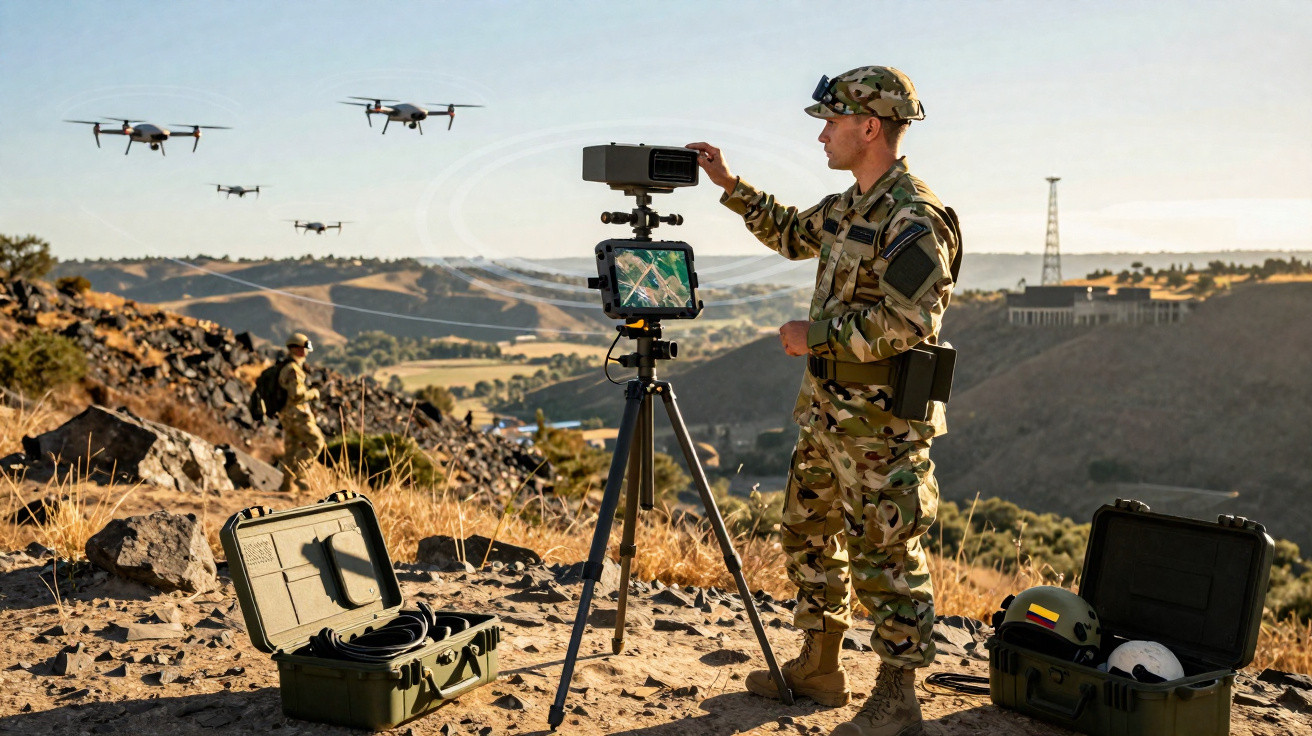
At the promotion ceremony for officers and the presentation of the military and police high command, held on 29 December 2025 at the parade ground of the General José María Córdoba Military Cadet School in Bogotá, Colombian President Gustavo Petro instructed Defence Minister Pedro Sánchez to begin procuring an anti-drone system. The measure is intended to enhance the State’s capacity to combat terrorist groups, reinforce defences at military bases and improve operational capability.
During the event, the head of state said that a budget of thirteen trillion pesos for purchasing the equipment must be managed through a Conpes document (National Economic and Social Policy Council). “We are talking about 13 trillion for effective weapons, not so that they remain stored in warehouses because they are of no use”; “We cannot put troops in front of the narcotraffickers and, therefore, we need anti-drones now; by any means”.
National Anti-Drone Shield Project: budget and strategic lines
The Ministry of Defence has launched a strategic initiative named the National Anti-Drone Shield Project. With an initial budget of $6.2 trillion pesos (approximately US$1.7 billion), the project will begin its preliminary stages in January 2026, allocating around $1 trillion pesos to the first development phase, which is planned to run throughout the year.
The initiative will be built around three strategic strands: legislation and doctrine; training and operations; and technology. It brings together a multidisciplinary team including the National Police and the Military Forces, all of which will participate in the Drone and Anti-Drone Group established at the end of 2025. Its principal mission will be to detect, identify and neutralise unauthorised drones; prevent drone attacks carried out by illegal armed and drug-trafficking groups; control airspace; anticipate emerging threats; and safeguard citizens’ lives.
In a post on his X account, the Defence Minister stressed: “This project, valued at 6.2 trillion pesos, seeks to protect our nation against a new challenge posed by drones and their use by threats…” “…this project seeks to guarantee control of the airspace, because otherwise we will lose many lives…”
Procurement requirements for Colombia’s anti-drone system
To begin acquiring the equipment, the Ministry of Defence has opened a tender process that is available to public and private entities, both domestic and international. Interested parties may attend an information meeting scheduled for 16 January at 9:00 a.m. Colombian time, and register through the Ministry’s website. For this call, the Ministry of Defence has set out a number of guidelines intended to ensure transparency and proper implementation, including the following:
A direct contracting process will be undertaken between the company and the national government, with backing from the State to which the signing company belongs. Only manufacturing companies may take part; intermediaries, systems integrators and trading companies will be excluded. Companies will communicate with the drone and anti-drone teams, which will be responsible for the dialogue, while proposals will be assessed by technical, economic and legal teams. Offering gifts, invitations or any activity capable of influencing the procurement process is prohibited. Finally, bidders must provide a performance bond from a recognised insurer.
It is worth noting that direct contact with the operators, who will determine which proposal is best, prevents outside interests from officers or politicians from interfering with the purchase, thereby making the process more transparent.
Some contractual conditions require the company to guarantee updates to the software it supplies. This includes technology transfer, training and instruction for trainers in operating and maintaining the equipment. It must also ensure that equipment is delivered within the agreed deadlines and that testing takes place in Colombia.
These procurement criteria are designed to ensure a call with rigorous technical, legal and economic standards, guarantee transparency, and protect the Colombian State against contractual non-compliance, as has happened with other defence contracts.
Between April 2024 and November 2025, Colombia recorded 382 attacks, resulting in 58 fatalities and 300 people injured. This is a very high figure given the nature of the conflict, making the development of this shield necessary to protect troops.
It should also be noted that the Army recently activated a drone battalion, which will be the leading unit in this process. However, as Zona Militar reported, it has shortcomings, specifically in counter-drone warfare and offensive capability.
















Comments
No comments yet. Be the first to comment!
Leave a Comment