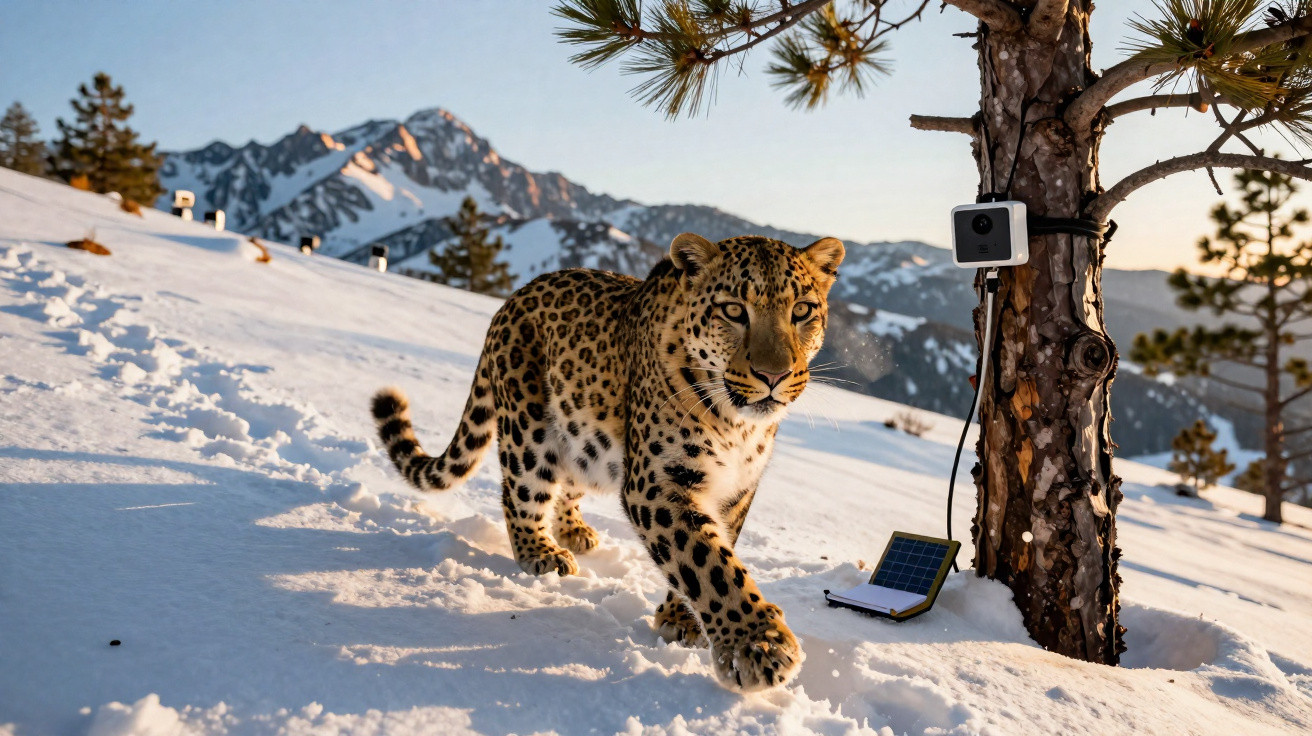
The first sign was neither a roar after dark nor a paw mark pressed into dust. It was a flashing red indicator on a trail camera spattered with mud, hidden deep within a neglected fold of the Caucasus Mountains. Two field biologists crouched in the cold, their breath suspended before them and their hands trembling more from anticipation than from the wind. For weeks, they had trekked along the same ridge, changing SD cards and searching for something almost unreal. Usually, the cameras recorded branches stirred by wind, stray cattle, or the occasional fox glowing like a thief caught in a torchlight beam. Nothing else.
Then a thumbnail loaded: two fierce eyes in snow and a low, spotted form flowing like a shadow through bare trees.
Neither scientist spoke.
Someone only whispered: “No way.”
There, frozen halfway through a stride on the small screen, was one of the world’s last wild Persian leopards.
Trail cameras capture a ghost in the forest
The trail camera that photographed the leopard had been fastened at waist level to a bent beech tree, nearly concealed beneath moss and frozen mud. Researchers had installed it weeks before on a slim animal track, winding between boulders and thorny shrubs, the sort of route known mostly to wildlife. They suspected it was a crossing point, having found wild boar tracks, deer prints and faint claw marks on a fallen trunk.
For much of the time, the woodland looked deserted. It was too silent and motionless, making the large predators mentioned in village whispers seem like nothing but old legends. That was precisely why the scientists placed greater trust in the camera than in their own sight. Made of metal, plastic and glass, it remained still and watchful, monitoring the same piece of darkness every night after people had left.
The video lasts only a few seconds. Drifting snow crosses the image and softens its edges. Then a powerful figure enters from the left. It has a thick tail, broad shoulders and rosettes scattered over its pale winter coat. The Persian leopard neither skulks nor retreats. It crosses the camera’s view with the confidence of an animal at home on the mountain, as though moving through a familiar corridor.
Afterwards, the team studies the recording frame by frame, counting whiskers and examining the pattern of spots along its side. Those rosettes function like a fingerprint. They establish the remarkable finding: this is not merely another leopard but an individual never previously recorded. It is one more living cat in a world where specialists fear fewer than 250 survive in the wild. To conservationists, the clip is not simply something likely to go viral. It is evidence of survival.
Trail cameras are, in truth, the spies of contemporary wildlife research. They do not grumble, sleep or become easily frightened. They endure storms, melting snow, dust and long months without activity. Such persistence is essential when monitoring an animal that deliberately avoids people, occupies territory as large as a small city and generally hunts at night.
People like to assume we “know” our mountains and forests. In reality, we tend to know only the areas we can reach at midday during a fair-weather weekend. Trail cameras overturn that assumption. They provide scientists with thousands of unseen eyes, discreetly documenting which animals pass through, where they travel and when they appear. For elusive species such as the Persian leopard, this is frequently the only means of discovering that they are still holding on.
How scientists made a cold hillside into a high-tech observatory
Capturing a leopard on camera does not involve entering the forest and randomly attaching devices to trees. The process starts at a kitchen table or shared office desk, with maps from the previous year spread around unfinished cups of tea. Researchers identify historic records, unreliable reports from shepherds, areas with concentrations of prey and even locations where rumours are more common than evidence.
Next comes the slow work of investigation: walkers’ photographs of unusual tracks, hunters’ accounts of a shape observing them from a ridge, and satellite images of isolated valleys lacking roads, settlements or lights. Using this information, the team builds a patchwork of possible zones. Then come the heavy rucksacks, packed with trail cameras, spare batteries, metal mounts and a particularly stubborn form of hope.
Conditions on the ground are different. What appears on maps as a route becomes a steep incline covered in loose stone. The team follows animal paths rather than marked walking trails, using scat, claw marks and branches broken at shoulder height for guidance. They search for natural pinch points: narrow saddles between hills, fallen trees that channel animals along one route, and shallow crossings where snow remains soft beneath sore paws.
One young Caucasus researcher recalled spending hours simply assessing how a ravine “felt.” Did it channel movement? Was it protected from the wind? Could a large cat stand there and scent everything in the valley below? Only once the terrain made sense from an animal’s perspective did she take a camera from her bag. This quiet, near-instinctive ability to read a landscape remains something no algorithm can fully replicate.
In reality, nobody carries out this work every day. Field teams operate in short, demanding spells - two weeks in one place, ten days in another - before returning to laptops and funding applications. The cameras remain behind. Choosing their locations is partly science and partly something more like storytelling. Where would a leopard place its paws if it wanted to avoid being seen while still needing to patrol its territory?
When the rare “ghost cat” eventually passes through the frame, months of preparation become concentrated in a few seconds: a blurred shoulder, a flicking tail or a head turned briefly towards the lens, perhaps irritated by a faint click. Those limited frames can alter conservation strategies completely. They may confirm the presence of a population, lead governments to redraw protected-area boundaries or halt plans for a new road that would cut through the final remaining corridor.
What the rare Persian leopard footage changes - and what it cannot
It is tempting to view footage like this as a happy ending: Persian leopard alive, mountains still wild, problem solved. Yet anyone familiar with these slopes understands that the situation is much more precarious. One recording does not make a population secure. It shows only that there are still animals that can be lost.
The difficult reality is that, when experts say “probably fewer than 250 left”, they mean animals dispersed across several countries and divided by roads, settlements, mines and diminishing forest fragments. Every sighting resembles seeing one light in a city after a blackout. It is reassuring, certainly, but not sufficient. What does change is the ability to state with confidence that these cats are here now, rather than existing only in old books or blurred photographs from the 1970s.
For communities living alongside the leopards, such footage can provoke complicated reactions. Some experience pride in knowing that their valley protects something scarce and almost legendary. Others are uneasy. Large cats may look magnificent on a phone screen, but feel less welcome when people are worrying about goats after nightfall. Conservation schemes that overlook this tension generally fail.
This is why an increasing number of teams take the videos to villages first. They screen clips in classrooms and tea houses, using portable projectors. They listen while elders compare the leopard on screen with stories remembered from childhood. A shared understanding begins to form: this is our animal, rather than merely a trophy for scientists. From there, discussions about compensation programmes, livestock protection and protected zones are more likely to turn into practical solutions rather than top-down rules.
The recording also raises an uncomfortable issue: what does “saving” a species really mean when its numbers are so low? It is not enough to draw a red circle on a map and label it a park. These leopards range across national borders, travelling from Iran into Armenia and from Azerbaijan towards Georgia, through landscapes shaped as much by politics as geology.
Technology can reveal where the cats still walk – it can’t decide how we share those landscapes. That responsibility belongs to us. It falls to governments, certainly, but also to consumers deciding where their timber, metals and holiday photographs come from. A few seconds of a cat walking through snow may seem insignificant. In fact, they reflect everything we are, or are not, prepared to change.
| Key point | Detail | Value for the reader |
|---|---|---|
| Hidden cameras detect what people overlook | Trail cameras discreetly watch remote routes around the clock | Helps readers understand how rare wildlife is located and recorded |
| Every leopard record can redraw maps | Fresh footage may lead to new protected areas or halt damaging developments | Demonstrates how a single clip can affect practical decisions and policy |
| Local voices determine the leopard’s future | Villagers, herders and governments must weigh safety, employment and conservation | Makes the story meaningful to anyone living near wildlife or concerned with coexistence |
















Comments
No comments yet. Be the first to comment!
Leave a Comment