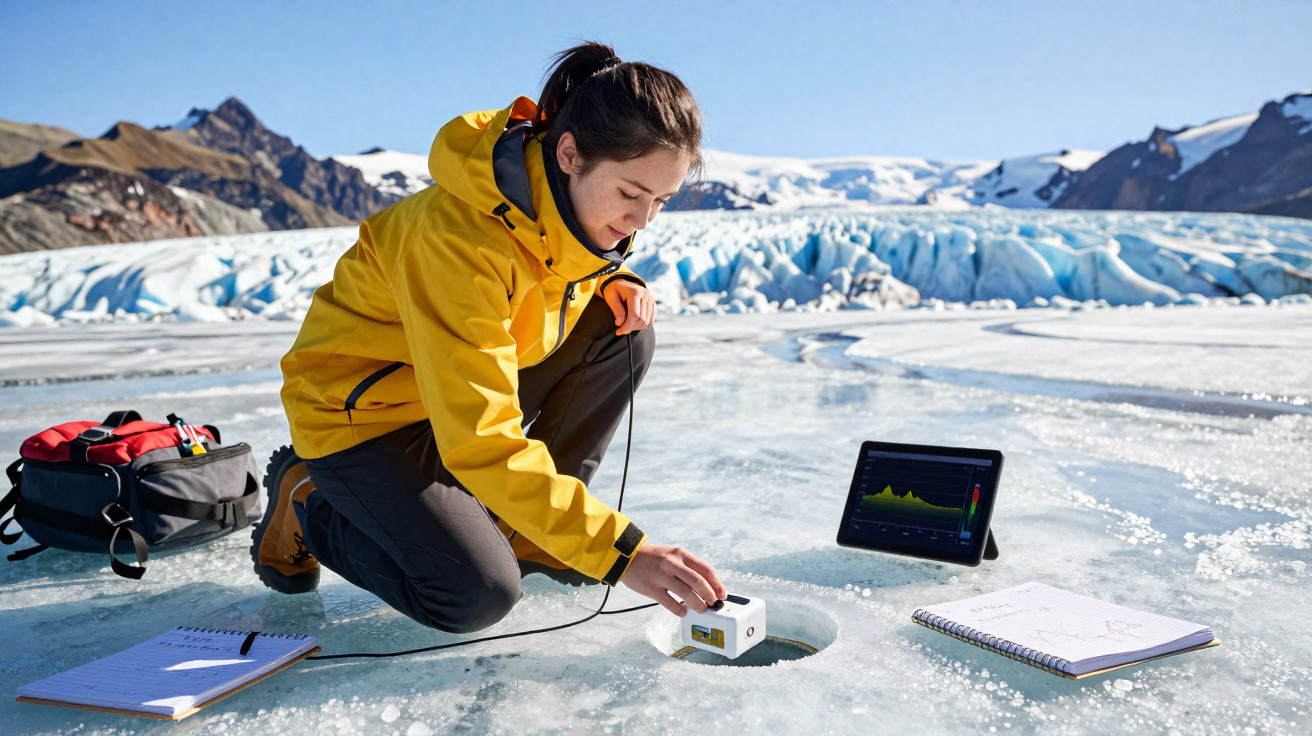
The metal case is scarcely larger than a shoe, but six scientists stand around it on the snow as though they are welcoming a newborn. Their breath hangs in the frigid Canadian air; their faces are flushed and their gloved hands awkward as they secure the final bolt. Above them, a drone buzzes as it records a small grey rectangle sitting at the edge of an enormous, fractured expanse of glacial ice that has grown thinner year after year.
One person examines an inexpensive off-the-shelf battery while another works on a smartphone. A green indicator flashes. There are subdued cheers and a few laughs, carrying as much relief as excitement. After months spent experimenting in cramped laboratories and garages, the affordable instrument sends its first signal skywards.
A string of figures appears on the display.
Nothing spectacular.
Only the kind of data that may transform the way we monitor a planet that is melting.
A small box on the ice, a major change for climate science
Imagine a Canadian Rockies glacier at summer’s end. Meltwater makes its surface slippery, blue pools gather in every dip, and muddy lines run across ice that was once unblemished white. Scientists have understood for decades that this ice is retreating, yet the equipment used to observe it has been costly, delicate and frequently unavailable to smaller research groups or communities.
A Canadian research team has now, without much fanfare, introduced a device that appears almost too simple. It is inexpensive, hard-wearing and made chiefly from parts that can be bought online by anyone. Positioned on the ice, it measures melting hour after hour and day after day, transmitting live data without a helicopter delivery or a million-dollar grant.
That is why some scientists are so quietly thrilled.
The concept did not emerge from a polished technology campus. It began in an unassuming university workshop, where money is consistently limited and every sensor has to justify the space it takes up in a rucksack. Frustrated by having to wait for funding before deploying conventional high-end instruments, a glaciologist drew a different possibility on a whiteboard: could a melt sensor cost a few hundred dollars rather than tens of thousands?
A small group then combined open-source code, affordable temperature and pressure sensors, a simple GPS chip and a weatherproof enclosure more familiar from garden projects than peer-reviewed research. Their first prototype stopped working midway through a storm on a test glacier in British Columbia. The second endured. By the third version, the team was trekking uphill with duffel bags full of the new boxes and installing them like weather stations for an era of disappearing ice.
The readings began arriving: clear, and unexpectedly detailed.
The importance is substantial. Glaciers supply rivers that provide drinking water, irrigation and hydropower for millions. However, knowledge of the rate at which this water “bank account” is being depleted has remained uncertain, particularly in remote or politically unstable places. Conventional instruments are expensive, require specialist upkeep and are often clustered on a small number of extensively studied glaciers.
A tough, affordable device changes that calculation. More glaciers can be observed more regularly and by a wider range of people: university researchers, northern communities and even citizen scientists who have some training. The number of eyes watching the ice rises dramatically. Suddenly, the story of glacial melt stops being based on a handful of snapshots and starts looking more like a live video feed.
For climate models, that information is immensely valuable. For those living downstream, it offers a reality check.
How the Canadian device works on a living glacier
The approach is remarkably uncomplicated. A researcher or local guide walks on to the glacier, drills a slim hole and fixes the small device in position, generally on a stable area of ice. Inside the box is a sensor that records shifts in ice thickness and surface location, alongside temperature and, in some cases, minute movements as the glacier flows downhill.
At scheduled intervals, every unit activates, logs conditions and transmits the information through a satellite or cellular network where one is available. There are no heavy cables or fragile laboratory-grade tripods. Its batteries are intended to last through severe seasons, while the casing can withstand snow, ice and the odd inquisitive fox.
The aim is to identify melting as it happens rather than only after the event.
One early major trial was carried out on a valley glacier in western Canada which local people have seen shrink since the time of their grandparents. Residents remembered where the ice had once reached, how long the walk to the snout used to take and how much louder the streams had become in spring. Yet stories alone do not persuade water managers or national policymakers. Data does.
The researchers installed a line of low-cost devices across the glacier, stretching from the lower tongue marked by dirt to the clean white upper sections. Throughout the melt season, each unit returned its own slightly different pattern of ice loss: fast thinning at the front, slower loss at higher elevations and abrupt peaks following warm rainstorms. When the graphs were presented at a town hall, neighbours could at last see their recollections expressed as numbers. One elder pointed to the screen and said softly, “That’s the sound we’ve been hearing”.
Scientific evidence had finally matched lived experience.
Technically, the genius isn’t in some flashy new sensor. The breakthrough lies in the underlying approach: rely on straightforward parts, tolerate small inaccuracies and make up for them through scale. Rather than protecting a single elite instrument like a crown jewel, researchers can place dozens of modest devices. Some will break and others may drift slightly, but the broader pattern becomes exceptionally clear.
This little box also represents a cultural change. More affordable equipment widens access. A small Arctic community need not wait for an international expedition to find out what its glacier is doing that year. A postgraduate student with a limited grant can operate a sensor network instead of repeatedly asking to borrow a single instrument. Let’s be honest: nobody really does this every single day, but the opportunity itself changes who can help create climate knowledge.
That is the understated revolution beneath the snow.
What glacier monitoring could mean for water, planning and daily life
For someone living in a city a long way from the mountains, this can seem distant. Consider your tap instead. Across many regions, summer water levels rely heavily on gradual melting from upstream glaciers, which act like a cold savings account that helps offset drought. The new Canadian device effectively enables us to “peek into the vault” with far greater accuracy.
With more frequent and less expensive monitoring, water managers can alter reservoir operations using more up-to-date information. Farmers can receive earlier alerts when a glacier-fed river is likely to run low in late summer. Emergency planners can recognise when exceptionally rapid melt, combined with intense rainfall, could increase the danger of flooding. It is not magic, but it replaces broad seasonal estimation with more precise week-by-week awareness.
That is a considerable improvement from something that can be carried in a rucksack.
There are still human pitfalls. A frequent error is to regard fresh data as a crystal ball instead of the beginning of a conversation. Dashboard figures can appear authoritative, making it easy for officials to depend on them while overlooking what people living on the land are noticing: moving riverbeds, fresh cracks in the ice or unusual animal behaviour. The device’s scientists understand this tension and seek to counter it.
They describe “co-design” with communities: deciding together where instruments should go, how frequently readings should be shared and which changes are genuinely important on the ground. Their strongest examples are not of a graph demonstrating that somebody was wrong, but of one supporting an instinct voiced by a local guide for years. Good data doesn’t replace people’s knowledge; it backs it up with timestamps and decimals.
Trust begins to form there, gradually, like fir trees beside a glacier-fed river.
The lead researcher on the project summed it up on a windy ridge: “We didn’t build this to win a gadget prize. We built it so more people can read what the ice is trying to tell us, before it’s gone.”
Affordable components
The device relies on off-the-shelf electronics and open-source software, reducing the price enough for smaller teams and communities to purchase and deploy it.Real-time melt tracking
By monitoring ice loss continuously, the units capture fast melting episodes and subtle seasonal changes that isolated measurements miss altogether.Broader participation
Its lower price and simpler construction allow glacier monitoring to extend beyond elite laboratories to schools, local authorities and northern communities.Better water planning
The fuller stream of information enables planners to anticipate low-flow years, manage reservoirs and prepare more realistically for droughts as well as floods.Stronger climate models
Dense device networks provide global models with newer, more detailed figures, improving projections that influence everything from policy to insurance.
A small device confronting an enormous melt
Viewed from a distance, the contrast is almost absurd. On one side are global climate systems, fossil-fuel politics and entire economies built around growth. On the other is a durable little box blinking through a snowstorm, attempting to measure the millimetres as ancient ice becomes water and flows downstream. But this is often how practical change appears: quiet, persistent and not particularly glamorous.
We have all experienced the moment when a basic tool makes a problem visible for the first time. This Canadian device can do that for glaciers. It cannot halt melting or resolve its causes. What it can do is turn uncertain anxiety into clearer signals, and clearer signals are more difficult to dismiss.
Perhaps its real strength is not the technology alone but the stories it may enable. Scientists, Indigenous leaders, farmers and students can each read the same melt curves, then draw their own connection between what the ice is doing and what should happen next.
Some revolutions begin with a speech.
This one may begin with a flashing green light on a lonely sheet of ice.
| Key point | Detail | Value for the reader |
|---|---|---|
| Low-cost device | Made with affordable off-the-shelf sensors and open-source code | Demonstrates that serious climate tools are no longer restricted to large, well-funded laboratories |
| Real-time glacier melt data | Tracks ice thinning, temperature and movement continuously on remote glaciers | Helps you see how changes to glaciers may affect rivers, water supplies and risk |
| Broader, shared monitoring | Communities, students and local researchers are able to install devices themselves | Brings more people into climate observation and decision-making, rather than limiting it to experts |









Comments
No comments yet. Be the first to comment!
Leave a Comment