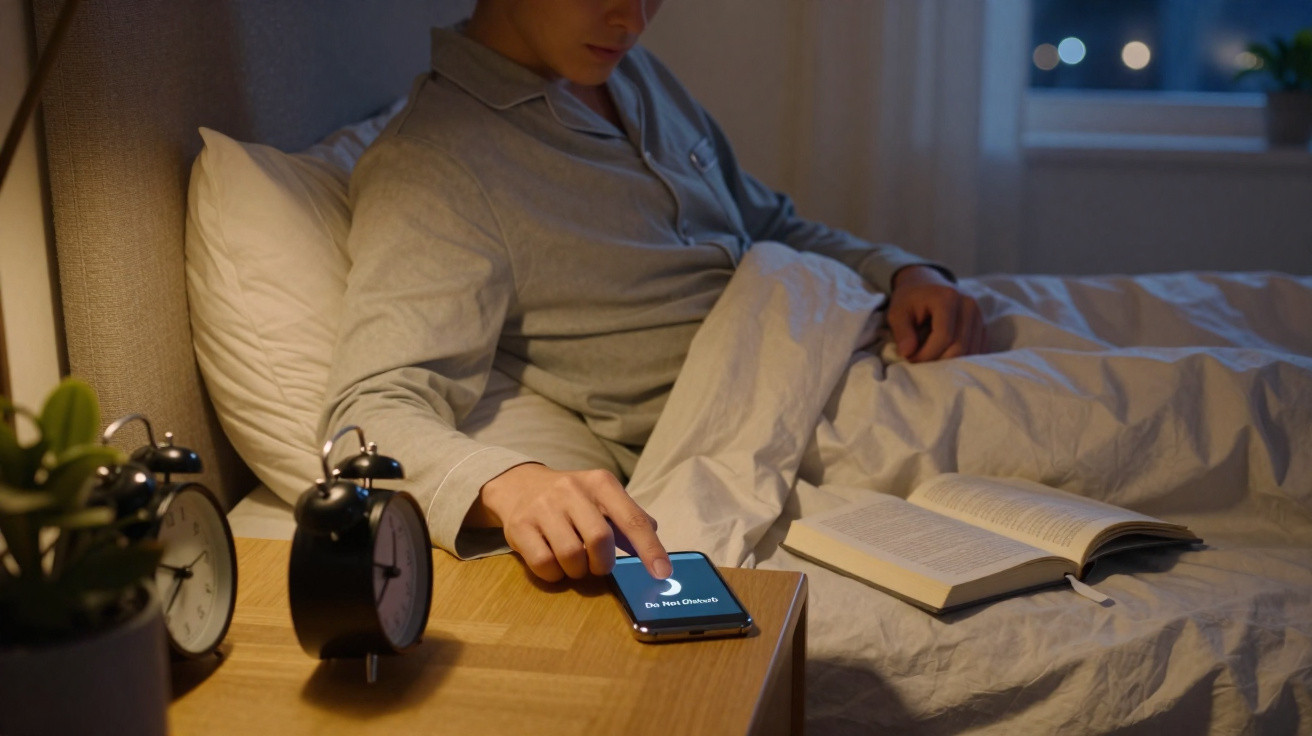
Smartphone use before bed is widespread: blue light filters promise an answer, yet millions of people still lie awake scrolling. We have all experienced it: the time suddenly changes from 11:12 to 12:04, while the mind refuses to settle.
The display is softened to a sepia tint, Night Shift is enabled, and brightness has been guiltily turned down with a thumb. It feels acceptable because news stories appear gentler in amber and messages no longer shine harshly back at me.
One notification leads to three open tabs, a muted video begins playing automatically, and there is a comment I know I should ignore but cannot. Nothing in the room has altered, yet my brain is suddenly alert and attentive, recording things it never requested. Time drags and then disappears, while the night sets around me like damp cement.
It was never only about the colour.
Why blue light filters are not enough
Night modes alter a screen’s colour, but they leave untouched the other two factors that determine whether you sleep: brightness and the stimulation created by your activity. Blue light is only one piece. Your body clock responds to light as a conductor responds to tempo, and it pays close attention to both timing and total intensity. A warm-toned screen at 80% brightness, held close to your face at 11:45 pm, still tells your body to “stay up”. The filter is a seatbelt, but the road remains icy.
There is a less dramatic finding from those who have tested this properly: studies comparing people who used an iPhone’s Night Shift at bedtime with those who did not found little to no difference in sleep. What repeatedly mattered was how participants used their phones. Extended social-media feeds, games and rapid messaging delayed bedtimes and made sleep seem lighter. Surveys show that a clear majority of adults scroll in bed, and many report waking more often during the night when they do. The screen tint did not save them; the behaviour kept them engaged.
Your brain responds to light, but it responds even more strongly to what feels important. Newness triggers dopamine. Interaction can raise cortisol. Movement, contrast and sound prepare you to act rather than rest. The glow is not the villain you think. The problem is the pairing of a bright rectangle near your eyes with a constant flow of cliffhangers, likes and alarming headlines. At midnight, you are not merely viewing light; you are operating a miniature casino in your hands. Filters make the casino beige, but the roulette wheel continues to turn.
What helps with smartphone use before bed instead
Treat bedtime as a landing rather than an abrupt halt. The change with the greatest impact is this: protect the last hour. Choose a time, perhaps 10:30 pm, and begin an uncomplicated wind-down routine 60 minutes beforehand. Lower your phone to the minimum usable brightness, use greyscale to remove its visual appeal, and activate Do Not Disturb so that nothing interrupts you. If phone use is unavoidable, choose a single calming app that has a clear end point: a downloaded playlist, a sleep-focused podcast or an e-ink reading app without a feed. Better still, leave the phone charging in the hallway.
Create friction for the late-night rabbit hole so that sleep becomes the default. Remove social apps from the first home screen. Disable autoplay. For any video or reading session, set a 15-minute timer to provide a definite stopping point. Small prompts work better than sweeping promises. Honestly, no one manages this every day. On some evenings you will forget and on others you will give in; that is all right. Focus on most nights. Two or three successes each week can move your body clock more effectively than a flawless run you abandon after ten days.
Your routine requires neither candles nor a worksheet. It needs a signal and a gentle route towards sleep. Consider writing for five minutes on paper to empty repetitive thoughts, taking a hot shower so your core temperature falls afterwards, and choosing one quiet activity you enjoy: ten pages of a book, a puzzle or a slow playlist. Afterwards, keep the bedroom cool and dark. Make the phone boring.
“Sleep starts long before you close your eyes.”
- Bedtime Mode and Do Not Disturb: enable them every night at the same time.
- Set brightness to 10–20%; switch on greyscale after 9 pm.
- Delete or move “infinite scroll” apps away from the home screen.
- Use a proper alarm clock and charge your phone outside the bedroom.
- Turn off autoplay. Set a 15-minute “last call” timer.
- Get morning light within an hour of waking to anchor your body clock.
- Stop caffeine in the afternoon, and keep the room cool and quiet.
Rethinking the nightly glow
Blue light filters seemed to offer an ingenious workaround: retain the habit and the dopamine while avoiding the outcome. Science suggests something more straightforward. Your body prefers regular rhythm, light that gradually fades and content that demands no more attention than you can give. In practice, that means low brightness, reliable timing and fewer cliffhangers before lights-out. This is not a moral choice; it is a practical one. You are selecting signals that support what you want your brain to do at 11 pm.
There is also a calmer world beyond the screen: a lamp that dims gradually, a brief post-dinner walk or a book you genuinely enjoy. When the ritual itself is appealing, the phone’s draw weakens without a struggle. You do not need a flawless routine or a monastery. You need one or two anchors repeated often enough that your body can anticipate what follows and relax into it.
The question therefore changes. Instead of asking, “Which filter fixes sleep?”, ask, “Which small change makes tonight easier?” The solution is not glamorous: a dimmer switch, a charging dock outside the door and content with a conclusion. The brain values closure. Give it some.
| Key point | Detail | Why it matters to the reader |
|---|---|---|
| Blue light is only one factor | Brightness, timing and engagement influence sleep more than colour alone | Avoid misplaced confidence in filters; focus on the factors that matter |
| Protect the last hour | Establish a wind-down period with low light, fewer inputs and clear endings | Fall asleep faster and wake less often without complex rules |
| Make the phone boring | Greyscale, Do Not Disturb, no autoplay and feeds removed from the home screen | Reduces late-night stimulation and keeps the bed for rest rather than scrolling |










Comments
No comments yet. Be the first to comment!
Leave a Comment