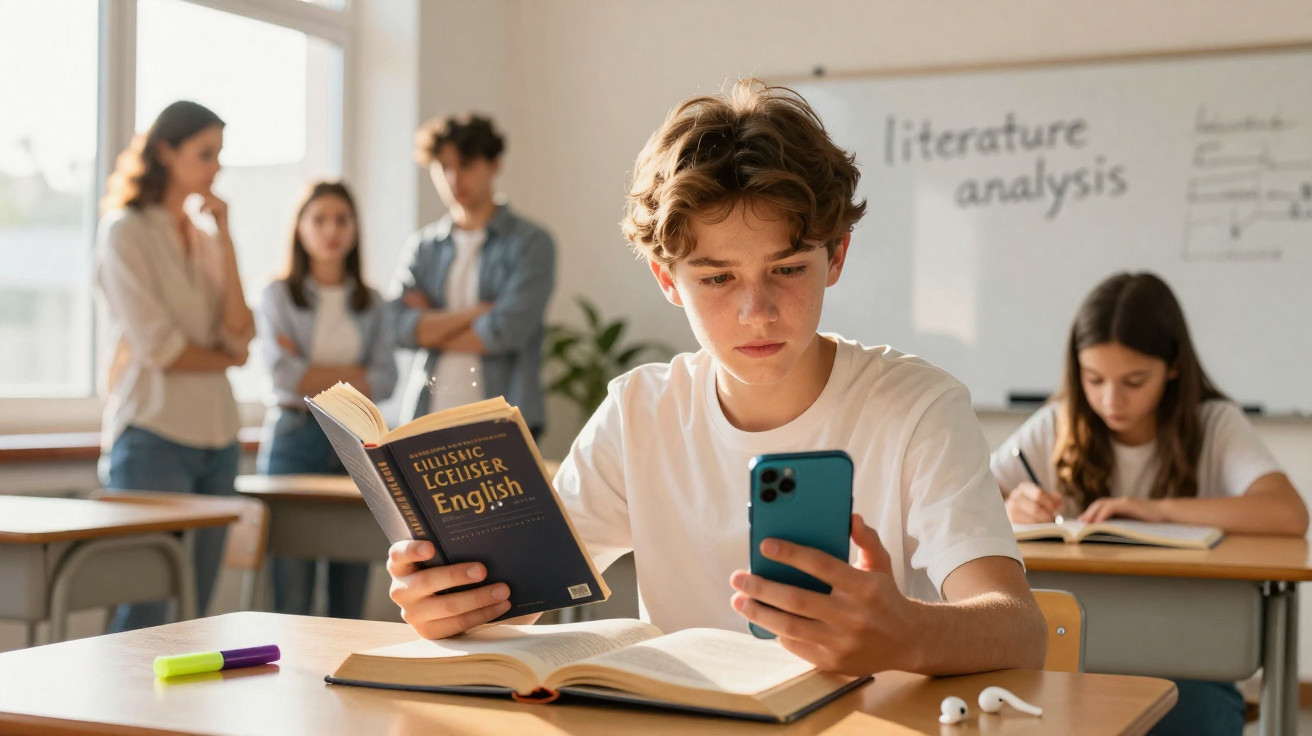
On a wet Tuesday evening, the auditorium at Lincoln High was filled with parents holding creased agenda papers and lukewarm coffees. They had not gathered for a talent show or a sports awards event. They had come because their children had returned home the previous week claiming they had “studied” Romeo and Juliet through 15-second TikTok clips.
In the car park, one mother flicked through her daughter’s phone and watched a sped-up mix of Shakespeare quotations and reaction memes. Her expression was a blend of bafflement and apparent offence.
At the front, the head of the English department stood beside an open laptop, with a PowerPoint slide paused on the words: “Meeting students where they are.”
The room seemed warmer than the thermostat suggested.
“We’re reading captions instead of chapters”: when classrooms enter full scroll mode
The first jolt of disbelief often happens around the kitchen table. A teenager drops their bag and casually explains that, rather than reading a novel, the class examined “trending BookTok soundtracks” to explore narrative voice.
Parents pause. They ask about essays, pages read and passages marked up. Frequently, the response goes something like: “We watched clips and wrote comments. Same thing.”
For an increasing number of schools, particularly those trying to present themselves as innovative while operating on limited budgets, replacing classic literature with short TikTok content can appear to be an easy route to engagement. Scrolling has found its way on to the syllabus.
At Jefferson Middle School, in a quiet suburb where the library still carries the scent of dust and plastic book jackets, the English curriculum was discreetly “refreshed” this autumn. The Giver and To Kill a Mockingbird disappeared from the Year 8 reading programme. In their place came weekly “media literacy labs” built around popular TikTok videos using the #BookTok and #StoryTime tags.
One father learnt about the shift only after seeing his son’s homework: TikTok comment screenshots intended for pupils to “annotate tone and audience”. There was no book and no printed text, only blurred usernames and emojis.
Within a few days, the parents’ Facebook group was buzzing. Images of the tasks, shown alongside the previous year’s reading list, circulated faster than any formal school message. One parent wrote, “My kid can scroll at home for free. I send him to school to read.”
Behind the anger lies a genuine concern about what may be quietly given up. Classic literature is slow, challenging, occasionally dull and often transformative. TikTok content is rapid, noisy and immediately gratifying. The two develop different mental habits.
Reading a novel develops endurance: remaining with a complicated character, noticing subtext and retaining long narrative arcs. Viewing a 20-second clip encourages instant judgement and quick emotional shifts.
The controversy is not simply Shakespeare against short-form video. It concerns the sort of attention schools decide to nurture. You don’t form deep readers with shallow rhythms.
Can TikTok and Tolstoy share a desk?
Some teachers caught between the two sides are quietly creating compromises. Rather than substituting TikTok for books, they use it as a loud entry point into the written text.
A secondary English teacher in Chicago begins her Odyssey unit with a selected playlist of TikToks retelling myths in chaotic contemporary language. Pupils laugh, groan and debate which videos “get it wrong.” She then gives them Homer’s actual lines.
Her question is: “What did the clip leave out? What did it change?” That becomes the connecting thread. The scroll serves as the hook rather than the main course. The book stays the centre of gravity.
Parents who object can sometimes take an all-or-nothing position: prohibit phones, block TikTok and call for a return to a 1980s-style syllabus. That response comes from love, as well as fear that their children may never experience being absorbed by a 400-page story.
But most teenagers already spend half their mental lives on platforms. When schools act as though that world is absent, pupils simply engage with it privately. Experienced teachers say the answer is neither to glorify TikTok nor to portray it as evil, but to bring it under control.
Let’s be honest: almost nobody reads Dickens every evening with their 13-year-old. Parents need practical ways to act, rather than tests of purity.
What is often left unsaid at these tense meetings is that many teachers feel cornered. Districts pursue “engagement metrics”, suppliers promote gleaming digital materials and school boards want to boast about innovative classrooms. Teachers are instructed to keep pupils looking at screens - any screens.
Some privately admit that TikTok content is the only thing that breaks through the exhaustion of a post-pandemic classroom. Others fear they are being pushed into superficial teaching.
“Give me permission to spend three slow weeks on a single novel,” one veteran teacher told me, “and I’ll give you real readers. But if you only value click-through rates and participation graphs, don’t be surprised when we start teaching like social media managers.”
- Ask what is being removed, not merely what is being introduced.
- Seek classes that combine short-form media with extended reading.
- Support teachers who defend sustained, quiet time for reading.
- Question programmes that turn literature into “content” and “engagement data”.
Where do we draw the line between relevance and surrender?
The dispute about TikTok in English lessons is ultimately a dispute about the purpose of school. Should it reflect the feeds children already inhabit, or offer access to something slower, stranger and harder to monetise?
We have all experienced that moment when your child is bent over a phone, laughing at a video you do not understand, and you feel as if attention itself is being cut into ever smaller fragments. Now picture the same scene beneath fluorescent lighting, with a mark attached.
Some parents will attend the next curriculum evening prepared for conflict. Others will arrive holding their breath and hoping for a sensible compromise. Somewhere between banning TikTok and bowing to it completely, there’s a fragile space where students can learn to scroll and to sit with a sentence until it finally opens up.
That is where the real struggle lies: not over apps, but over the kinds of minds being quietly shaped, one assignment at a time.
| Key point | Detail | Value for the reader |
|---|---|---|
| Ask precise questions | Request reading lists, example assignments and an explanation of how TikTok content is used. | Provides clarity rather than vague reassurance. |
| Look for balance | Short-form media should be paired with complete texts, rather than used in place of them. | Helps your child develop both attention and media literacy. |
| Support thoughtful teachers | Back educators who safeguard quiet, sustained reading time. | Makes it more likely that classics remain in your child’s classroom. |
FAQ:
- Question 1 Are schools really replacing classic books entirely with TikTok videos?
- Question 2 How can I tell if my child’s teacher is using TikTok as a tool, not a replacement?
- Question 3 What should I say at a school meeting without sounding like I’m attacking teachers?
- Question 4 Can short-form content actually help my kid enjoy books more?
- Question 5 What can I do at home to balance out a “scroll-heavy” classroom?














Comments
No comments yet. Be the first to comment!
Leave a Comment