
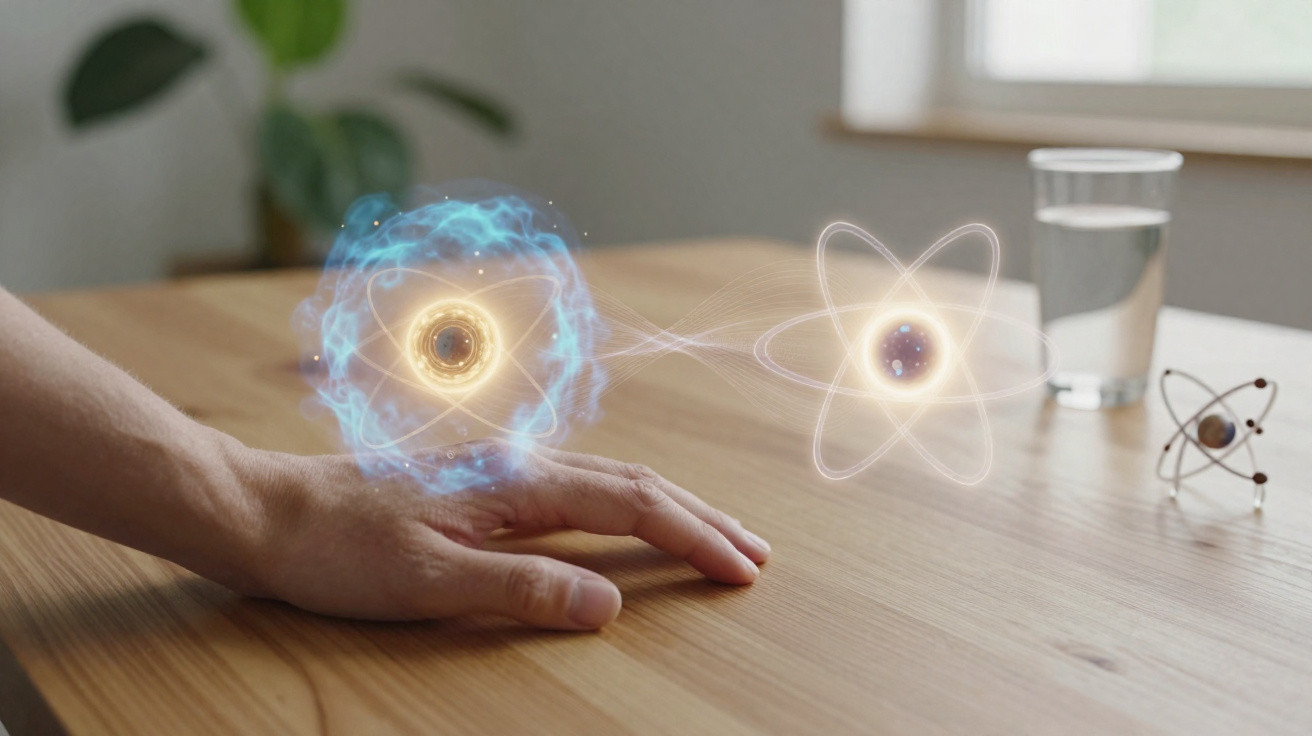
Have you ever considered that almost everything inside an atom is empty space-yet your chair still supports your weight without you dropping through the floor? Scientists have wrestled with this apparent contradiction for decades, and the explanation sits in the rules of quantum physics.
The hidden emptiness inside every atom you touch
Every atom contains a tiny nucleus made of protons and neutrons, with electrons moving around it as a kind of cloud. Between the nucleus and that electron cloud is a vast gap when you compare it with the size of the particles themselves.
To picture it: if an atom’s nucleus were the size of a marble placed in the middle of a football stadium, the nearest electrons would be way out in the stands. What seems like solid matter is, in fact, almost entirely empty space.
- Tiny nucleus: it holds nearly all of the atom’s mass, yet it takes up a negligible amount of space compared with the electron cloud.
- Electron cloud: it surrounds the nucleus and accounts for almost the whole volume of the atom, even though it is mostly empty.
- Enormous distance: relative to the nucleus, the space out to the electrons is immense.
- Electrical repulsion: the negative charges of neighbouring electrons push each other away before any “contact” can occur.
- Pauli exclusion: it stops two particles of the same type from occupying exactly the same quantum space.
When two surfaces meet, physics takes over
Putting your hand on a table feels straightforward, but underneath it is a complex give-and-take between particles. The electrons in your skin and the electrons in the wood never truly touch.
It is more like bringing two magnets together with the same pole facing. No matter how hard you press, something you cannot see forces them apart. That electromagnetic repulsion is what gives the world around you its sense of solidity.
The rule no particle dares to break
On top of electrical repulsion, there is an even stricter second line of defence: the Pauli exclusion principle.
Pauli exclusion principle
A rule nature never breaks
Under this rule, electrons-and other particles known as fermions-can never share the same quantum state at the same time in the same place.
That limitation prevents the electron clouds of two objects from overlapping, giving matter its characteristic firmness.
So even if the electron cloud in your body “tries” to overlap with that of a wall, nature simply will not allow it. Together, repulsion and exclusion are what hold up everything we call solid.
What this changes in your everyday life
Grasping these ideas helps explain effects that go far beyond classroom physics. Scanning tunnelling microscopes, used to image individual atoms, rely precisely on these quantum rules to work.
The same reasoning also sheds light on why different materials have different hardness, and why some electrons move freely in metals while others remain bound, creating insulators.
The near-impossible loophole quantum mechanics leaves open
There is a phenomenon called quantum tunnelling, where particles can pass through barriers that should be impassable. But the probability of that happening to an entire human body is so tiny that, for all practical purposes, it is zero.
Next time you sit on a chair or set a glass on a table, it is worth remembering that a universe of invisible forces is keeping everything in place. The emptiness inside atoms is real-but the rules of quantum physics are more powerful still.
If this dive into the world of atoms has sparked your curiosity, share it with someone else who enjoys uncovering the mysteries hidden in everyday life.






Comments
No comments yet. Be the first to comment!
Leave a Comment