
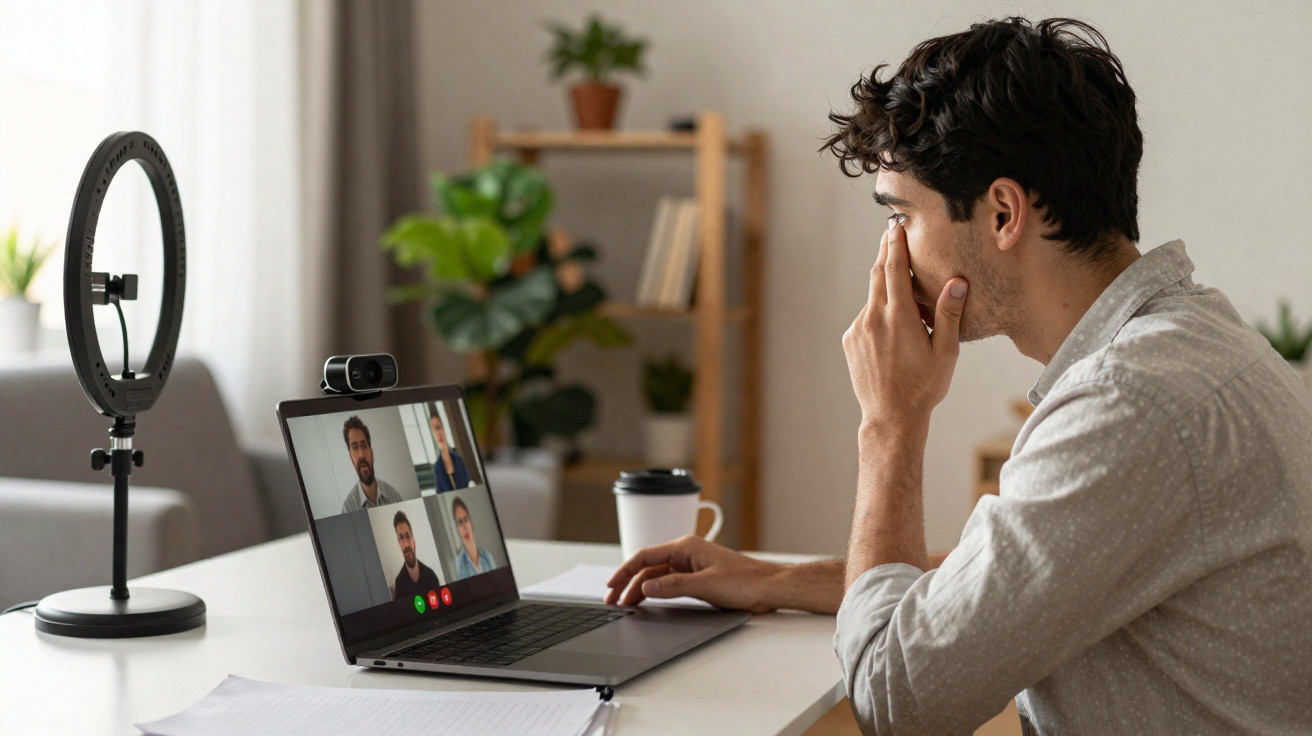
Work socials and other office get-togethers rarely top anyone’s list, but a lot of people feel especially uneasy when meetings take place via videoconference.
New research led by Chaeyun Lim at Michigan State University suggests that this feeling-widely labelled “Zoom fatigue” (videoconference fatigue)-is associated with dissatisfaction with one’s own facial appearance.
Surveys indicate that when remote working is available, employees tend to favour it, and people who rely heavily on videoconferencing often report relatively low overall distress.
Even so, Zoom fatigue is a genuine phenomenon. Prior studies show it can affect anyone, but women and people of colour report higher levels.
Although videoconferencing is not essential for everyone, it plays an important role for many individuals and sectors, supporting efficiency and productivity in a wide variety of situations.
The researchers note that Zoom fatigue could become a major obstacle to wider uptake of virtual meetings (VMs). However, the links between VM fatigue and dissatisfaction with facial appearance-and the way this fatigue shapes willingness to adopt videoconferencing-are still not well understood.
“Despite VM fatigue's critical role in shaping workplace interactions and digital inclusion in emerging virtual work environments, its effects on VM adoption – and the mechanisms linking facial appearance concerns, VM fatigue, and VM adoption – remain underexplored,” the authors write.
To explore this gap, Lim and her colleagues focused on impression-management features-tools built into videoconferencing platforms that allow users to change how they look by adjusting their own video feed.
The team recruited 2,448 workers based in the United States, drawn from professional, technical, or scientific roles. All participants worked remotely at least some of the time and regularly attended virtual meetings for work.
In a 15-minute survey, participants reported how they felt about their facial appearance and described impression-management behaviours, such as using touch-up options to improve their self-view, or applying video filters or avatars.
Using structural equation modelling, Lim’s group examined how these variables related to one another. They found that participants with greater dissatisfaction about their facial appearance also reported higher levels of VM fatigue.
That pattern, in turn, was linked with more frequent use of impression-management tools to alter the user’s appearance.
Some participants may have felt unhappy with their facial appearance before they ever experienced VM fatigue. Still, the researchers highlight signs that prolonged self-view on screens can intensify dissatisfaction.
“Excessive screen time, engagement with social media, and selective self-presentation through modifying photos before posting them have long been associated with appearance dissatisfaction,” they write.
“Similarly, the extended amount of time spent on VMs may exacerbate negative perceptions of self-image, as well as concerns of critical evaluation.”
The study also found that VM fatigue tied to facial appearance dissatisfaction was associated with more negative views of VMs-for example, judging them to be not useful-which then influenced attitudes towards adopting videoconferencing for workplace meetings.
One proposed remedy has been switching off self-video. Yet for many people this is not a realistic option, including those who prefer-or feel they must-keep an eye on how they look during meetings.
“Beyond disturbing workplace interactions and productivity, such negative experiences can create psychological barriers to adopting VM technologies, contributing to technology inequity in the workplace,” the team writes.
The authors point out several notable limitations of the new study, including that it cannot establish cause-and-effect relationships and that the survey only included US workers.
The researchers recommend that future work include participants across a wider range of cultural settings, and that studies be designed to test ways of reducing VM fatigue.
The study was published in PLOS One.




Comments
No comments yet. Be the first to comment!
Leave a Comment