
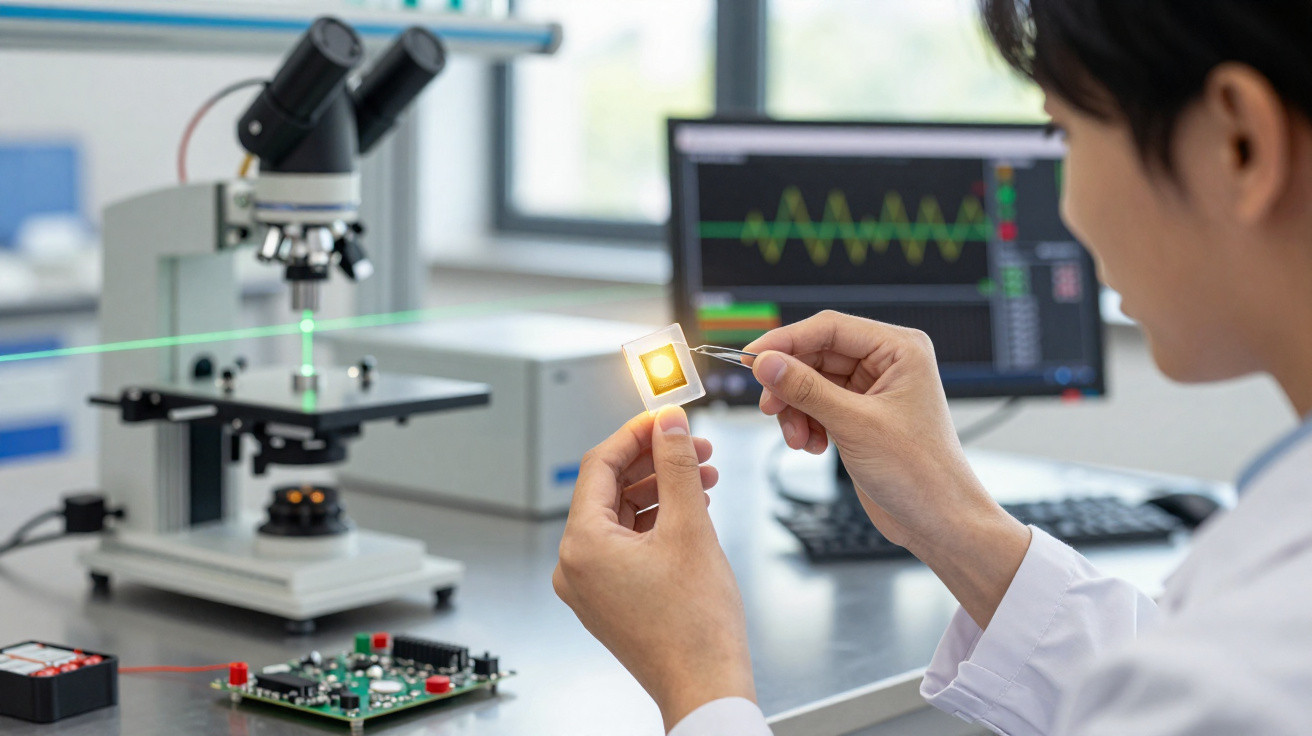
Researchers have created the first quantum battery that can complete a full cycle inside one device: it can be charged, store energy, and then release that energy as electricity.
This achievement turns what has long been a theoretical concept into functioning hardware, giving the research community a practical benchmark for pursuing faster energy storage.
How the quantum battery works
The battery is built as a layered organic device containing a minute cavity. When laser light was directed into that cavity, it ultimately emerged as electrical current, effectively completing the battery loop.
Dr James Quach at CSIRO showed that a prototype could be charged, retain energy, and then be discharged again.
The team built eight versions of the device and observed the same behaviour each time. In the larger versions, key charge points were reached more quickly.
That outcome flips conventional battery intuition on its head, raising the central question: why did increasing the amount of material make charging faster rather than slower?
Bigger size charges faster
Rather than relying on chemistry, the device exploited superposition during charging, in which quantum states can overlap at the same time.
Inside the cavity, many absorber molecules responded to incoming light together, rather than acting as independent, isolated units.
Because this collective response strengthened the connection between light and stored energy, adding more absorber molecules reduced charging time instead of extending it.
If this scaling trend holds in bigger architectures, quantum batteries could one day be far better suited to delivering rapid bursts of power.
A device that traps light
At its heart was a chamber lined with mirrors, designed to confine light between thin reflective layers within the device.
These mirrors matched the laser energy to the absorber molecules and generated polaritons-hybrid states combining light and matter.
Once those mixed states formed, energy could move through the device wirelessly, meaning a charging lead did not need to physically connect to the battery.
The approach remains extremely small and sensitive, but it gives researchers a controlled environment for probing quantum effects.
How the battery stores energy
Rapid charging only matters if the device can retain energy long enough to retrieve it.
In roughly 200 quadrillionths of a second, excitations transferred into a triplet state-an electronic state that relaxes slowly.
That transfer extended storage to tens of nanoseconds, around a million times longer than the charging pulse itself.
Even so, this brief window was sufficient to extract electricity, although any practical battery would require storage lasting far longer.
How stored energy becomes electricity
A system only truly behaves like a battery when stored energy can be converted into useful work outside the device.
Here, charge-transport layers moved separated charges towards opposing electrodes, converting stored energy into a measurable electrical current.
Relative to control devices without mirrors, the cavity-based design produced a threefold increase in photon-to-charge conversion efficiency.
Earlier studies had demonstrated rapid charging, but this work advanced the field by showing that electrical power could actually be drawn out.
Tests confirm the real effect
One of the most persuasive elements was not the headline finding itself, but the comparison with near-identical controls that lacked cavities.
Those control devices were fabricated on the same substrate, reducing the likelihood that subtle manufacturing differences accounted for the performance gap.
Once the cavity was removed, the unusual benefit of increased size vanished-implicating trapped light rather than an idiosyncrasy of the materials.
As a result, it became far harder to dismiss the outcome as a straightforward materials effect rather than a quantum one.
Why it works at room temperature
Many quantum technologies still demand very low temperatures, so operating this prototype under normal laboratory conditions immediately raised its significance.
Ordinarily, heat disrupts fragile quantum behaviour. In this case, light–matter coupling-a strong link between photons and electrons-helped preserve the crucial collective effect.
The tests were also performed in ordinary air rather than under high vacuum, nudging the work closer to practical engineering.
“Our proof-of-concept device showcases rapid, scalable charging and energy storage at room temperature, laying the groundwork for next-gen energy solutions,” said Dr. Quach.
The battery is still very small
Bold statements can obscure the experimental scale, which is still vastly smaller than anything comparable to a phone battery.
Peak discharging power density was between about 10 and 40 microwatts per square centimetre, a credible figure but still extremely small.
Energy retention also remained limited to tens of nanoseconds-adequate for a proof of concept, but nowhere near consumer requirements.
These constraints make the result more credible, and they also underline why commercial deployment remains distant.
Quantum batteries of the future
A single microscopic device will not threaten lithium-ion technology, so the clear next step is linking many units together.
The researchers highlight flat arrays with shared electrodes, enabling multiple cavities to operate in parallel.
Extending storage duration and improving charge separation are equally important, because rapid charging offers little benefit if energy dissipates too quickly.
“My ultimate ambition is a future where we can charge electric cars much faster than fuel petrol cars, or charge devices over long distances wirelessly,” said Dr. Quach.
By integrating charging, storage and discharge in one room-temperature device, this prototype clears a barrier that earlier quantum battery demonstrations did not.
It could take years before the approach powers cars or phones, but quantum batteries have now moved beyond theory: researchers have working hardware to refine and scale.




Comments
No comments yet. Be the first to comment!
Leave a Comment