The waiter arrives with the bill, and everyone eases back in their chairs, rolling their necks.
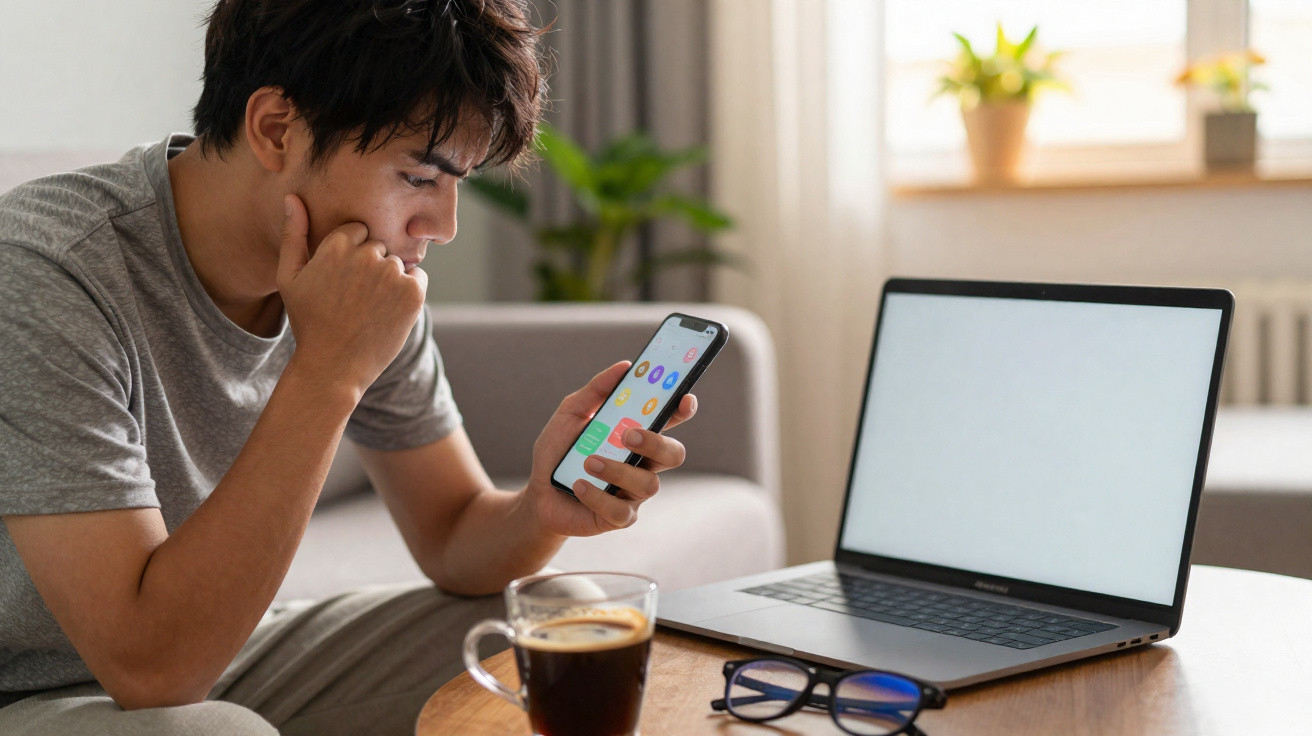
Laptops close with that crisp, pleasing click. The table already seems less cluttered. Yet your phone remains in your hand, your thumb moving through the screen automatically while your eyes look faintly unfocused.
You intended only to “quickly check” a notification. Twenty minutes on, you are moving between apps without taking anything in, with a slightly clenched jaw and tight shoulders. Time on the laptop felt useful. Time on the phone feels as though it is taking away something you cannot see.
In theory, a phone is smaller, lighter and more convenient. Physically and mentally, it can feel like the reverse. Your thoughts are crowded, your mood has dipped slightly, and it is as though you have been carrying a bag of sand in your head.
Why can such a small device feel so weighty?
Why your pocket screen weighs on your mind
Look around a busy train at rush hour. People rest laptops on their knees to answer emails or work on a spreadsheet, then fold them shut and stow them away. Phones, by contrast, stay in people’s hands. In moments, they move from Instagram to WhatsApp to breaking-news alerts.
Your phone is not a single tool: it is every tool at once. It holds work, friends, finances, family messages, news updates, dating, photos and emergencies. All that rapid switching leaves your brain unsure which “mode” it should occupy, so it remains partly prepared for everything. That permanent state of readiness is what makes it feel heavy.
A laptop comes with a more defined context. You open it to “do something”: write, research, watch or work. You open your phone to “be available”. And being available is tiring.
Imagine a Sunday afternoon on the sofa. Your laptop is on your knees, a film is playing, the charger is connected and nothing needs your attention urgently. You pause the film, stretch and get a drink. It all feels bounded, almost like a ritual.
Set that against scrolling on your phone in bed late at night. The screen is five centimetres from your face, casting blue light into already tired eyes. A Slack notification arrives, followed by a news alert, stories from your ex, a bank message and a comment on your photo. With every swipe, a different version of you is drawn into the room.
Researchers refer to “context switching costs”: whenever you move between tasks or roles, your brain uses energy to reload the relevant mental file. On a phone, you may change roles ten times in a minute without realising it. The heaviness comes from that continual background reloading.
There is also how intimate the device is. Your phone sits beneath your pillow, in your pocket and on the bathroom sink. It records your steps, heart rate and late-night searches. A laptop stays on a table; a phone rests against your body. That closeness makes every vibration a small emotional shock.
The mental burden, then, is not only about what you do on your phone. It is also about what the phone demands of you throughout the day. It keeps suggesting: “Something might need you.” Hearing that once is easy. Hearing it hour after hour becomes a burden.
How notifications, posture and design add quiet kilos
One practical way to reduce this “phone heaviness” is to create firm boundaries where your brain currently has none. The easiest place to start is with the physical location of your phone when you are not using it.
Try this for one week. Give your phone a dedicated “parking spot” at home that is neither your pocket nor your bed: a shelf, a basket by the door or a side table. When you get home, place it there face down. Use it while standing up, then return it to that spot.
This small rule has two effects. It makes phone use intentional rather than automatic. It also gives your nervous system a place that signals “I’m not on call right now”. That is the sense of separation a laptop bag once provided.
Posture is another source of weight. You are unlikely to spend hours bent over a laptop on the bus, with your neck lowered and wrist at an awkward angle. Yet many people use phones in exactly that position for long periods. That bodily discomfort contributes to mental tiredness.
Lift the phone towards eye level instead of lowering your head to it. Support your elbow so your wrist is not suspended in mid-air. When reading something lengthy, move to a larger screen where possible. The point is not productivity; it is comfort.
And, of course, the familiar warning is true: blue light at night disrupts your sleep cycle. Softer filters, warmer tones and a firm screen curfew can help. Let’s be honest: hardly anyone manages that every day. Even so, having some evenings when your phone stays outside the bedroom can ease that sense of heaviness more effectively than any productivity trick.
Beneath it all, phones are built to keep you slightly unsettled. Infinite scrolling, red notification badges and pull-to-refresh features are all designed to activate your brain’s reward system.
Every notification is a small lottery ticket. It could be nothing, drama or love. Your body reacts with tiny doses of anticipation and stress.
Laptops tend to present you with tasks. Phones tend to present you with feelings. That is why you can use a laptop for three hours and feel “tired but okay”, but spend forty minutes hopping between apps and end up strangely empty, mildly overstimulated and somehow heavier.
The encouraging part is that a handful of intentional habits can disrupt that pattern. Disable badges for social apps. Remove messaging icons from the home screen. Keep only necessities on the first page: maps, camera, calendar and calls. You are not refusing to use the phone; you are taking away its ability to pull at your nervous system whenever it chooses.
“The device in your hand is not neutral. It has an agenda. If you don’t bring your own, you’ll live inside its.”
Our phones are not disappearing, and, truthfully, we would not want them to. They are lifelines, cameras, compasses and emergency exits. On difficult days, they can also become escape routes that we slip through without noticing.
To make the weight more manageable, favour small, compassionate limits over dramatic digital detoxes. During a coffee break, pick one app and one specific reason to open it. At night, charge it just beyond arm’s reach. When your thumb pauses over the screen “just to check”, ask aloud: “What am I hoping to find?” Often, the answer is not in the rectangle.
You can also reorganise your phone as you would straighten up a cluttered studio. Keep fewer icons on the home screen. Remove social media from the dock. Mute groups that are rarely important. This is not a question of willpower. It is about rearranging the space so you stop colliding with distractions on the way to what you genuinely need.
- A home screen containing only 5–8 essential apps
- Notifications permitted only from people, not platforms
- A phone-free “parking spot” at home
Living lighter with the same device
Most of us know the moment: you place your phone face down, look at the ceiling and experience a sort of mental hangover. It is not caused by work or one major upset, but by a thousand small demands on your attention.
What if the answer is not a digital fast, but a quiet renegotiation of your relationship with this object? The same phone, with different rules. The same apps, with different access. You do not have to become someone who logs every minute of screen time and posts about a “dopamine detox”. You only need one or two limits that your nervous system can rely on.
Laptops feel less burdensome because they belong to particular places and times. They have a clear “on” and “off”. When your phone starts to follow the same pattern - parked, called upon and used for a reason - its mental weight changes. Rather than becoming a constant hum in the background, it becomes a tool you pick up and put down.
Ultimately, the question may not be why the phone feels heavier. It may be what you would rather carry when you set it aside: a slower thought, a walk, a conversation or simply the unusual experience of being unreachable for a short while.
| Key point | Detail | Benefit for the reader |
|---|---|---|
| The phone combines every role | Work, personal life, emergencies and entertainment on one screen | Understand why mental fatigue arrives sooner |
| Design creates continual restlessness | Notifications, infinite scrolling and constant context switching | Put words to the feeling of having a “full head” |
| Small rules reduce the burden | A parking spot, a simplified screen and targeted notifications | Practical ways to feel lighter without cutting everything off |












Comments
No comments yet. Be the first to comment!
Leave a Comment