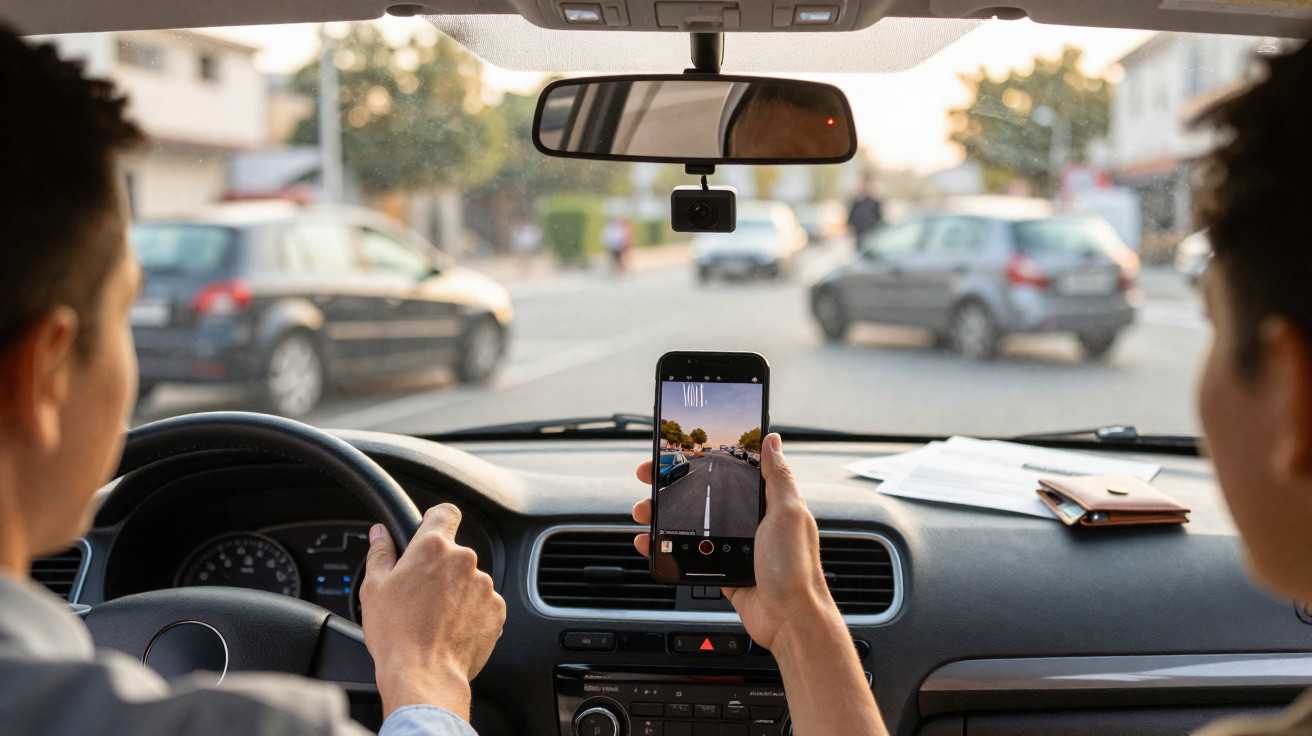
You never quite understand how delicate “the truth” can be until you are standing on a rain-soaked kerb, your hands trembling, as somebody confidently gives the police an account of events that simply never occurred. Your car is steaming, your pulse is racing, and a stranger is claiming that you changed lanes without signalling. You know that you did not. You also know that, in ten minutes, once the adrenaline has subsided, your recollection may become blurred and uncertain. Theirs, meanwhile, will somehow stay perfectly sharp and remarkably helpful to them.
At that point, insurance premiums and policy excesses are not on your mind. You are thinking: “How do I prove I’m not lying?” Without footage - without something impartial, clinical and digital - it becomes a contest of stories. Their word against yours. Somewhere, a weary claims handler is left to decide who wins.
That is when a cheap piece of plastic attached to your windscreen can become the most valuable witness you could have. It may be the difference between losing everything and keeping your no-claims bonus intact.
The morning everything went sideways at a roundabout
Speak to people in almost any office and, before long, someone will have a “my dash cam saved me” tale. For me, that person was Dan: the colleague who is always five minutes late, arrives carrying coffee, and looks as though he has just run through a wind tunnel. One Monday, he turned up early, pale and strangely composed, with his phone in one hand and a tiny SD card in the other. Holding it up like a lottery-winning ticket, he said, “I’d be ruined without this,”.
On the way to work, a van had moved across his path at a roundabout, caught his front bumper and forced him onto the kerb. Nobody was seriously injured, but the van driver had already begun delivering his prepared account: Dan had been speeding, Dan had used the wrong lane, Dan “came out of nowhere”. His voice had the certainty of somebody who had done this before - the kind of person who understands that sounding sure can make everyone else question themselves.
Then Dan did the most understated and satisfying thing possible after a collision. He gestured towards the little black rectangle fixed to his windscreen and said, “It’s all on there, mate.” There was no shouting and no scene. Just a calm, dreadful pause while the other driver understood that a camera had witnessed every second. The dispute stopped halfway through a sentence, as if the audio had been switched off.
From “50/50” to “not my fault” in one video clip
When the insurer called later, Dan did not need to depend on his memory or provide lengthy, miserable statements that he would agonise over for days. He simply uploaded the recording. It showed the van edging into his lane, the indicators - or absence of them - the timestamp and the drizzle across the windscreen. It was not dramatic; it was evidence. Without a camera, that sort of evidence is exceptionally difficult to obtain.
Anyone who has handled an insurance claim knows the phrase that can wreck your finances: “We’ll have to treat this as a split liability claim.” That courteous line really means, “We don’t know who to believe, so we’ll call it 50/50 and your premium will still rocket.” Dan avoided the entire ordeal. His dash cam changed what might have been a complicated, costly dispute into a clear-cut decision.
The repair costs for his car exceeded £3,000. His excess was £350. At his next renewal, the price barely changed. All because he had bought a £50 camera on a dull Sunday afternoon, driven more by curiosity than anxiety. There is something almost disconcerting about how quietly that choice proved worthwhile.
Why “your word vs theirs” is a losing game
We want to think that truth naturally prevails, and that honesty will make everything come right. Then adulthood arrives, along with car ownership, and we encounter the shadowy world of insurance investigations and conflicting accounts. Two people may live through the same crash and be utterly convinced of entirely opposing realities. One insists the traffic light was green; the other would stake their house on it having been red. Panic, pride and guilt become tangled in memories. Facts grow softer, while stories become fixed.
The driver who hit you may sound charming on the phone. They may be more capable of remaining cool under pressure. Or they may simply have more practice at “managing” an insurance claim. Meanwhile, you are hearing the tyres screech again and again in your mind, wondering whether you made an unnoticed mistake. Your voice shakes. You omit details. Later, you question yourself and wish you had said more.
In truth, hardly anyone sits down after a collision with a tidy notebook and carefully drawn diagrams, however much the advice pages recommend it. You are trying to stop your hands shaking and work out where you put your insurance documents. You take several unfocused photographs. You neglect to get that witness’s contact number. You assume the truth will reveal itself. It does not always happen.
The quiet power of a cold, emotionless lens
A dash cam removes much of that confusion. It does not panic or forget. It does not reshape events to make itself appear blameless. It records. The date, time, speed and road position, and sometimes even the GPS route. When it is “your word vs theirs”, the camera can quietly intervene and say: here is what actually happened.
Insurers appreciate that. They may not always say so initially, but claims handlers face a flood of contradictory statements and absent details. Providing a video clip instead of an unfocused account makes their work simpler. Some UK insurers even give discounts where an approved dash cam is fitted, not through generosity, but because fewer disputed claims mean less money leaving their accounts.
It is like employing a witness that never blinks and never favours either side. For the cost of a takeaway, you gain an account of events that cannot be intimidated, interrupted or conveniently rewritten an hour later in somebody else’s kitchen.
When the lie is deliberate – and aimed at your wallet
There is an even bleaker aspect to this: people who do not merely remember incorrectly, but deliberately stage or manipulate collisions. The familiar “crash for cash” scams that occasionally appear in the news are not urban myths. They take place on busy UK roads every week. A sudden stop on an empty road. A vehicle pulling in front and braking hard so that you drive into its rear. An unexplained passenger dramatically holding their neck two days afterwards.
Without proof, these cases are extremely hard to contest. On paper, you drove into the back of another car, which is generally considered your fault. That is the end of it. You may feel certain that you were set up, but instincts do not cover repair bills or legal costs. Fraudsters understand this. They operate in that murky space where there is suspicion but no evidence.
A dash cam throws an unpleasantly bright light into that uncertainty. It can reveal brake lights coming on without reason. It can demonstrate that there were no vehicles ahead, no danger and no child running into the road - only a calculated, cynical stop. Footage like that can make insurers take notice, reassess the incident and occasionally inform the police. One small camera can change you from an “easy target” into someone who is “too much hassle to try that on again”.
The day a scammer chose the wrong car
A reader once emailed me about what he described as his “favourite purchase of the last ten years”: a budget dash cam. He had encountered precisely this type of scam on the North Circular. A worn-out old saloon moved in front of him, slowed gently, and then slammed on its brakes with no apparent cause. He drove into it. The occupants jumped out, already angry and already partly through a phone call about “severe neck pain”.
As they spoke, he calmly pressed his dash cam and said, “Just so you know, that recorded everything.” He saw the driver’s face lose its colour in what felt like slow motion. The rage faded away. The performance ended. They still exchanged details, but the threatened injury claim never appeared. The dash cam had stopped the act before it had properly started.
He explained that he had bought the camera on a payday impulse, “because everyone online kept banging on about them”. It had no sophisticated features, rear camera or parking mode. It was simply a lens, a memory card and a power cable. That small box may have saved him thousands in fraudulent injury claims and exaggerated repair costs. Protection is not always spectacular; sometimes it silently removes a future problem that you will never completely see.
The £50 that keeps paying you back
Buying a dash cam is a distinctly unglamorous experience. It does not bring the excitement of a new phone display or the satisfaction of fresh tyres. Instead, you get a cable to tuck into the roof lining and a little square mounted just high enough to be mildly irritating until you stop noticing it. It is not thrilling. It is administration.
Even so, that unremarkable purchase can transform the financial calculations of motoring. One non-fault collision, where you cannot establish your innocence, can affect your insurance for years. Increased premiums, larger excesses and the growing fear that one more renewal could make driving unaffordable. A single clear video clip can prevent that sequence before it begins.
Picture your no-claims discount as a precarious pile of plates balanced on the dashboard. One “undecided” claim, labelled 50/50 for convenience, can break half of them. Over the coming years, that can mean hundreds of pounds quietly leaving your account. A £50 dash cam sits next to that pile, doing nothing on most days, before stepping in on one wet Tuesday and keeping it all upright.
It’s not just your money on the line
There is also the emotional burden of not being believed. Most of us have experienced someone telling a story about us that is not entirely true, followed by that fierce, powerless anger rising inside. Multiply that feeling tenfold when your driving, integrity and safety are being challenged after a crash. Being able to say, “Watch the video,” safeguards more than your money; it protects your peace of mind.
You no longer replay the collision repeatedly at 3am, wondering whether you could have made a stronger argument on the phone or filled in the form more clearly. You know the footage confirms what you recall. You know it was not imagined. In a situation filled with spiralling what-ifs and maybes, the camera becomes a small anchor of certainty.
If you have ever tried to make an anxious, newly qualified driver feel more comfortable on the road - a teenager, partner or parent returning to driving - that reassurance has real value. “If anything happens, the dash cam will see it” may be the difference between driving while tense and frightened, or simply… driving.
Choosing a dash cam without getting lost in the jargon
The amusing part is that you do not need an expensive, spaceship-standard camera to gain these advantages. A thoroughly capable model at around $50 (or about £40 in the UK) can record at 1080p, overwrite old recordings in a loop and automatically save clips when it detects an impact. That is sufficient to show lane placement, traffic lights, indicators and braking - the details that determine who pays for what.
Concentrate on the essentials: sharp footage in daylight and at night, a sufficiently wide view to capture what is happening on either side of the bonnet, and straightforward controls that do not require fiddling when you are stressed. You do not need app livestreaming, cloud subscriptions or a camera that could probably communicate with your fridge. A dependable lens and a good memory card handle 95% of the task.
Most drivers fit dash cams immediately behind the rear-view mirror, where they are legal and do not obstruct vision. Installation takes ten minutes, one mildly swear-filled struggle with a cable clip, and then you largely forget it is there - until the day you are exceptionally grateful that it is.
The tiny witness that changes how you drive
Knowing that your car is recording has another effect: you become slightly more conscious of your own driving. You allow a little extra room. You are marginally less likely to force your way through an amber light. It is rather like travelling with a courteous, silent passenger who occasionally raises an eyebrow but says nothing.
That does not make you a saint, and the camera is no replacement for common sense. It merely encourages the version of yourself that you would like always to be at the wheel: the person who could watch their own footage without flinching. Oddly, that may be its most overlooked advantage. A safer version of you means fewer near misses and fewer occasions when you whisper “that was nearly bad” to the steering wheel.
We buy car air fresheners and phone mounts without thinking, but the thing that could save us thousands – and a mountain of stress – is the one we keep putting off. A dash cam is not exciting. It will not make your car quicker or more attractive. It simply stays there, unblinking, prepared to speak for you when you most need support.
When the future you says “thank you”
Imagine it is late at night, the road surface is wet, and another driver strays into your lane on a dark dual carriageway. There is an impact, a jolt and the acrid scent of burnt rubber. Shaken, you get out to find the other driver already insisting that you caused it. Traffic is gathering, lights are flashing, and your heart is beating a drum solo in your chest. For a moment, cold panic takes over: what if nobody believes me?
Then you recall the little flashing light on your windscreen. Your shoulders ease slightly. You still need to handle forms, calls and the garage; life does not suddenly return to normal. But you are not going into a fight with nothing but your account and an unsteady voice. You have evidence. The balance of pressure changes.
Somewhere in the future, there’s a version of you who’ll either be desperately wishing they had a dash cam… or quietly relieved they do. Today, while all is well and roads are simply roads rather than crime scenes, you can choose which version of yourself you will be. That choice may cost less than a tank of fuel.



Comments
No comments yet. Be the first to comment!
Leave a Comment