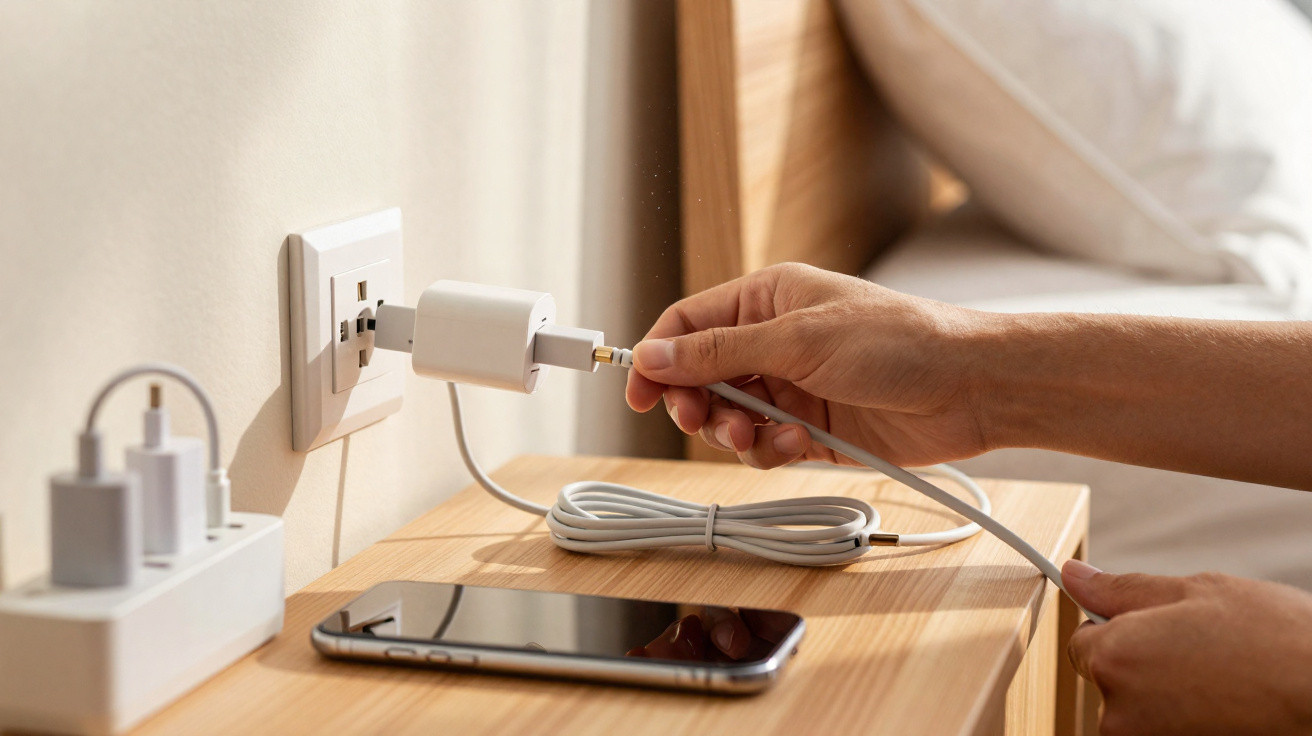
You plug it in, set your phone down on the bedside table, and do not think about it again until morning.
A small blue LED shines in the darkness as electricity hums softly. Beside it sits a mess of old leads, spare chargers and the bulky adapter you picked up from a bargain basket three years ago. Your phone reaches 100%, and you feel reassured: charged up and prepared for the day ahead.
A few weeks later, though, the battery appears to disappear by lunchtime. Apps seem more demanding and the percentage drops in abrupt jumps. You blame the handset, a software update or the manufacturer - but not the charger. The charger is never the suspect.
Yet one easy habit involving that plastic plug at the wall may be causing more harm in silence than all your scrolling put together.
The quiet battery killer in your bedroom
Most people assume phone batteries deteriorate slowly because of screen time, gaming or social media. That is only part of the picture. Often, the real culprit is plugged into the socket around the clock, even when no phone is attached: a cheap or unsuitable charger left permanently at the wall.
It seems innocent enough: compact, quiet and always available when required. However, many ageing or low-quality chargers can supply inconsistent current, producing tiny “power hiccups” that you cannot see. Your battery experiences every one. Night after night, charge after charge, those micro-stresses accumulate.
It is easy to assume that all chargers are interchangeable. Same connector, same cable, same outcome. Your battery would disagree silently.
A London repair-shop owner recently described a customer who brought in an almost-new flagship phone. It was less than a year old, yet its charge could plunge from 30% to 1% within minutes. There were no cracks or signs of water damage - only a worn-out battery behaving as if it were far older.
The usual questions followed: lots of gaming, excessive heat, power-hungry apps? Nothing stood out. The only unusual detail was the charger: an unbranded adapter bought online for about the cost of a coffee, left permanently plugged into an overloaded extension lead behind the bed.
The shop replaced the battery and tested the phone with an original charger. Its readings stabilised immediately. It was the same handset with the same use pattern, but a different power source. The difference was harsh and unmistakable.
Battery engineers will tell you lithium-ion cells hate three things: extreme heat, deep discharges, and dirty or unstable power. The last of these may not sound dramatic, but it can quietly remove months from a battery’s lifespan. Cheap or worn chargers may “pulse” power unevenly, causing tiny stress cycles within the cells.
Your phone attempts to even this out, but it cannot perform miracles. Eventually, the battery’s chemical structure changes and capacity declines faster than it would through ordinary day-to-day use. You may think your phone is ageing, when actually the power you give it is simply… poor.
Here is the catch: everyday use is predictable, and your phone is built for it. Poor charging practices are chaotic. Batteries do not like chaos.
The one habit that quietly ruins your battery - and how to reverse it
The biggest mistake is using whichever charger happens to be nearby, then keeping it plugged into the wall permanently like a small toxic tap. It might be the charger from the drawer, a hotel travel adapter, or a “fast charger” supplied with another device years ago. Your battery pays for that convenience every night.
The remedy is unexciting, but highly effective: use high-quality certified chargers that suit your phone’s specifications, and unplug them when you are not charging. There is no need to fixate on every percentage point. Simply stop the reflex of keeping a charger permanently connected and waiting.
Your phone will still recharge, and your routine will barely be affected. But the strain on its battery will reduce in ways that become clear months later, when it can still last a full day instead of demanding a power bank at 3 pm.
One grey Monday morning, I watched a colleague throw their phone onto the desk at 11 am; it was already at 19%. “This thing is dying,” they sighed. The phone was under 15 months old. They had already disabled background apps, reduced screen brightness and even changed to dark mode.
We looked into their routines. Chargers were everywhere: the office, car, kitchen and travel bag. Most were random chargers that had been borrowed and never returned. Some were visibly worn, while others felt slightly warm even when nothing was connected. At home, one remained plugged in behind the sofa all the time, collecting dust while its plug moved about in a loose socket.
They moved to one reliable charger at home and a certified one at work, unplugging both after use. Three weeks later, they sent a message: “Battery’s still bad, but it doesn’t free-fall anymore. It actually feels… normal.” It was not magic, just cleaner power.
The principle is straightforward. Every battery has a limited number of charging cycles, but those cycles are not all alike. Steady, properly regulated charging resembles a smooth motorway journey. Erratic, dirty charging is more like city traffic, with constant braking, acceleration, stops and starts. You cover the same distance, but the engine suffers greater wear.
Random chargers - particularly cheap ones - can create voltage spikes, become excessively hot or fail to work properly with your phone’s built-in protections for the best charging speed. In time, the phone may compensate by charging more slowly and cautiously, or it may simply lose capacity. To you, it feels as though “this phone is getting old fast”.
The frustrating reality is that daily scrolling may irritate you, while your charger choice quietly determines how long the battery can support that scrolling in the first place.
How to charge smarter without becoming a tech obsessive
You do not need a spreadsheet or an app to look after your battery. Three straightforward changes can make almost all the difference. First, choose one or two good chargers: the original model or one from a recognised certified brand. Keep one where you usually charge your phone, and retire the others - particularly any that get hot or appear damaged.
Second, remove the charger from the socket once you have finished. Not merely occasionally: make it part of the same action. Disconnect the phone, then pull out the plug. It is a small, quick physical habit. Third, do not charge from 0% to 100% every single time. Aim to keep your phone in the 20–80% range more often. Perfection is unnecessary; simply be less harsh on it.
There is already plenty of guilt around phone use: screen time, doomscrolling and late-night TikTok rabbit holes. Charging should not become another source of anxiety. Most people only want a phone that works properly and does not require a battery replacement every year. That is entirely reasonable.
The same mistakes happen everywhere: playing games while charging on a bed, where the phone gets hot; using an old tablet charger “because it still works”; leaving a cable bent beneath a pillow; or relying on a no-name airport charger after a long flight. This does not mean you are “bad with tech”. It means you are human and tired.
Let’s be honest: nobody genuinely does all of this every day. Nobody inspects chargers as carefully as a laboratory technician. The aim is not perfection, but to shift your habits from “slow battery suicide by convenience” towards something less damaging.
“People think batteries just ‘wear out’,” explains an independent repair technician I spoke to. “But a big part of that wear is how we feed them. Good power is like good food. You can’t see the difference on day one. You really feel it a year later.”
For busy lives, keeping it extremely simple helps. Use this quick mental checklist whenever you reach for a charger:
- Is this an original charger or one from a recognised certified brand?
- Is the plug or cable frayed, discoloured or unusually warm?
- Is it connected to a secure socket rather than an unstable extension lead?
- Am I charging on a hard surface that lets heat escape?
- Will I remember to unplug it when the phone has finished charging?
Pick three of these to focus on. If necessary, leave the rest aside. Even a partial effort is better than acting as if the charger has no effect at all.
What changes when you stop ignoring the charger
A subtle change happens when you begin to view the charger as part of the phone rather than a random accessory. You feel slightly more in control. The battery indicator stops being purely a source of anxiety and becomes a quiet sign of whether your small habits are helping or harming you.
Many people understand this only after an unpleasant incident: their phone dies in the middle of a journey, a video call freezes at 2%, or a digital boarding pass disappears immediately before boarding. On a good day, you laugh about it; on a bad one, it becomes a story you repeat for months.
We keep these glass rectangles closer to us than some friends. They wake us, direct us home and store our photos, passwords and conversations. Giving a little more care to the way we charge them is not technological obsession. It is peace of mind.
Replacing that one dubious charger and unplugging the reliable one after every use will not feel heroic. No app will applaud you. You will probably stop noticing the change after a week. But six, nine or twelve months later, when your battery still comfortably lasts the day, you will notice the result.
Perhaps you will mention it to somebody whose phone is already struggling by midday. They may roll their eyes, then quietly replace their charger that evening. That is how these small invisible habits spread: not through grand tech manifestos, but through genuine stories, minor adjustments and a phone that simply… lasts.
| Key point | Detail | Benefit for the reader |
|---|---|---|
| Choose a good charger | Use original or certified chargers that are suitable for your phone | Reduces premature wear and the risk of batteries becoming “tired” too early |
| Unplug after use | Do not leave the charger permanently connected to the wall socket | Limits electrical micro-stresses and avoids unnecessary battery exposure |
| Make charging cycles gentler | Avoid routinely charging from 0–100%; favour the 20–80% range | Extends battery life without completely changing your habits |














Comments
No comments yet. Be the first to comment!
Leave a Comment