
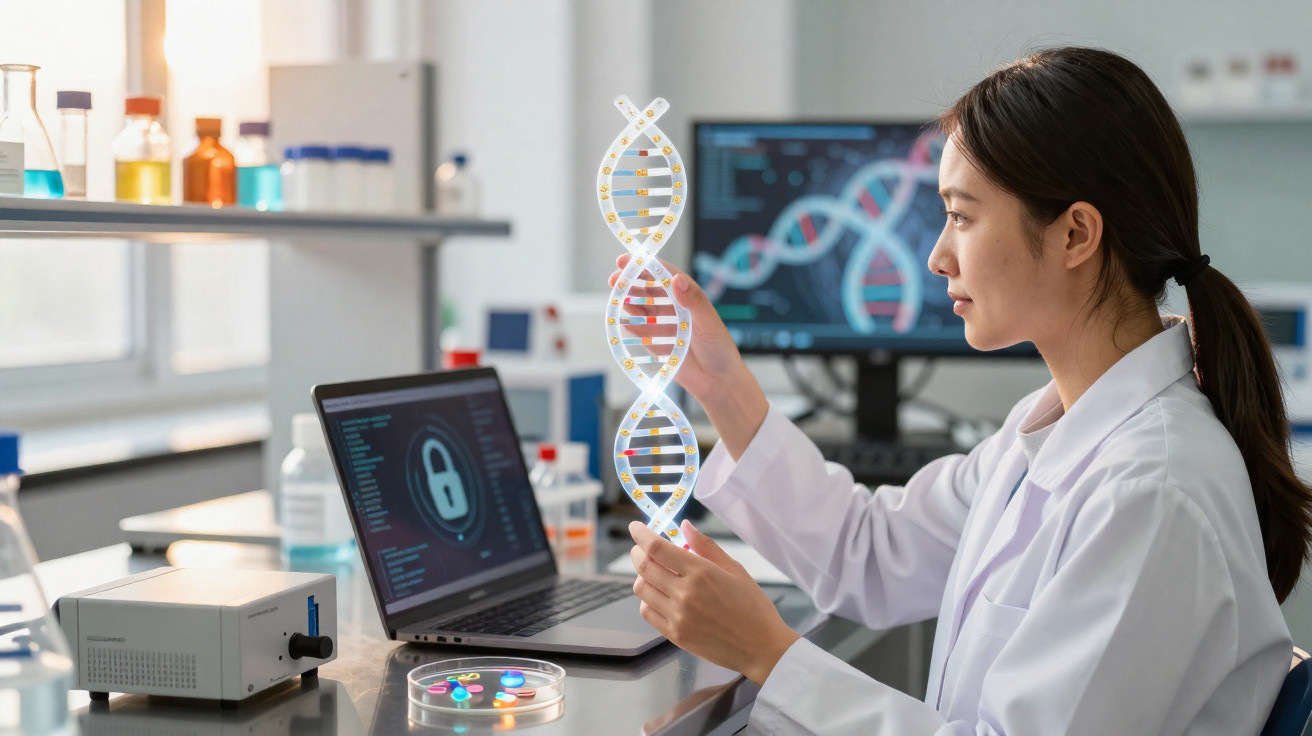
The next era of data storage might not be housed inside a computer at all. Instead, it may be contained within DNA molecules.
With the world producing unprecedented quantities of digital information, scientists are working to create storage technologies that are more compact, durable and secure.
A team at Arizona State University (ASU) has shown that engineered DNA can provide both data storage and encryption, with the potential to surpass traditional silicon-based technologies.
DNA challenges silicon storage
Today’s computers use silicon to retain and safeguard information. Although silicon operates quickly, storage infrastructure requires sizeable facilities, uninterrupted electricity supplies and cooling. Preserving information over the long term is also challenging.
DNA presents a remarkable alternative. Minute quantities of DNA can contain vast amounts of data while remaining stable for thousands, or even millions, of years.
“For decades, information technology has relied almost entirely on silicon,” said Hao Yan, a Regents Professor in the School of Molecular Sciences at ASU.
“What we’re showing here is that biological molecules, specifically DNA, can be engineered to store and protect information in fundamentally new ways.”
“By treating DNA as an information platform rather than just a genetic material, we can begin to rethink how data is stored, read and secured at the nanoscale.”
Encoding data with DNA
Rather than treating DNA as a lengthy sequence of genetic letters, researchers use it as a set of construction blocks.
The DNA strands are folded into microscopic structures, much like paper origami. Every structure represents an item of information, in the same way that letters combine to make words.
The data is not obtained by reading a genetic sequence. It is contained in the structure itself. Distinct forms represent distinct messages, just as different keyboard symbols carry different meanings.
When these tiny DNA forms pass through miniature sensors, each one produces its own electrical signature. Machine-learning-trained computer programs identify these signatures and associate them with the relevant structure.
After the form has been recognised, the message it contains can be read again. Because genetic sequencing is unnecessary, this method is quicker and considerably less expensive than conventional DNA sequencing.
DNA-based encryption systems
A second study applies DNA storage principles to encryption. Scientists create intricate DNA origami designs in which information is concealed in nanoscale configurations. Accessing these designs depends on specialised imaging equipment and decoding rules.
High-speed DNA-PAINT super-resolution imaging makes it possible to view individual DNA docking points with nanometre-level precision.
Machine-learning software subsequently sorts clusters of signals and rebuilds the encrypted messages. Without the right decoding rules, the designs seem to have no meaning.
The routing, sliding and interlacing of DNA strands produce a vast number of potential folding routes.
The encryption key is more than 700 bits long, substantially exceeding widely used digital encryption standards. As a result, unauthorised decoding is almost impossible.
Faster imaging improves security
Previous DNA origami encryption techniques depended on slow imaging approaches, whereas high-speed DNA-PAINT addresses this constraint.
Thousands of DNA structures can now be read within minutes rather than hours. At the same time, unsupervised clustering algorithms assess the patterns without training data, increasing both accuracy and speed.
The research teams reached readout accuracy of close to 90 percent, including for three-dimensional DNA structures.
Error-correction methods raise reliability further by building redundancy into the pattern designs. This ensures that accurate messages can still be recovered when some signals are lost.
Three-dimensional DNA origami provides another protective layer beyond conventional two-dimensional formats. Data can be concealed through depth, angles and spatial positioning, making it harder to decode with standard imaging equipment.
Super-resolution microscopy records these intricate arrangements accurately, and the researchers demonstrated effective encryption and decoding with wireframe forms and rigid DNA assemblies.
More rigid assemblies increased accuracy because they limited structural flexibility.
Bridging biology and computing
The researchers demonstrated that DNA can perform two essential functions simultaneously: it can retain information and protect it.
Certain approaches concentrate on rapidly reading stored data, much like a computer accesses files. Others aim to conceal information in complex DNA structures that are exceptionally difficult to duplicate or predict.
DNA-based storage may support the long-term preservation of extensive information collections, including scientific research, historical archives and medical records.
DNA encryption may also function in demanding environments, including intense radiation or extreme heat, where conventional electronics frequently fail.
The work combines several disciplines. Biology supplies the DNA, materials science shapes it, electronics enable it to be read, and machine learning assists with decoding.
DNA is no longer regarded solely as a component of living cells. It is now emerging as a durable, secure means of storing and protecting future information.






Comments
No comments yet. Be the first to comment!
Leave a Comment