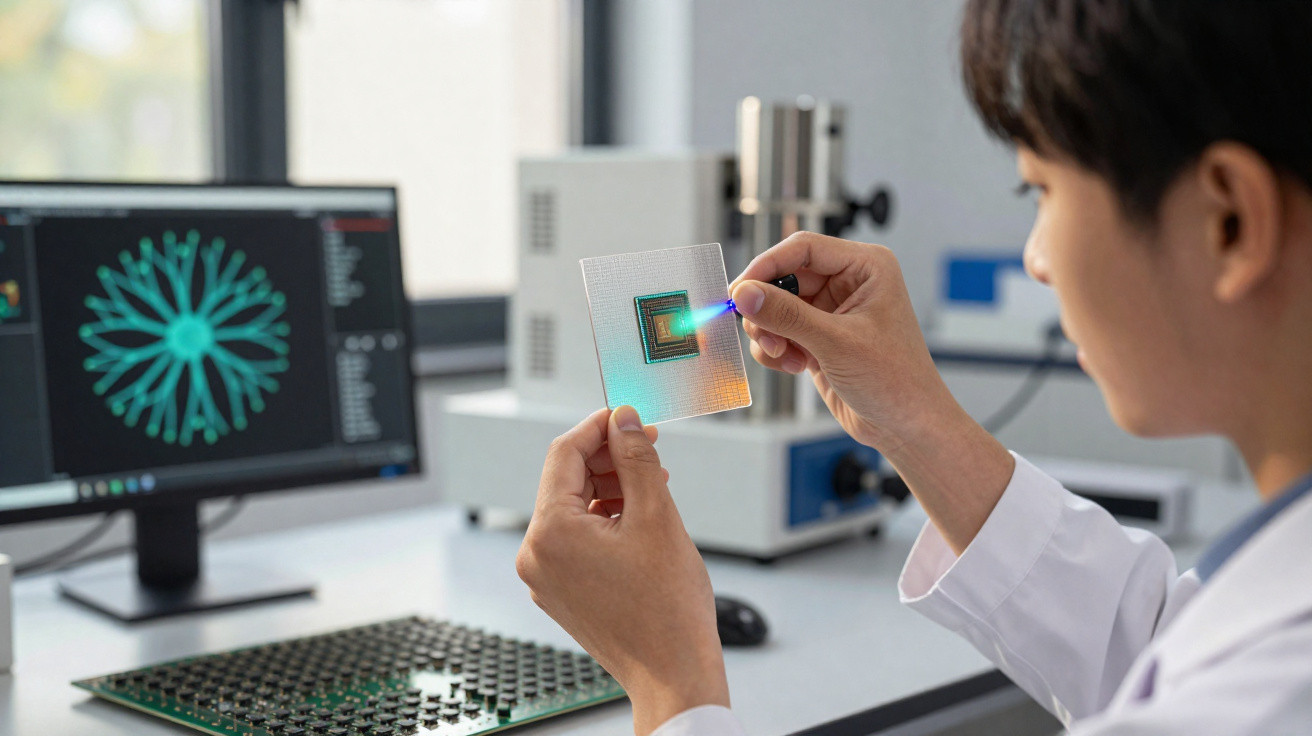
Scientists have demonstrated that ultra-thin carbon sheets can retain a record of the way electricity has passed through them.
This inherent memory may enable artificial intelligence systems to operate with lower power demands, as less data would need to travel between separate computer components, reducing pressure on data centres.
Materials that store memory
In a range of demonstrations, atom-thick carbon films repeatedly switched between electrically conductive and resistant states, remaining stable after every change.
After comparing these patterns, Dr. Gennady N. Panin of the Russian Academy of Sciences (RAS) concluded that the material is capable of storing memory.
His RAS review connected this stability with atomic-scale alterations that fix a device in one of several possible states.
Retaining memory within the same component that detects a signal could reduce the energy requirements of artificial intelligence chips.
How memristors work
Engineers use memristors-small electrical components whose resistance changes according to the amount of current that has passed through them-where resistance must respond to previous current and retain its setting without continuous power.
A 1971 paper suggested the device as a missing circuit element, defining it through the relationship between charge and voltage.
Made from two-dimensional (2D) materials-crystals that are only a few atoms thick-these devices can be densely packed and switched using low voltages.
After it has been programmed, a non-volatile state-memory that remains after power is removed-can retain the weights used by artificial intelligence to make decisions.
Why AI consumes electricity
Most computers use the von Neumann architecture, which separates processing from memory, and this division consumes energy.
The International Energy Agency projected that global data centre electricity consumption could reach about 945 terawatt-hours by 2030.
Transferring data between memory and chips can account for more than 50% of a system’s electricity use.
Combining storage and computation within one 2D element reduces this back-and-forth movement, lowering heat while making more electricity available for processing.
Conductivity by design
Graphene, a carbon-atom sheet just one atom thick, is central to the work because electrons can move readily through its flat lattice.
When voltage is applied, sections of its structure can form new bonds, leaving some areas less conductive and increasing resistance in a controlled manner.
“Two-dimensional materials possess unique structural and electronic properties required for the development of highly efficient nanoenergy memristor devices for low-energy information technology,” wrote Panin.
These reversible changes in bonding can provide stable memory states, although they must stay reliable through years of heat, stress and repeated switching.
Oxygen flips the current
In graphene oxide, which is a graphene sheet covered by oxygen groups, introducing oxygen makes it more difficult for current to pass and increases resistance.
Through a redox reaction-a transfer involving oxygen and electrons-the material can shed oxygen, restore its conductivity and reduce resistance.
The devices reviewed maintained controllable oxygen movement, allowing dependable switching even when engineers used different electrode materials.
This chemistry creates several stable levels, enabling a single cell to hold more than simple on and off values.
Light writes another layer
Memory can also be written with light, producing a photomemristor: a memristor whose state is altered by light rather than voltage alone.
Photon energy can move atoms into a particular arrangement, allowing the device to sense light while also storing the outcome.
Switching that works from ultraviolet to infrared light could help machine vision systems stay accurate under changing lighting conditions.
Although optical control offers extra flexibility, future designs will need to stop stray light from replacing a stored state during normal operation.
Smarter machine vision
Bringing memory and calculations into the detector makes in-sensor computing possible, meaning signals are processed within the detector for quicker recognition.
In Panin’s examples, a sensor altered its conductance and retained that setting, sending subsequent circuits a cleaner and smaller flow of data.
This behaviour supports neuromorphic computing-hardware designed to imitate the way neurons transmit signals-and is well suited to vision tasks involving repeating patterns.
Reducing the data that leaves a sensor could lower power use in AI vision for self-driving cars, though training would still take place elsewhere.
Building dense grids
Dense arrays are important because AI models hold millions of weights, with every weight requiring a predictable low-power value.
Using a two-electrode structure, large numbers of 2D memristors can be arranged in grids, allowing currents to add and multiply within memory.
Placing these layers above CMOS, the standard transistor technology used in chips, could allow sensors and memory to occupy a single stack.
Scaling up requires defects to be tightly controlled, because one weak cell may distort part of the CMOS hardware and spoil the results.
Roadblocks before deployment
Chips intended for real-world use must withstand heat, vibration and years of switching, making endurance tests just as significant as material development.
Manufacturing requires repeatable patterns, while methods such as focused beams and lasers must be scalable without increasing costs or harming CMOS layers.
Several switching mechanisms are competing, so engineers will need to select either rapid optical control or slower chemical tuning according to the application.
Until these arrays can be programmed as simply as current memory technology, 2D memristors will remain largely confined to research laboratories.
Future of carbon memory
Embedding memory in atom-thin materials alters where visual computing can take place by keeping signals alongside their stored states.
Should engineers establish long-term reliability and integrate these components into CMOS manufacturing, data centres may be able to perform more AI work while using less electricity.
















Comments
No comments yet. Be the first to comment!
Leave a Comment