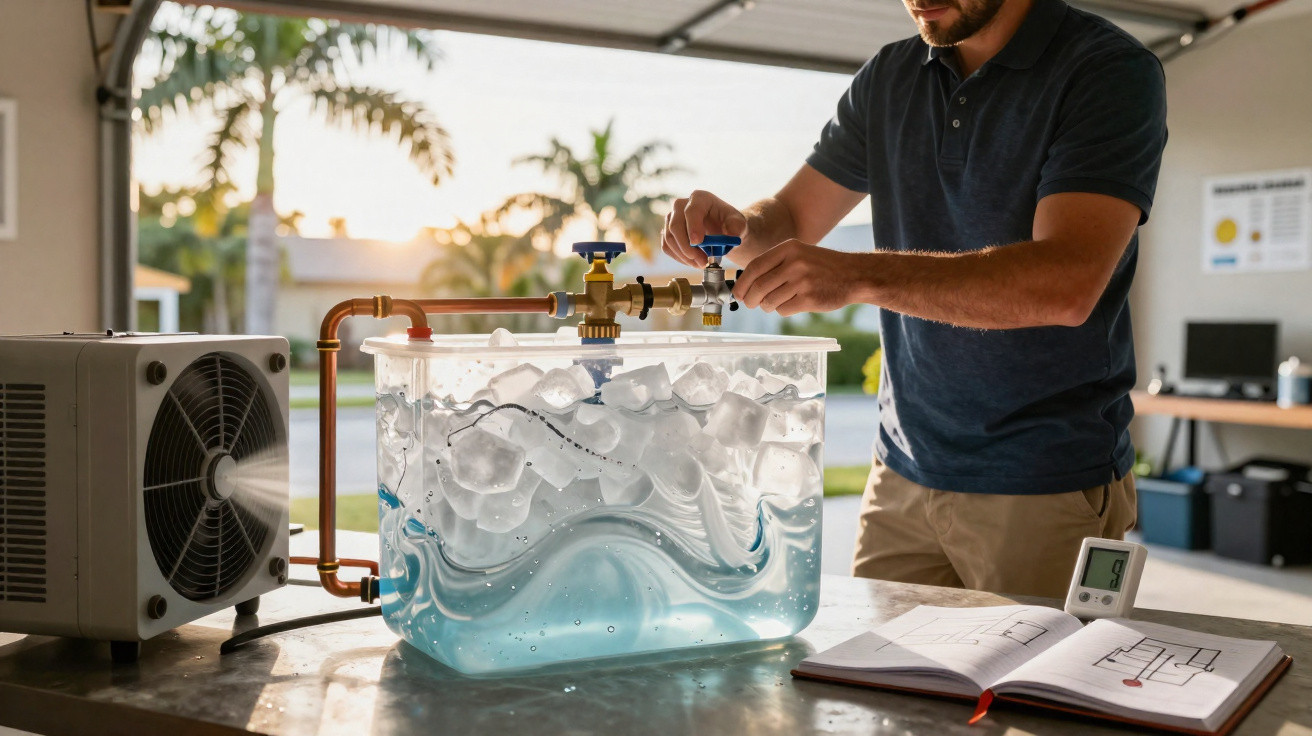
The search for greener alternatives has taken an unexpected turn in Florida thanks to a pioneering home-built invention. An independent designer has created an innovative device that uses an ice battery to cool rooms without placing extra strain on local infrastructure.
How does thermal storage using ice work?
The underlying principle is to build up cooling during daylight hours, when natural light collection is at its strongest. The system freezes water inside an insulated tank, forming a reserve whose capacity helps regulate the indoor temperature.
As temperatures rise, a substance is circulated through coils submerged in the ice. This cools the fluid before it reaches the radiator, providing immediate relief without requiring heavy-duty generators. The practical benefits observed include:
- Complete autonomy: The system runs independently by making use of periods with the greatest availability of natural light.
- Intelligent storage: Converting water into a solid state retains cooling potential for many hours.
- Genuine savings: It avoids excessive use of costly electricity tariffs during the hottest parts of the day.
How efficient is this home-built innovation in practice?
The prototype built in the United States produced promising evidence of the potential of small autonomous systems. Using three collection panels, the inventor was able to store sufficient energy to keep cooling stable in very small spaces.
While it cannot replace powerful equipment designed for entire homes, the device performs very effectively in insulated cabins or vans. The direct transfer of cooling avoids the losses often associated with chemical storage systems, and its efficiency has surprised many specialists.
Below, you can watch the official video from the Hyoerspace Pirate YouTube channel showing the project.
What components are needed for this ice battery system?
Reproducing this environmentally friendly idea on a small scale requires readily available materials. Its foundation is made up of photovoltaic collectors that power a refrigeration compressor, ensuring the structure operates reliably and with full safety.
Practical system assembly
Connections and hydraulic circuit
The main circuit uses copper pipes that pass through the insulated tank containing water and glycol. This mixture prevents the metal pipework from freezing internally, allowing continuous and highly efficient heat exchange.
At the other end, a small low-voltage pump sends the chilled liquid to the radiator, where ventilation pushes cool air into the chosen space.
In addition to the items described above, the assembly needs secure fittings to prevent unwanted fluid leaks. Proper thermal insulation around the tank ensures that the ice remains preserved. Check the support components needed to maintain stability:
- 100-watt photovoltaic panels for direct collection.
- A compact compressor compatible with direct current.
- A thermally insulated tank for water storage.
Why does this technology benefit the environment?
Wider use of sustainable systems directly reduces pressure on urban electricity networks. By shifting peak demand towards natural solid-state storage, we reduce dependence on fossil sources and lessen the ecological impact.
As well as cutting emissions, using natural daylight prevents energy waste caused by long-distance transmission. This approach encourages decentralisation, offering benefits for environmental preservation. Consider the main elements of this contribution to conservation:
- An immediate reduction in an individual’s carbon footprint.
- Avoidance of excessive use of polluting chemical batteries.
- Optimised consumption during the hottest hours.
What are the practical limits of this project?
Despite its advantages, physical constraints prevent immediate large-scale adoption. The considerable weight of water significantly restricts the portability of this home-built mechanism, making it unsuitable as a completely portable everyday device.
Another critical issue is safety, because homemade installations may use flammable refrigerant fluids. Any pressurised leak can cause accidents without proper approval. For that reason, the model serves as an excellent example before further improvements are introduced.
References: EU Rules – Fluorinated Greenhouse Gases – Climate Action
















Comments
No comments yet. Be the first to comment!
Leave a Comment